
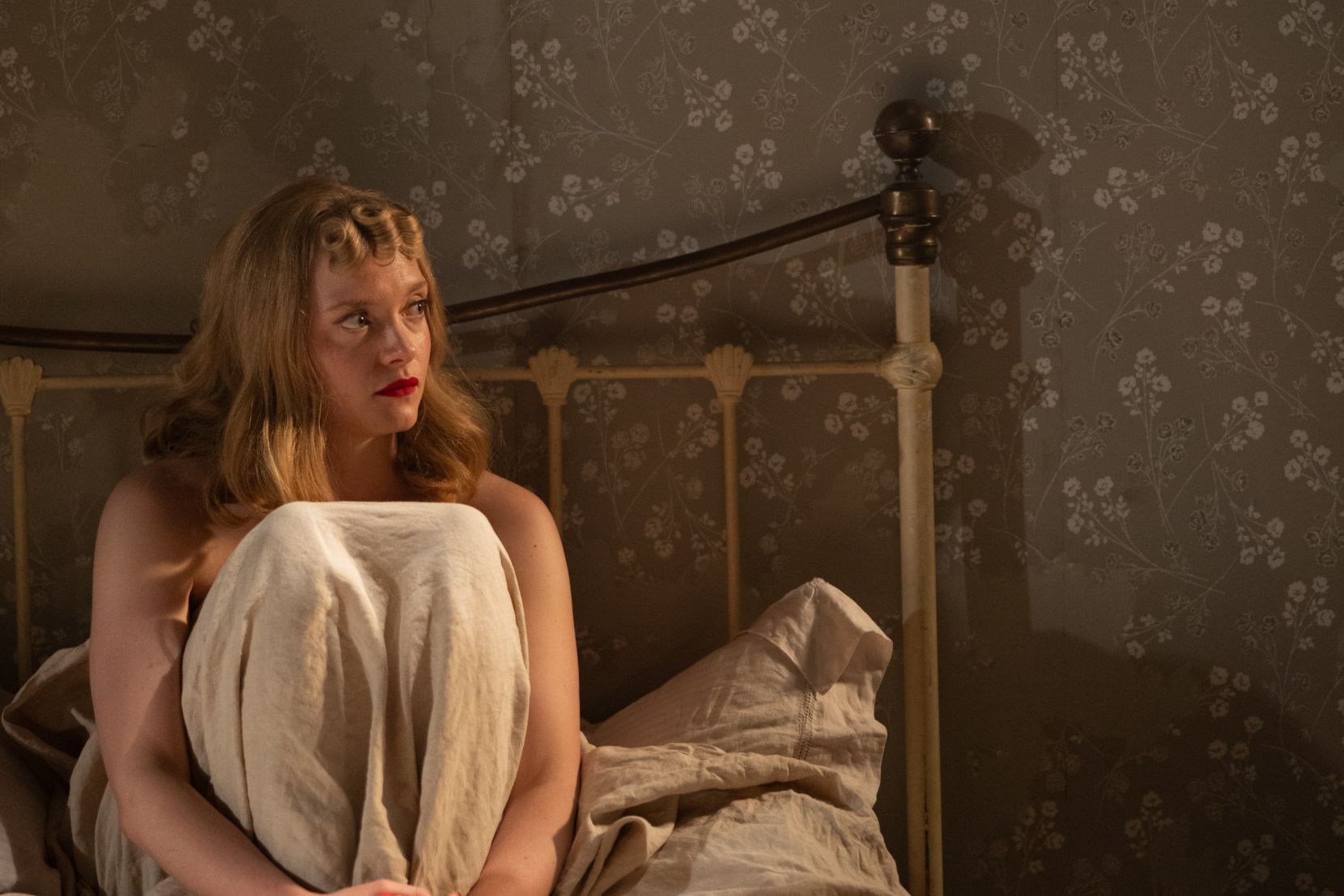
Natalie Quarry is an actor best known for playing Nurse Rosalind Clifford in Call the Midwife. Natalie takes a starring role as Holly Spurring in the new film Think of England, based on the urban legend that Churchill commissioned state-sanctioned pornography to boost the morale of frontline troops. Holly is one of six disparate souls somewhat press-ganged into participating in the production of a hardcore film. What seems like recipe for laughs take a very dark turn, particularly with Holly’s co-star Evans, played by Jack Bandeira. It’s a very different role for Natalie, and we spoke to her ahead of the British Premiere at Glasgow Film Festival. She told us about the film, her preparation for a demanding role, and her hopes for the film.
Can you tell us about the film?
I mean, it’s a film about an unusual group of people who are brought together to try and attempt to make a sort of state-sanctioned porn film to send to the front line as kind of… encouragement for the men fighting on the front. As you discover throughout the film each character is there for a different reason, and they all have quite high stakes as to why they have to be part of this project. And the story explores why each of them are there, and what’s on the line for each of them.
It explores themes of where every person’s moral boundary is, because obviously at the time, the Hays Code was a big part of how they navigated what’s appropriate on screen. And then this film throws that out of the window for them. They’re all kind of navigating their own moral boundaries within the confines of what they’re making and questioning what they feel is real and what they feel isn’t real, and what is okay, and what isn’t okay, and what’s acting, what’s not acting. And they’re all kind of losing their control of their images. It’s very interesting. A lot of questions about truth and authorship and control.
How did you come to be involved in the film?
A very traditional route. I got the audition. It seemed interesting at the time, you know. I got the scrip the day before the audition… this is very common, and I just sort of was like, ‘Oh, okay.’ I went in for my first round. I thought it seemed like a really interesting, exciting project. But at the same time, when you do a first round, you never know how it’s going to go. And I try not to get too invested. And it was only when I started to recall and meet the team I properly took in that it was a very interesting indie film, and was something that I was really interested in doing. So it was a very traditional route. I did rounds of auditions. I met everyone. I decided that I was really interested in the part. It was a very traditional audition process, really.
What was it that really appealed to you about the role, once you’d got through some of the rounds of auditions and grasped what it really was?
I find Holly’s character really interesting because she is questioning a lot of her own beliefs throughout the film, and I think exploring the sort of roller coaster that she goes on emotionally and and – I guess not politically – but she’s changing her boundaries all the time and trying to work out what she really thinks and how she feels and what she’s okay with, and why she is or isn’t okay with certain things. And I think it’s interesting playing a character who changes that perspective so much throughout one story, and is going through such an extreme experience, and that’s not something that I’d done before.
It was interesting to play such a complicated and layered female character, which, you know, you don’t always get. And I think exploring a story that is potentially going to make audiences feel uncomfortable rather than be like a really easy watch, is something that I think is really exciting, and I’m really excited to see what people think. So that was kind of the reason; it seemed like a very unusual project, and I’m interested in trying to do work that I feel challenges me and helps me grow as an actor and is well written and interesting, which this was. So that was what really drew me to it once I’d got past the first couple of sections of the process.
How did you prepare for the role, emotionally, knowing what it involved?
At the same time I was preparing I was filming a season of Call the Midwife. So I was kind of doing two projects at the same time, which was very stressful. I remember feeling very stressed because it’s a lot of work. I did a lot of historical research, because that’s quite fun, trying to put myself in the position of where Holly was when we meet her at the beginning of the film; of what her life might have looked like before that point. And then I did a lot of work on her accent, because she is constantly trying to put on a more posh accent than she has, and then she drops it, and then she picks it up. And I don’t know whether maybe people think I just can’t do a straight up normal accent, but actually it’s deliberate. She’s constantly wanting them to think that she is less working class than she is because she’s paranoid about their preconceptions of who she is from the way that she presents, right?
So she’s trying to present as different from who she is. I did a lot of work on when she has a certain accent, when she’s got slightly different accent, and at moments where she drops it. Why has it been dropped? And what does that mean? And that really helped dictate the emotional journey of the film, which really helped emotionally prep. But at the same time, you know, a lot of the things that Holly’s doing for the first time in this film, I am doing for the first time as Natalie. So there was a lot of mirroring, of like, just using some of my own experience to help dictate what maybe Holly was also feeling. Obviously, very, very, very different circumstances, and different levels of control.
I was completely in control of everything that I was doing, and she has a loss of control of the situation that she’s in, and is kind of being forced into doing something that she doesn’t feel comfortable with. And that’s obviously not the same situation, but in terms but in terms of kind of nervousness about exposure and intimacy, it there were definitely some mirrored elements. And her wish to be an actress and me being an actress; and where are your moral boundaries, and what’s your line, and is this too far? And you know, some of that I think I found it easy to connect with. But also, at the same time I was working on something else before and after. So I also just had to go with my gut a little bit, because there’s only so much prep I physically could do whilst I was full time shooting on Call the Midwife, until the day or two days before we started shooting this, you know? So it was very tiring, I remember.
The film had an intimacy coordinator [Ros Phillips] to make things as comfortable as possible for you on set, but the scenes themselves are really uncomfortable to watch. How did they thread that needle and what did the intimacy coordinator bring to those scenes?
I think I’ve said this before, because of the content of the scenes and the emotional tone. It’s almost like fight directing. We are kind of finding a ramework of physical movement, like a dance. So that we both felt like we were comfortable and happy with the boundaries that we personally have, and working together to find the flow of that scene that feels like it fits the emotional tone, but where both of us know exactly what’s going to happen at every moment, and then within that framework, we find the emotional spontaneity.
That was [the intimacy coordinator’s] role, was helping us find with Richard [Hawkins, the film’s writer and director] – and actually, we also had a fight director – the kind of physical framework where everyone felt comfortable. And that was really the key, I think because, as you say, these scenes are very intense and quite nasty experiences. And I think that just making sure that we we knew what was happening, nothing was ever a surprise, as you would with any fight scene or any intimate scene. I mean, I’ve never had to do an intimate scene where the characters are having a nice time. So I actually don’t know what that would be like, but this is like finding the framework and then building within it so that everyone felt comfortable and safe.
And you know, working with Jack. We’re quite good friends now. We got to know each other really well. We felt very comfortable, you know? And that I think really helped, because he’s my friend so I felt I could talk to him. But, you know, the purpose of the intimacy coordinator would be to bridge that gap; if you didn’t have such a friendship, where you felt that you couldn’t be open. But luckily we got along very well. So it’s kind of a mixture of many things.
I think that level of trust must be important given how intense Jack is, because Evans is one of the most unsettling characters I’ve seen on screen for a long time. Deeply traumatised, but obviously very dangerous at the same time.
He did it so amazingly, and I think that he’s a fantastic actor, but he’s not like that in real life, you know? He’s a really nice guy, so I know that he’s acting so it’s okay, but he is very convincing. And I think sometimes I let that fear of the character that he was portraying take over, because it really obviously helps, because that’s acting, right? I think knowing that on a sort of base level that he isn’t dangerous, but then on set trying to forget about that was really helpful. Because he is such a good actor that when you’re in that space it really helped to create the tone – the stakes of those situations – and how dangerous that character really is. But, yeah, it helped that I knew that obviously he’s my friend and he’s a normal, lovely guy and a really good actor, and I was never actually in any danger, obviously, as no one would be on set.
It’s the scene where he first attacks you that I realised this wasn’t the film I was expecting it to be.
That’s interesting that you say that. What did you think it was going to be?
The film’s description makes it sound a bit like a seaside postcard version of Their Finest, where they’re making wartime propaganda.
I think that’s really interesting. I love the kind of switch [the film takes], but I think the first hour of the film is actually very funny, and then it really takes quite a dark turn from that moment where you realise how dangerous his character is, and how much they all have at stake. And I think that that’s where it turns into a very interesting exploration of everyone’s moral boundaries and what they are willing to sacrifice for what they need, and what level of loss of control they’re okay with to get what they want.
What I found interesting in Holly, was she has the least to lose personally if this film doesn’t happen, but takes on most of the burden because of what she’s expected to do, and how much everyone else has on the line.
She’s kind of using it more as an opportunity to get away from from her previous life, whereas I think that a lot of [the other characters] are kind of essentially being blackmailed, whereas she isn’t so much. It’s more that she sees an opportunity. She’s an incredibly focuseddreamer. She’s desperate to become an actress, almost to the point of feeling it’s life or death. She’s so focused and I think I had my own reasons as to why I felt that she was that way, and I think that’s really interesting.
You’re right, because she does take on most of the burden, and also she has the most to lose when the films come out. Because of her being a woman in that time, doing that kind of work, and then wanting to go and be an actress, she’s questioning whether this is going to give her the boost that she feels it will, or whether it’s going to hinder her. A lot of the conversations in the film are around her navigating whether she thinks it’s a good idea or not, and whether she feels that she’s going to get what she desperately feels that she needs. Everyone else has got more to lose, and they’re kind of being held by a higher power, and if they don’t do this, then this will happen; whereas, if she doesn’t do this she loses her dream. She doesn’t lose much else, in a way, but it’s a very interesting conundrum for her.
It’s a very morally ambiguous film, again, which I wasn’t expecting it to be. What for you were the main themes of the film? When you’d seen it for the first time, what was your takeaway from it as a whole?
Through working on the script, thematically it’s about control and censorship and hypocrisy, and how people see themselves and how they want other people to see them. And, where is the line between performance and reality, and why do we draw that line in certain places? That I knew, all of that. So I think it was really interesting seeing the film holistically, because it actually was much funnier than I thought it was going to be. I thought it was going to be really serious. We had the opposite experiences. You went in thinking, ‘Oh, this is gonna be quite a nice film.’ And I went in thinking otherwise, because my experience of Holly is that she’s had a really, really hard time. And they’re all having a very difficult experience. And I think I came out thinking that lots of it was much funnier than I remembered, which was kind of interesting.
I feel like the themes that I explored when I was like reading and working on the script come across in the film, which is a relief, because that’s what we tried to make. But I remember finding so much of it more funny, especially the first hour, much funnier than I remembered. But in terms of themes, I wouldn’t say anything jumped out at me that that I didn’t remember heavily working on when we were making the film, because we, as I say, worked very hard to try and tell a certain story.
I hope that people find it interesting and question those same things as our characters while they’re watching it, because it’s not an easy film to watch. I’ve seen it a couple of times, and I struggle watching it, because it’s hard to watch, and I’m in it. It’s probably hard to watch because I’m in it! I hope that people will watch it again and again, but I struggle. It’s difficult to watch when you’re in it, because those characters have a such horrible time!
One bit I did find very funny was the fact that they were making three versions of the porn film, one for each branch of the armed forces, because representation is important! Of course, you couldn’t possibly get into it as a sailor watching an airman.
We were changing costumes over and over again! It’s so funny, and it was so hot. We were shooting in the Summer. It was like 30 degrees, and [Jack’s] wearing these full wool outfits. Oh, man, I felt bad for him!
The film had its premiere in Tallinn, and had a good response. What are your hopes for the film as a low-budget, very independent drama?
I mean, I guess I hope that people love it. You know, with lots of indie films I think they kind of grow a real cult following. And I hope that’s what would happen to this film. I hope that people see it and… enjoy is hard because it’s, as I say, a difficult film to watch. But I do hope that people watch it and enjoy it and find that it makes them think about something, or that they find the story interesting and ask the same questions our characters are asking themselves. I really just hope people want to watch it, that is my hope, and that they find the story engaging and interesting. And that they want it to go to cinemas, because that’s what I want!
Yeah, I think I just hope that it grows a cult following. But you never know with these things, you just don’t know how people are going to respond. And I’m excited to see what people think, because it is such an interesting film with a very interesting line that it draws. And I’m curious to see what people think of that and how they take it.
Think of England screens on Fri 6 Mar & Sat 7 Mar 2025 as part of Glasgow Film Festival

Comments