
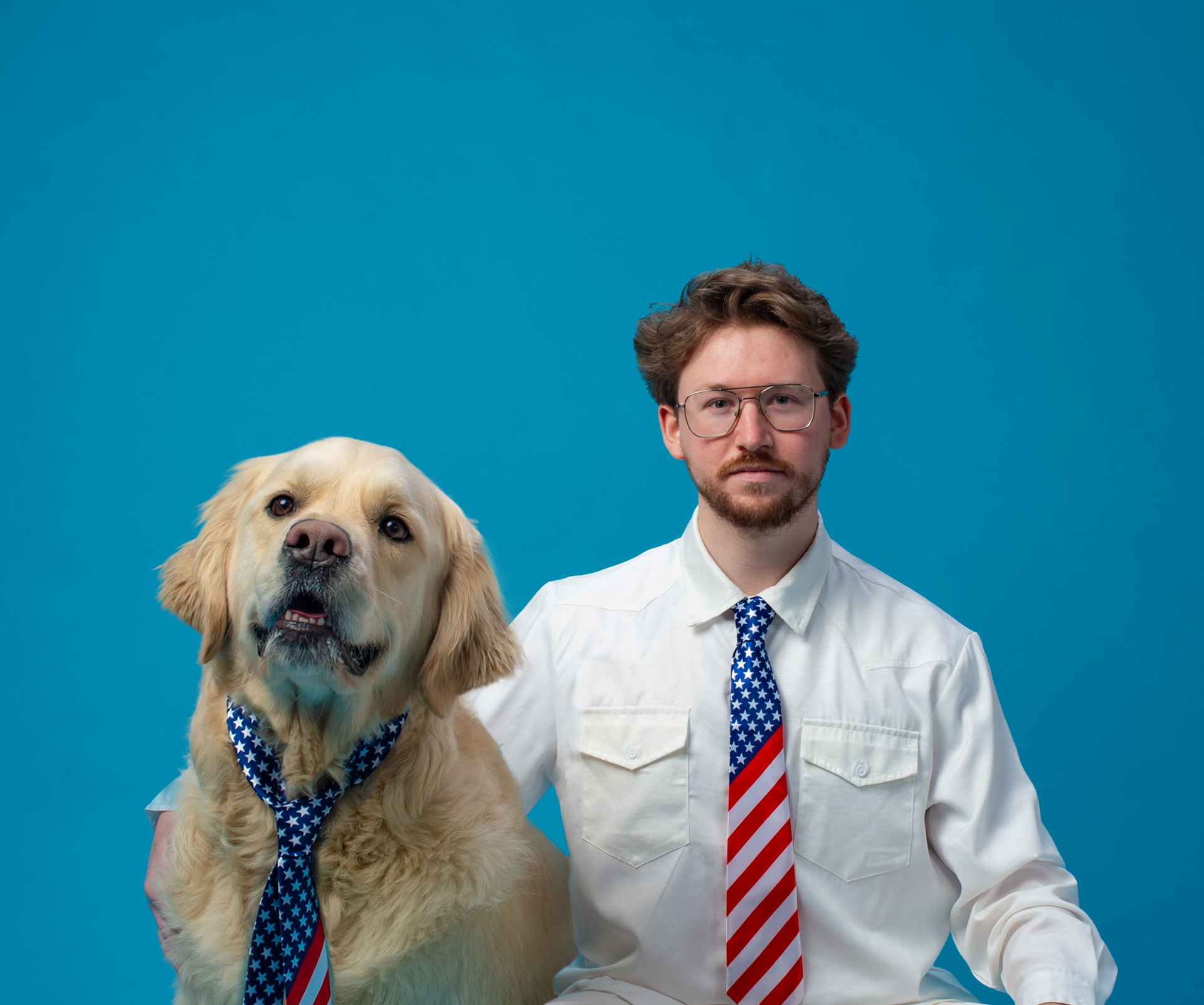
Do you like dogs? Do you like puppies? Would you like to look at photos of puppies living their best lives, while a nice man on stage shares a whimsical tale about them? Then you’ll love the first half of Meet Mayor Max, a one-man talk with slides, reminiscent of Louis Theroux’s sympathetic forays into the odder side of American culture. And you’ll like the second half, too – though the story gets weird in a different way, and the feelings it musters are far more ambiguous.
The hook this all hangs on – and as far as I can tell, this bit’s absolutely true – is the town of Idyllwild in California, which in 2012 “elected” a dog as its “mayor”. You need a fair few scare quotes to tell this story accurately, but once top dog Max got the (sort-of) democratic nod, he grabbed the ball and truly ran with it. With a little help from his owner Phyllis, he appeared at parades, hosted lunches, and brought boundless golden-retriever energy to his social media presence. His mission? To champion canine values of joy and unwavering love amidst an increasingly fractured world.
Our host Alex Robins, a playwright by profession, paints a lyrical verbal picture of Idyllwild itself: a place shaped by waves that swept the nation, first of frontiersmen, then of tourists, then of stars in search of a manicured retreat. It’s a self-aware but uncynical telling, and Robins describes his encounter with small-town Americana with heartwarming delight. But we know all along there’s something darker too – a misplaced word here and there, an incongruous topic mentioned and abandoned, all hinting that the wholesome story might mask a deeper truth. And so his research leads Robins somewhere unexpected: towards a culture I’ve always been curious about, but will absolutely never risk sampling myself.
The details of the narrative are exquisitely crafted, particularly the way that unexpected details reveal their true significance much later on. At times, though, the overall arc lacks a clear direction. Robins is part of the narrative, but he shows up fairly late; the transition from documentary to personal memoir is distractingly visible. A little more background on Robins as a man – what drew him to this story, what was his life like in 2012? – might help smooth the friction between the two modes.
And with so many enticing parallels to be drawn, the script sometimes reaches for one too many: there’s a reference to Trump, for example, which might be better cut if it can’t be fully explored. It’s the central concept that deserves the focus – the tale of joy mixed with mild obsession, and the warning that simple stories can hide a more nuanced reality. Admirably for this polarised age, Robins offers no heroes or villains. But there is, without question, a very good dog.

Comments