
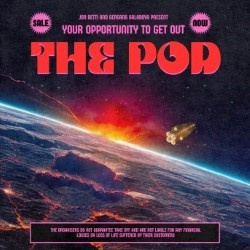
The door to the theatre slams heavily behind us – a serendipitous but fitting welcome to the claustrophobia of The Pod. The scene on stage could be a celebrity doctor’s waiting room: white, sterile, and soullessly reassuring. Everything’s calm, everything’s normal. Except that the chairs have seatbelts.
In this doomsday two-hander with absurdist influences, this sealed tin can represents the best and last hope of survival. In eight minutes, either the pod will blast into space, or the world itself will end. No spoilers, but the advertised running time’s an hour, so you might reasonably guess that something will reset the clock before it ticks to zero.
The setting and the script pack in a lot of modern anxieties. While the nature of the doom isn’t quite nailed down, there’s more than a hint of environmental catastrophe. AI’s there, in the form of a mysterious robotic voice that may or may not also be listening to them, and the displacement of the state by big corporations is clearly implied. Most of all, there’s bitter and well-argued anger at the likes of Musk and Bezos, whose space ambitions are mocked by the script even as it rails against their privilege.
The central gambit – the eight-minute timer – isn’t played as strongly as it could be; the feeling of desperate tension isn’t there, and after a while you might forget it’s running at all. Similarly, though the show’s blurb emphasises its LGBTQIA+ focus, that doesn’t go much deeper than a gay man (Adam) and a bi woman (Kaia) pretending to be a couple. But perhaps it doesn’t need to: Adam’s beautiful, captivating monologue about his late husband stands out in any context, while the sparky mismatch between the two friends drives much of the show’s humour.
And the humour works well, from snappy surprise one-liners to a purposefully extended explanation of a preposterously complex game. Adam’s character is deliciously arty, just the right side of a parody, often wearing the perfect expression of performatively detached disdain. The comic tone heightens as the climax nears, with an escalating gag involving a stubborn door made all the funnier by unfolding off-stage.
But the best absurdist work provokes us to rethink our real-life condition, and it’s here that The Pod has most room to grow. The foundations are there – Adam makes the case for survival, while Kaia’s more of a fatalist – but the ideas feel familiar and the ultimate payoff is more formulaic than I’d hoped. Still, I enjoyed my time in The Pod, and the characters were rounded enough to make me care. It may not quite reach the stars, but the hour still flies by.

Comments