
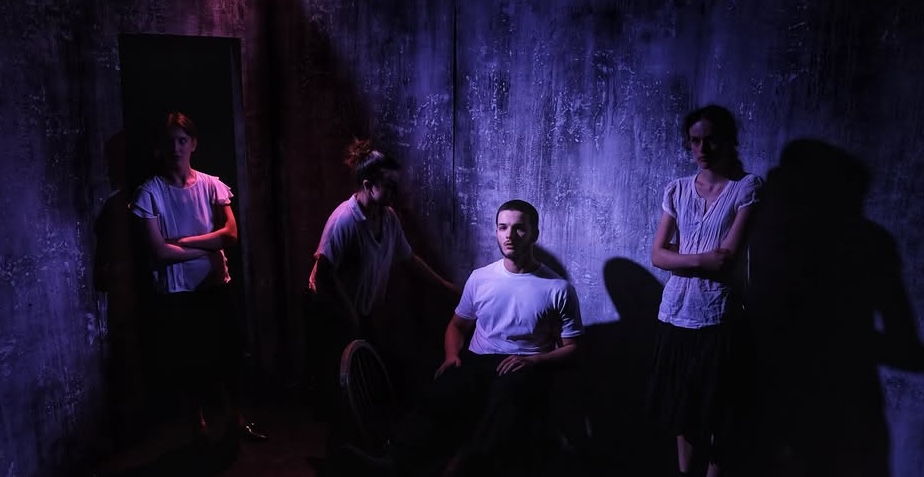
The first thing you notice is the wall: a stark, shabby, mottled grey backdrop that looms over scenes and characters, an ever-present symbol of bleakness and unfeeling brutality. Bertolt Brecht wrote Fear and Misery of the Third Reich in 1938, when he was already in exile from Germany, and our knowledge of what happened next inevitably colours our response to it. But this stripped-back four-person production does well to capture the original intent as a warning built from snapshots of numerous lives.
This Fringe-sized production selects seven scenes from the standard 24, and they’re a well-chosen mix of length, topic and tone. The first is bitterly comic, highlighting the thuggish hypocrisy of Nazi ideology embodied by two drunken SS men. In other vignettes the cast capture a creeping sense of complicity and suspicion, as neighbours turn on neighbours and an old friend receives a devastatingly cautious welcome home. Most shocking is a scene in a concentration camp, where an SS guard’s self-interested mercy degenerates into conformist sadism as soon as an officer appears. The beating happens off-stage, but we hear the victim’s screams – a more visceral piece of live performance than anything they could show us.
Brecht is famous for his “estrangement effect”, where the knowledge that you’re watching a play pulls you back from the emotion of the moment to focus on the underlying ideas. But that doesn’t mean the performance should be emotionally dead, and the company manages that tricky balance well. The acting retains its power but there’s a sense of detachment, a hint that the characters are themselves adopting roles in a world that’s knocked askew. It’s strongest, I think, in the final scene, where the obvious artificiality – the same woman’s played by multiple actors and she makes calls on a modern mobile phone – complements the story’s progression from rehearsing a difficult conversation to finding that it runs depressingly to plan.
While the approach is clever, and the recorded narration and soundscape are truly superb, the live execution isn’t always so strong. The monologues work well but more conversational passages were often inaudible near the back of the room, and on several occasions I genuinely couldn’t follow what was going on. In one particularly frustrating example, the scene’s key line is delivered quietly towards the wall. And while the production’s not responsible for the venue’s limitations, it’s fair to suggest they might adapt to them; one scene was completely invisible to me because they were all sitting down.
I also wish they’d pushed a little further with their bolder ideas. A brief and original prelude is coldly thrilling and impeccably Brechtian, as are the occasional moments when characters move off the stage and into the aisles, but none of these additions is developed very far. This is nonetheless a well-crafted and intelligent production which gets to the heart of Brecht’s text, albeit sadly compromised on the day I attended by uneven delivery. There’s a lot to admire here, and I hope it has further life post-Fringe.

Comments