
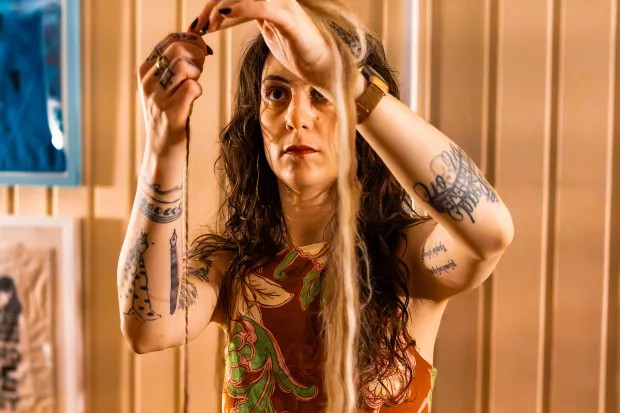
Frankie Regalia is spinning yarn while we take our seats. She asks us what the word spinster means to us, and lists the usual, ‘hag, witch, barren, bitter, old, lonely, cat lady’. Then she tells us that a spinster was a spinner. A woman with a trade who could make her own money, and she’s about to tell us three Scottish folk tales about spinsters that will track the word’s meaning from a job title to an insulting or pitiful label.
The first story is from Orkney and it’s about a beautiful girl becoming an outcast, working as a freelance spinner for low pay, and finding enough lint to make her daughter a golden dress that will save her from poverty. There are lovely images of wild island landscapes, sea caverns, bright green turf, and grey seas and skies. It’s spare and vivid and epic, with these women trapped in their hard time and place, but also immortal archetypes who have survived despite ruthless opposition.
The story is linked to feudalism and the success of peasant revolts, while the second story is about a lazy girl who is given a choice of spinning well enough to attract a husband, or going into a nunnery, which shows the way in which spinster came to be associated with marriage. The lazy girl gets up to all sorts of fairy tale antics, napping, deals with good fairies, finding a wealthy lover, seeing things in threes and doing things in sevens. It has a happy ending, but this is the start of commerce, and colonisation, witch trials and the powerful dividing and conquering.
The third story is about Whuppity Storrie, an elegant, but bad, fairy who cures a cow and demands a baby boy as payment unless her name can be guessed, which it always can be, because fairies have a habit of saying them out loud, in this case while Whuppity is spinning down a well in a deep forest that our agitated heroine happens to be walking in. The meaning of this story is that in an era of Empire and industrial revolution, a woman’s value is in children.
Hearing folk tales is so much better than reading them. The script is poetic, funny and informative in a way that doesn’t feel educational. Regalia speaks and moves, gently and slowly, building a world that feels true and fantastical, with grace and authority. We’re left with a call to find our craft and reclaim its enchantment.
Spinster has finished its run

Comments