
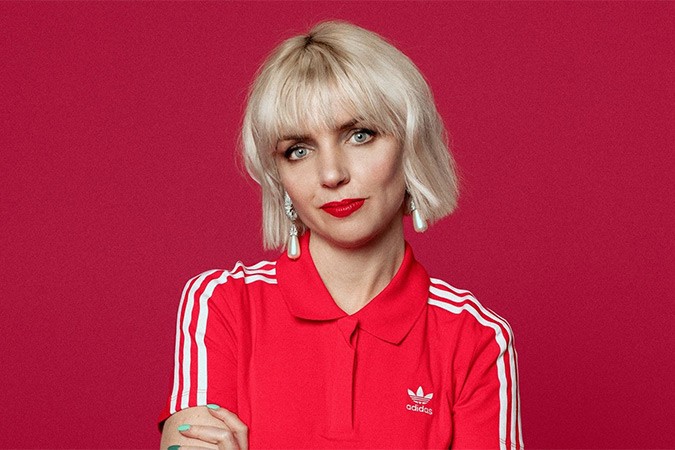
Alexandra Haddow is a comedian and writer based in London who has been a fixture of the British comedy scene for over a decade. She has performed two previous shows, ‘Not My Finest Hour’ and ‘Third Party’ at various festivals. She also founded the club night Indie Amnesty and co-h0sts the Battered Book Club podcast. We chatted to Alexandra ahead of her work-in-progress performance of new show ‘Deadly’ at Aberdeen Comedy Festival.
For anyone unfamiliar with you, how would you describe your comedy and your approach to performance?
I describe my comedy as, hopefully, funny in in more ways than one. I’m trying to maybe take an optimistic take on things that aren’t that optimistic. My approach to performance… that makes me sound a lot more highbrow than I probably am! I just like to be as fresh as possible, really. I like speaking to the audience as well. I feel like it brings us into the room. When I say speaking to the audience, that kind of freaks people out. But I don’t mean ripping the piss out of them. I mean genuinely finding out about people at the start of the show. I feel like that’s a nice atmosphere to start the show in.
You’re bringing your work in progress, ‘Deadly’, to the Aberdeen Comedy Festival. Can you can you tell us a bit about the the show?
It is literally a work in progress at the moment, but it’s kind of talking about… I promise you it’s funny. It’s kind of talking about mortality and hypochondria and aging and going through a different stage in your life, and then also wanting to still be seen as fit, because ‘deadly’ is sort of an Irish slang for when you look really good. So it’s kind of combining all of that sort of thing. I think that’s why I decided to call it that. It’s a bit of everything, but it’s [also] about looking after your parents, feeling like you’re maybe finally an adult yourself, and coming to terms with a lot of stuff, but in a in a very upbeat way.
At what stage is the show at at the moment? Is it coming together?
Quite an early stage! I’ve only done one before, and I did not know that it was in a big venue at that point. I really, genuinely thought it was going to be a 50 seater above a pub, so I am working on it this week for you. But yeah, it’s very early stages. I enjoy those [shows] a lot because you end up doing a lot of stuff off the cuff, and it’s a bit chaotic. But definitely there’s a lot of stuff in it that’s tried and tested. It’s more like the structure of the show.
Do you come up with the theme first and tie the jokes around it, or do you find the topic emerges amongst the jokes that you’ve already written?
I think a bit of both, but definitely [the narrative] emerges first, and then once you can see a sort of pattern, then that helps you I think in the second half. It helps me to have like a centralised theme-ish, just because you can you can sort of write around it rather than just writing about absolutely anything, you know?
So, it’s definitely not like a theme first. It’s more like this story or how I’m feeling at the moment, and then genuinely for ages when I’m working on a show, I always think, ‘Oh, there’s no unifying theme. There’s nothing!’ And then eventually, out of the smoke it emerges. Yeah, it’s kind of a bit of both.
We interviewed you about three years ago, just before your debut show at the Fringe. Looking back, how have the last three years been going from your first show to starting your third?
It’s been great actually. My first show, I really liked the subject matter, but I think it’s difficult when you’re doing your first hour to fully relax. I actually really enjoyed my second show, ‘Third Party’, and then this one hopefully will be even better. So actually it’s going in the right direction. I love working on a new show, so actually for me it’s been the most exciting bit. Like, when you’ve said it 200 times, it’s not as exciting as it is now, you know?
You did your first tour for ‘Third Party’. How did that go?
It was a small tour, but it was a lot of fun. For some reason, I don’t know why, I’ve got no connection to Bristol, but I always have the most fun shows there. The crowds there are just really up for it. I genuinely don’t think I had a bad gig, but Bristol and London were were insane, and I want to do more Scottish dates for this one as well because my dad’s Scottish. I feel a bit of an affinity. I gigged in Aberdeen last year for the first time actually at the Comedy Festival and it was great. I did the late night mixed bill show and it was amazing,
You’ve supported some huge names like Frankie Boyle, Bill Bailey, and Tommy Tiernan. What did you learn from them, and did they give you any particularly choice advice?
Bill Bailey, I was sort of opening for him on a work in progress, and then Tommy Tiernan, I met him, but I didn’t really get to spend a lot of time with him. But he was lovely.
But Frankie, I think that what Frankie taught me is that you can really evolve your comedy as you evolve. I think a Frankie Boyle audience of maybe 20 years ago, you’d think it would be kind of very laddy, very kind of… I don’t want to say toxic, that’s the wrong word, but you know, people heckling and quite a maybe aggressive environment. And I think as Frankie has gotten older and gotten… I think he’s always been political, but I think maybe as his comedy has become more political, he’s kind of exposed a lot more of that side of his opinions and stuff.
I think his audience have kind of grown with him, and I think that’s a really brilliant thing to have learned how to do, do you know what I mean? Not just to stick with the stuff that obviously he’s still famous [for] because of how sharp and how cutting he is, but I think it’s brilliant. He taught me that basically, if you want to start changing what you’re doing a little bit, then you can do that and the right people will keep following you.
You’ve been a comic for about about a decade now. Can you tell us about any super memorable gigs for good reasons or for ill?
For ill, I can tell you, a gig I did in Aldershot, quite early doors, [which] was one of the weirdest experiences, not even gigs, weirdest experiences I had in my life. Me and my friend Jamie Allison had to fill in last minute. I don’t know what happened to the two people that were on. I can’t even remember who put us in touch with it, but we thought we were going to a bigger venue in Aldershot, and we weren’t. We were actually just going to a pub, and we just stood in the corner of the pub. There was no stage. There was no mic. The audience; I’ve never seen anything like it. The audience were heckling each other. It was crazy. They were all kind of like pseudo-fighting, not actually fighting, but kind of riling each other up and all this sort of stuff. And yeah, it was absolutely crazy. A mother of four offered me drugs after the show, and it was like a Tuesday night at half seven. We could have walked to the station [but] it’s the only time I think we’ve panic called a cab and just legged it to the nearest train. So that was memorable for… I say bad; bad at the time, but really fun looking back on on it.
But there have been great gigs. Ealing Comedy Festival was a great gig. Supporting Frankie was genuinely one of the most fun run of gigs of my life. Just to sit and watch somebody that I’ve watched growing up after I’ve been on was amazing, and probably like like probably my tour shows. You know, it’s nice when people are sort of actually there for you, even though the pressure is sometimes worse. You’re like, there’s no one else on the bill. This is this has got to be good.
What’s next for you after Aberdeen? Where else can we can we see you?
Well, I’m kind of everywhere, actually. I’m up at Monkey Barrel a fair bit up in Scotland. If you follow me on Instagram, you’ll see me. I’m basically working on this new show, and then hopefully I’ll tour it next year, so you can catch me there. You can catch me at my my club night Indie Amnesty. But I’m yeah, basically I’m out and about everywhere.
‘Deadly (WIP)‘ is at Lemon Tree, Aberdeen on Sat 26 Sep 2026 as part of Aberdeen Comedy Festival

Comments