
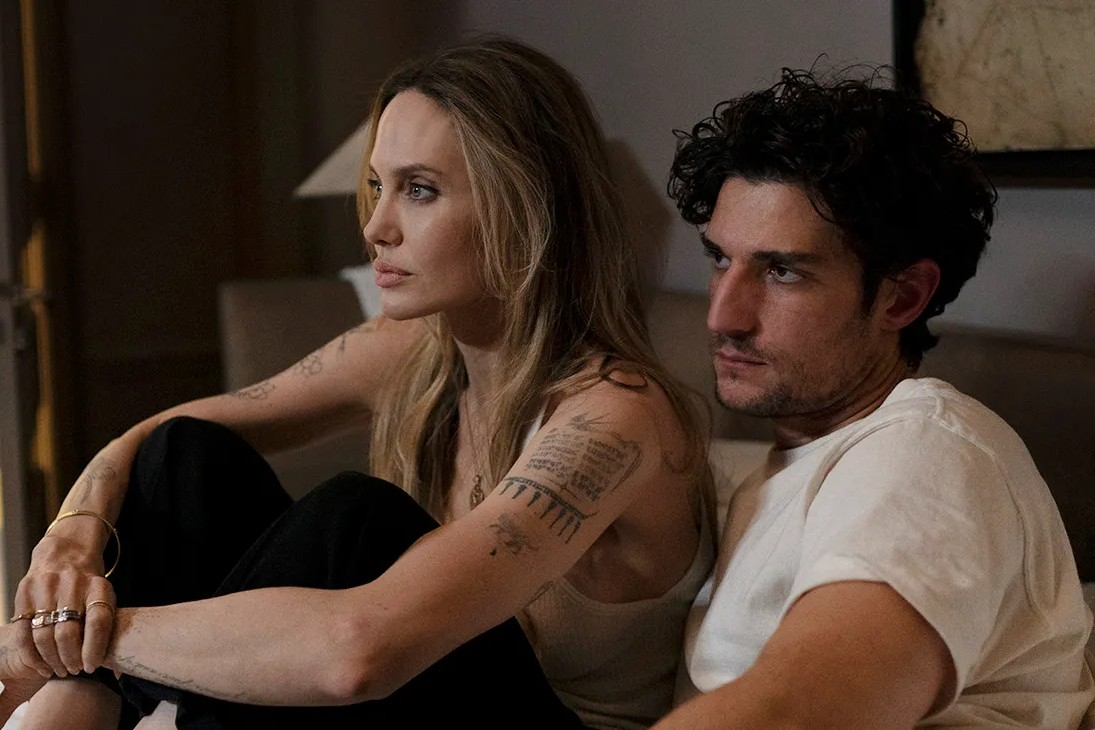
French filmmaker Alice Winocour returns with Couture, her latest feature following Paris Memories (2012) and Augustine (2012). Starring Angelina Jolie, Louis Garrel, Ella Rumpf, and Garance Marillier, the film had its UK premiere at the 2026 Glasgow Film Festival. We spoke with Winocour about the cast, couture and fashion, and the film’s reflections on womanhood.
The film opens with a phone, and the phone consistently exists throughout, all the characters use their phones to communicate with parents, with the writing tutor. What does the phone mean to you?
Yes, we see a lot, and it’s true that they are all on their phones. I think it’s something very contemporary, that we are all spending our lives on the phone, but also we see people that are alone with their wounds or their sutures and try to connect to others. And I thought that’s really what we need, there is this thing about being alone and trying to connect to others. It’s really what I tried to capture in the movie.
Yes, we have this relationship between Angelina and her daughter, they are only talking on the phone. And it was very moving to me to have her also connected to her personal life.
It’s interesting that you cast so many newcomers in the film, including Aida [Atarssa] as the leading role. How did you discover her, and what made you decide to cast her in such an important role?
To me it was something political about having a very big star like Angelina, one of the biggest stars, and someone who has never played in a movie, and to have them on the same level. At the moment in the mezza of the film, she says, “I’m a risk taker.” And it’s also whether the Angelina Maxine Walker is also in the movie. And I think it’s what the movie does, jumping into another story. Because of course, the story could have been the whole story with the big star and the love story in a more classical way. But to me, it was interesting to have this kind of jump and to have all those jumps between women.
And yes, it was very moving to work. It was the idea to reunite all women coming from different backgrounds, they all come from very different parts of the world: South Sudan, US, Switzerland, Ukraine, because the Ukrainian model comes really from Kiev. And to have all of these women together supporting each other.
And yes, of course, it was difficult to find Aida, to find a model who could act in front of Angelina. We saw 300 girls to find her, and also the others. But we worked together, and because it’s also part of the stories, because they are real stories, it was a bit easier to play your own part.
Why did you choose to cast Angelina, because the character is very similar to her own experience, she is also a director in her own life, with a similar medical condition? Does her own experience as a director inform the writing of the character or the filming of the film?
Yes, it’s true. What is really amazing, I wrote really inspired by my own experience. And then I thought I need someone who would be connected in a way to the story. But she was even more than I thought, she was also a director, she had children, and she had, at a moment of her life, this issue of telling her daughters that she had to go through this operation. And it was a special moment in her life where she wanted to also take a risk in being in a movie that is not like the others, that is different.
And for all of these reasons, we chose to create a character who is a fiction, who is a bit of me and her, we used to say on the set, ” Maxine is us.” We were creating her with different aspects of our personalities.
But I think she’s also a bit Gothic. I’ve always been really interested in Gothic arts and music, working with Anna von Hausswolff, this Gothic Swedish composer, but also since my first feature, which was a kind of dark romanticism love story between a patient and a doctor in a hospital. But at the same time, I also wanted to have this horror movie director. I wanted to respect a director who is an outsider, a cool outsider. It could have been Angelina as a director in those kinds of films, but I thought it was more interesting to have a kind of geek, someone who is marginal in the industry. It’s a bit what horror movie directors are, to understand that she comes into this world of fashion as an outsider, that she’s not part of the industry.
The look in the film is really similar to the Chanel tradition of having a bright look to close the show. How did you and the team come up with the look? And in the film’s context, this look obviously carries more meaning when Ella [Rumpf] works on that road. What do you want to express through this reimagined bright image?
We really closely worked with Chanel, even if their name doesn’t appear in the movie, and I’m very thankful to them for that. Because at first it was my condition to work with them: not to do an advertisement for them, but at the same time I wanted to have the reality of a real maison couture. And I knew I couldn’t recreate that in a movie, it’s so difficult with all this luxury and this very special atmosphere we get there.
It was the same as what I did with the European Space Agency for my previous film, Proxima. I had asked the European Space Agency if I could shoot in real places, as I knew I couldn’t do a mock-up of an International Space Station. So it was really working closely together. They really created the costumes inspired by dresses that existed before, but in different collections. And we worked with a studio to have those special collections for this fictional collection in the movie. And we wanted to have those very white dresses, there were beautiful ones, but not really in fashion at the time.
And also, with all the models, the staging of the show at the end was really created with them, exactly as the backstage of original shows. So yes, it was really a collaboration.
What happened near the end of film to the dress wouldn’t be what would happen for a Chanel closing look. What do you want to express by putting that kind of imagery and body in that environment?
To me, what was very interesting in setting the whole story in the fashion world was that fashion is about the ephemera of time. I could have set it, of course, in the cinema world, but to me, fashion is even more about that. It is also with cinema, as we know, next Cannes, next season, next, always the next project. Once you leave something, it’s already a race to get another something else. I think it’s really the contemporary race for everything that is new, and everything goes faster and faster. It’s really what I wanted to capture in the movie. But in fashion it’s even worse, because it’s always looking for what is fashionable, and so there is this song in the movie, “My Friend the Rose” (Mon amie la rose). And it’s really this, to me, fashion’s ephemera of time.
And so I wanted to capture this, I think it’s interesting to have a character who receives news that she’s confronted with the idea of her death, but in a world where everything runs so fast.
The film also features three male characters: a film director, a model, and a makeup artist. Why did you choose those three? Did you cast them first and build a background around them, or did you look for them based on the script?
I had a very good question yesterday in the Q&A. Someone asked me, it’s all men telling women what to do in their lives. And it’s true, that’s really what it is in the movie.
I cast them – Vassilis, the doctor, is a very big star in France and I knew he had this physical presence and the authority of a doctor. And he was very afraid to have to draw on Angelina’s breasts, it’s something very particular. And so he really did a lot of oncology work to prepare for the scene. And he’s also, I think he was really right for the DOP, because he has this magnetic way of looking. And to me, what is really the relationship between the two of them is that he really sees her. DOPs, they don’t look at you as a normal person, they look at the shadows on things, they can capture little details. So it was really as if he was seeing her soul. And so I think it was a very romantic relationship between the two of them.
And the first one is not like that. He’s more the boring teacher who is so rude and thinks there’s only one way of writing. And I think there’s no way of writing, I think everyone has to find his or her own voice. And I think it’s also what Angele [Rumpf’s character] becomes. It was interesting to me that it’s the makeup artist who becomes the narrator of that story, she is the one who is hiding wounds. And at the same time, because she’s hiding everything, she knows all the sutures and wounds. And so she can have a voice. And it’s not about the quality of what she’s writing, it’s just about the idea that she has finally found a voice.
You conclude the film with a swing ride, seen from outside the window. What is the intention or emotional note you want to leave the audience with?
Because I don’t know if you noticed that sound is very important to me in that movie, as well as in all of my movies. When she’s in the room with the DOP, they hear from the inside all the screams during the love scenes, and it’s a kind of threat you don’t really know. It creates a strange atmosphere in the room.
Also, when she arrives in that room, at first she sees it from the outside. And to me, in the end, we hear those screams which are terror and at the same time exhilarating, something very joyful. And I think that’s really what life is, this turmoil, this mix of beauty and fear and death and complex feeling, but everything turning. To me, it’s really the image of the film, this round dance, all those people turning, turning, like life. It’s mixed and it’s crazy and it’s frightening, but they are alive.
And I think she’s in the end shaving. It means she’s going to fight for her life. And of course, it’s a bit of a strange end, we don’t know if she will survive or not, or what will happen to her. But still, she wants to go for it, and we see the image of what is life.
Two of the characters are from Sudan and Ukraine, which are war zones. Is that intentional? Why did you bring that into the story?
Because the fashion world is, I don’t know if you would say this in English, but it’s penetrating, it’s coming into our world. And I think the real world is also coming into the fashion industry. It’s something I noticed when I was backstage at fashion shows, I thought, oh, it’s so interesting that the real world is also in this glamorous and unreal world. All those models, they don’t all come from war zones, but a lot come from really difficult places in the world.
I had met this Ukrainian girl who was coming for every fashion week from Kyiv, taking the train to Poland, going through all those wars and terrible places just to get there and to work, to earn money. And the film shows how money is important for people. Everyone is on the phone, but everyone struggles to have money, even the director, even the makeup artist. And what I like about this war element is that two people who don’t come from the same war, but who share those experiences coming from the war zone, suddenly connect. And the film is really about how you can have this instant connection between people coming from very distant worlds when they share sutures.
You have an admirable filmography and you won the César. What is your advice for young filmmakers who want to get into filmmaking?
I think it’s really about trying to find your own voice. I think now with Netflix and the ChatGPT thing and the fear of everyone, all the images look the same. And so this idea of trying to believe in the power of cinema, the poetry of cinema, and not being unsettled by the fact that storytelling has really changed because of series, because it’s ten hours to tell the stories. It has changed our relationship to the way of telling stories, because everyone is looking for the next jump and the next cliffhanger. And cinema is running after this.
But I think we have to believe in the force of cinema and this cathartic experience, and also in moments that come from something unconscious, fragile things. So for young filmmakers, I would say: try to find your own voice and believe in the force of cinema.
Couture screened as part of Glasgow Film Festival and will be released digitally on release on Mon 20 Apr 2026.
Comments