
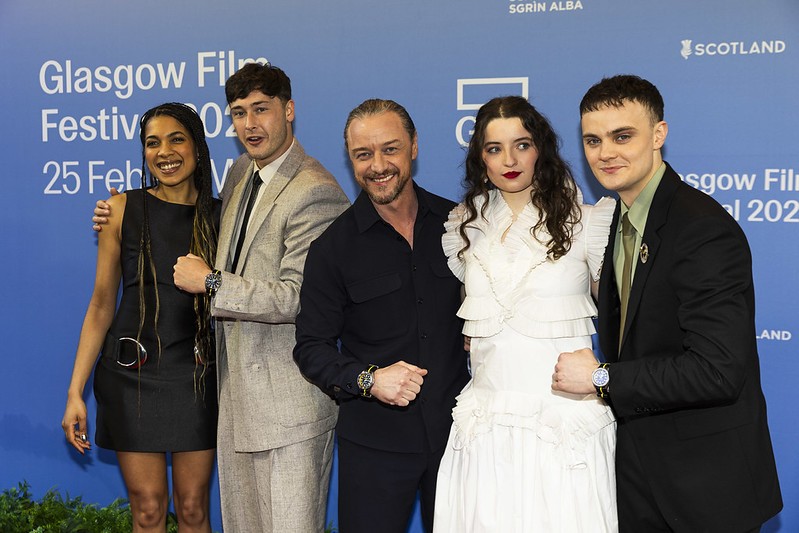
James McAvoy’s debut film as director, California Schemin’ was the Gala closing film of Glasgow Film Festival. An adaptation of the memoir of Gavin Bain, the film tells the story of Silibil N’ Brains, the Scottish hip-duo who pretented to be American to get ahead in the music industry. It’s a classic rise and fall tale with a Scottish working class spin, told with passion and affection, and an ideal choice to bring the festival to a close. Ahead of the screening Kevin Ibbotson-Wight took part in a round-table interview with James and the talented young stars of the film, Samuel Bottomley, Seamus McLean Ross, and Lucy Halliday.
The Silibil N’Brains story took place in the early 2000s, as McAvoy was beginning his career. One could assume there were certain parallels, and some of the indifference that the duo received, may have been mirrored by some of James’ early experiences in the industry.
James: Nobody said to me, ;You can’t be an actor because you’re Scottish’. ‘There were already Scottish roles out there. Not enough, but there were. It’s kind of different, because my whole job is about, you know, you pretend to be someone else, quite often from somewhere else.
But I have had moments where I stopped being a person capable of infinite possibilities, and in some people’s eyes, as soon as I open my mouth I become an accent, and the accent becomes the biggest thing about me, and it sort of reduces everything else I’m capable of to an accent. I’ve been asked not to be Scottish off camera a few times, not because it’s important that I stay in accent for my character, but because they can’t understand me. I did have a director once tell me whilst I was playing Macbeth, and I’m playing in Scottish theatres, ‘James, [mimes dial being turned down]’ I was like, ‘What do you mean?’ He went ‘[Adopts mocking accent] Scottish’. And I just just ignored the guy pretty much from that point on and did my own thing, because I thought, ‘If you’re gonna be that offensive about a Scottish guy playing the Scottish king in the Scottish play, I think you’re missing something here. So, yeah, I’ve definitely faced it. But then I’ve faced it once when I was like 15 or 16 in my own country, at the hands of a posh Jock.
James was asked about his directorial style, particularly coming from an acting background, and the actors asked about their experiences being directed by him.
James: I’ll let you guys go first,.
Samuel: Really good at it [laughs]. He was really, really good at it. Let us just be ourselves. And he was very open and lovely with us. Yes, man management was on point.
Lucy: I think he’s got such a natural affinity for it. So it was so surprising this is the debut, because it didn’t feel that way at any point. But I think that’s just a combination of him being such a great performer and such an articulate human that he could translate those thoughts very seamlessly. So you were never at a loss for what he wanted. But I also… I don’t know what it is about James, but he made you want to be better. And I’ve never had it on a job to this extent of wanting to be a better actor than than you do when you’re around James. And maybe that’s just because he’s a really good actor. Or maybe it’s because he was such a great leader that that inspired you. But whatever it was, he’s really good at it, and I hope he does it again.
Seamus: I think he had this passion. When he talks about acting, it’s honestly so inspiring. In the audition room, me and Sam did a scene and I walked away in the scene, and James was like, ‘Whoa! What are you doing? What you doing? You had something there!’
Because he’s such a screen animal, he knows this game inside out. He’s done it for years. He’s one of Scotland’s best actors.
James: It was always about hold the energy, hold the energy.
Seamus: It was. When you hear him talk it’s so invigorating, like it just felt like it was life or death in the best way, and that made you passionate about the project. And hearing someone talk about a script, who knows it inside out, loves it, and feels like he loves yous. You felt held. You couldn’t escape the project because he had it in his hands.
James: Aww, thanks, man!
Samuel: I’d also like to say he completely delegated more than enough time for us and each department as well.
James: It’s job as a director, you sort of need to be there for your crew and answer the questions that need to be answered. There are directors that sort of kick the can down the road a lot. They don’t want to really have to make a decision and then wonder why the wall isn’t the right color when they get too upset to shoot it.
In terms of my style as director, I don’t really think that’s for me to answer. And I think as an actor of 30 years, my style of acting has changed and evolved, and I’ve never really been pigeonholed, so I don’t really want to do that to myself, and I also think it would naturally evolve and change anyway. I think I can’t see myself making the same kinds of style of films or tone of films, or look of films again and again and again. Although some directors who are known for a style are wonderful and brilliant, I’m not slagging them off for that. It’s just not going to be my bag, and it will probably be a quite eclectic mix.
James and the cast were asked about how they balanced the tone of the film, going from a largely comedic feel to the darker, more emotional moments. They were also asked whether the film was shot chronologically.
James: I’ll answer the logistical question real quick. We did not shoot it chronologically. Unfortunately, it’s
quite expensive to shoot things chronologically, so it’s one of the first things to go, the idea that you shoot chronologically when you don’t have enough money.
Seamus: Yeah, thinking of Chloe [Zhao], the Hamnet director, talking about the way she does films cyclically. Films and TV shows are never shot chronologically. It was a big eye opener for me when I rocked up to a set! The cost of that is, you have to know the story inside out and to map it out as an actor, to be like, ‘Oh, I’m here doing this bit.’ But James is very good at being like, ‘No man, you’re playing Brains right now’, or ‘Your energy’s up here, when in the story, we need to see the arc from here’. I mean, we would know the arc, and we had to know that. But James is very good at reminding us of where we need to be in the story so we get the payoffs. I’ve seen the characters change, I think, in terms of the balance.
Lucy: So it kind of, I think, came hand in hand with the fact that we were granted a lot of space to take a scene or take a character how we thought it would go. And so there is a real mix of… very much articulating the words that were on the page, but also James gave us a lot of freedom to improv at points. And so I think that kind of allowed the levity and allowed the seriousness also to present itself, because we got the freedom to experience both.
James: My favorite thing as an actor over the last 30 years is usually when I’m getting to be deeply sort of upset, or scary, or harrowing, or brutal, or something negative and funny at the same time. So it’s clear to me that my directorial interests might lean that way as well. They might change, but I do like it. I do like making them laugh and then making them cry, making them laugh and then scaring the shit out of them. That’s a great visceral experience in the theater. And I was definitely trying to make a film that should be enjoyed at home, at home alone with your loved ones, of course, and streaming, But that I was trying to make a film that would play well in a communal setting.
James was asked how the film contributes to the conversation concerning accessibility in the arts for working class people, given how arts funding continues to be cut.
James: I think it’s absolutely a real life, true story of somebody that gets told ‘You can’t do this particular thing because of the way you sound,’ and the implication of that being because of where you come from. So that contributes to the argument there in displaying this bit of a miscarriage of social justice. Also, you know, I stuck in the mural of Trainspotting in there [depicting Renton emerging from the toilet with the phrase, ‘It’s shite being Scottish’]. I did wonder why I was fucking forcing everybody to go for this thing when your directorial debut is also calling to mind in the audience’s mind possibly the greatest Scottish film ever fucking made. Is that really such a wise idea?
The point being is that these people are getting told they can’t do something because of where they’re from, because of the way they sound. I feel like we are being indirectly told we can’t make films about ourselves. And the proof of that is the fact that something as good as Trainspotting was 30 years ago. What’s been since then? And you might throw out a couple of names of films that you go, ‘Wow. Okay, yeah, that’s great. Give me 10.’ And not only you personally think are really good, but that actually fucking broke out and landed and entered the public – even if they weren’t financial, massive blockbusters or successes critically – landed in the kind of collective subconscious. Something that lasts as of a piece of art that really sort of latches on to you as as a nation, and not about making it in the rest of the World.
What I mean is for us as Scottish people that we have ourselves to look at on screen, in all our shapes and sizes and all our colours, and all our religions, and all our socio-economic steps on the ladder. We’re not fully represented. Even if it was just pockets of Scottish society that are represented, we don’t even have enough of that. Even if you were just going to make it only about posh Scottish people, we don’t even have those movies!
So that’s why I put that in to try and point out that, whilst this is a film about two kids trying to make hip hop, there is actually a bigger gap in our cultural diet and we can’t expect Hollywood to pay for it. Why would it? It’s not Hollywood’s responsibility to meet the cultural needs of Scotland, and it’s not even England’s necessarily, so it needs to change.
The cast were asked what they did outside of the shooting itself, to get in to character and prepare for their roles.
Lucy: Oh, well, Sam nearly gave us carbon monoxide poisoning!
Samuel: The first time I met Lucy I was like, ‘Let’s run some lines, get comfortable with each other, and have a bit of dinner.’ We went out some nice food, went back to mine, and started running lines and stuff. And I had this beautiful apartment on Byers Road with a little stove fire in the middle, and it had a couple of fire lighters, and it had some wood there. Obviously, just for aesthetic purposes only. And I was like, ‘Actually, should I put the fire on. It’s a bit cold, isn’t it?’ She’s like, ‘Yeah, alright’. So I light the fire and we start running lines and like, an hour later, me and Lucy are sat on the couch and a little bit high.
Lucy: Feeling quite ill!
Samuel: We had to open all the windows in my apartment and try and put the fire out. I nearly killed Lucy!
James: And he broke his elbow.
Samuel: Yeah, we had what were supposed to be two weeks of skateboarding.
James: I said to them as well! I knew I needed Sam to skateboard in the film a little bit, and you ended up skateboarding way more than I thought I would need you to. And I thought of the two actors I don’t want both of them learning to skateboard, because I thought they could get injured learning to do this. And I’ll be screwed if we lose one of them. And the next thing I know is Sam turning up on the first day going, ‘I heard Seamus was learning to skateboard. Here’s mine!’
Seamus: Cut to us dressed as Michelin Men.
Samuel: I broke my elbow trying to impress James McAvoy. Because it wouldn’t have happened if our skateboard instructor wasn’t recording it and telling us it’s going to go to McAvoy.
James: Oh, that’s what it was!
Seamus: So those videos are never getting released.
Lucy: He had the X-ray framed in his living room.
Samuel: I thought it was the X ray. A couple weeks later, I found out that’s just a general one of a fracture. I’ve been like, ‘Yeah, this is my fracture.’ And like someone else has been like, ‘No, man, this is just what a fracture looks like.’
Finally, the cast were asked how they found the balance in a story that could easily have been told as either a celebration of ambition or as a cautionary tale of deception.
James: It could be a celebration of ambition, or a cautionary tale. And it’s also an indictment on the music industry. It’s also just a true story. So you’re kind of stuck going, ‘Well, this is just what happened.’ And although we made some tweaks, ultimately, we only really tell the story of what happened; and maybe slightly compressed [it]. The real story took two and a half years. Our film looks like it takes about eight weeks.
I was thinking about that last night, actually. Is it a cautionary tale? Is it a celebration? I think it’s both things at once, and I think you can have that. That’s the beauty of it, if there is a beauty to it, and you can decide yourselves that it is both things at once. If they didn’t get found out, it does feel like this is a success story. And it’s not even that they get found out that is the problem. What’s at stake is their relationship, and their relationship with their own equilibrium and sanity.
So yeah, I guess it is both things at once. I don’t think the cautionary [aspect] is that you’re not allowed to sell parts of yourself. You can do whatever you want to get whatever you want; sacrifice your identity, your integrity, your authenticity, wherever you’re from; your loves, your lives, your job, your health, whatever gets what you need to get. But at some point you’re going to need to look in the mirror and live with yourself, and maybe you can pay that price and still live with yourself. And maybe you pay that price and you can’t live with yourself, and Gavin nearly didn’t live with himself.
So the caution, really is, whatever you do to get there, you’re going to need to settle up at some point, and hopefully you’ve got enough left to be able to pay and have some of yourself left.
California Schemin’ closed the Glasgow Film Festival on Sun 8 Mar 2026 and will be in UK cinemas Fri 10 Apr 2026

Comments