
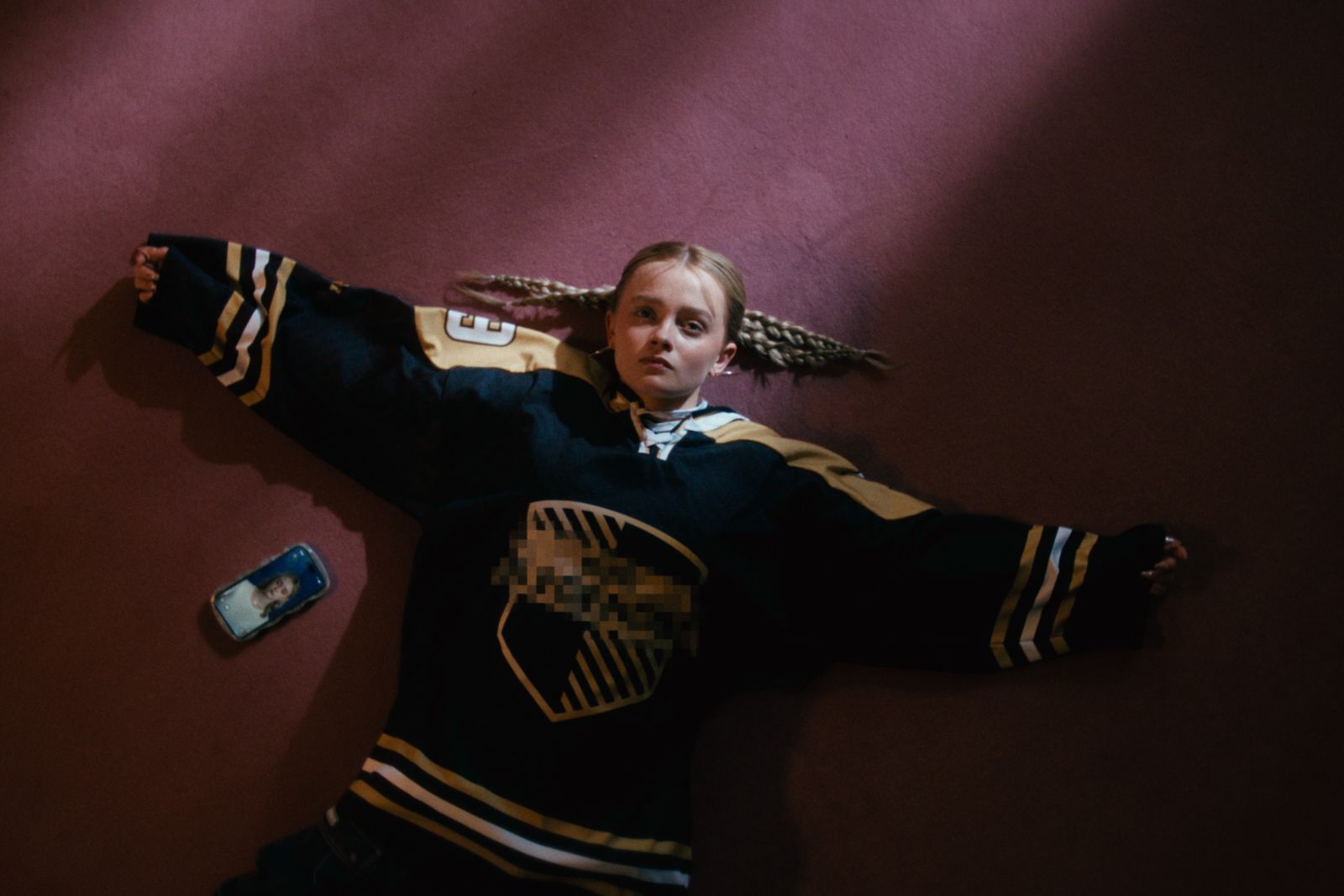
What a blessing to have reached adulthood just before the internet age really began. Luca, the protagonist of Joscha Bongard clinical, coolly detached Babystar, has known nothing but social media stardom, right down to her birth being streamed live on her parents’ YouTube channel. But when a rebellious streak comes through, it’s not at all compatible with a life that has been not merely curated, but corporately sponsored. It’s an intriguing premise, rich in satirical potential. But when real life has already taken this kind of tale to its chilling but logical conclusion, Babystar‘s bite feels a little defanged. Like The Truman Show walked so Babystar could… continue to walk.
16-year-old Luca (played with a sly, slowly evolving outrage and mischief by Maja Bons) is the porcelein pretty main attraction of her parents’ (Bea Brocks and Liliom Lewald) YouTube channel ‘Our Bright Life’. She’s known nothing else but being raised through the lens of a camera, with every special moment broadcast for big bucks. Luca has been a knowing participant throughout, but when her parents bring up the idea of a new baby, Luca reacts badly and begins to lever away at the cracks that appear in the family’s relationship behind the pixels.
Bongard has crafted the world of his blandly marketable family with precision. The glimpses we get of their archive videos feel authentic in their visual style, content, and ersatz perfection. He films with the dispassionate gaze of Michael Haneke and the slightly off-kilter absurdity of Yorgos Lanthimos. This works beautifully in the initially stages as we view this family through a goldfish bowl of their own making. But despite this excellent first act, and a well-written subtlety to Maja’s motivations, Bongard frustratingly allows the narrative to rather drift along at a pace that lets its satire rather blunt.
The film’s strongest aspect is Bons’ Maja and how she is written. The evolution of her character is beatifully nuanced and performed. There are a few ‘big’ moments where she acts out in magnificent fashion, like a spectacular display of petulance in a posh restaurant. But it’s in the growing realisation of forlorn loneliness, and her knowledge that being internet-swaddled her whole life has left her unable to function in any normal sense, that the Bons excels.
One initially assumes that her aghast reaction to being told a new sibling is on the way is a tantrum at the thought of losing centre stage, and maybe there’s a part of Maja which does bristle on that level. Really, she has realised that she’s been denied any semblance of a genuine childhood. She comes to the conclusion that sabotaging the channel is the only way to protect her new brother or sister. That her actions provoke frantic damage control from her parents rather than an attempt to engage with Maja’s concerns prove her to be something of a muted hero.
That’s why there’s a slight feeling of missed potential here. You can appreciate Bongard’s restraint, particularly as a first-time filmmaker. But Babystar feels characterised by an overall melancholy fatalism rather than a righteous anger or a true sense of absurdity. You can also argue that his style ultimately limits the extent to which we truly empathise with Maja. What the film does have is an impressively wide-reaching narrative that pulls contemporary concerns like AI into its thematic palette in a clever way. As it is, Babystar is an intelligent update on ideas of surveillance and voyeurism that The Truman Show did so well, and which go all the way back to Jeremy Bentham‘s concept of the panopticon.
Screening as part of Glasgow Film Festival on Fri 27 & Sat 28 Feb 2026

Comments