
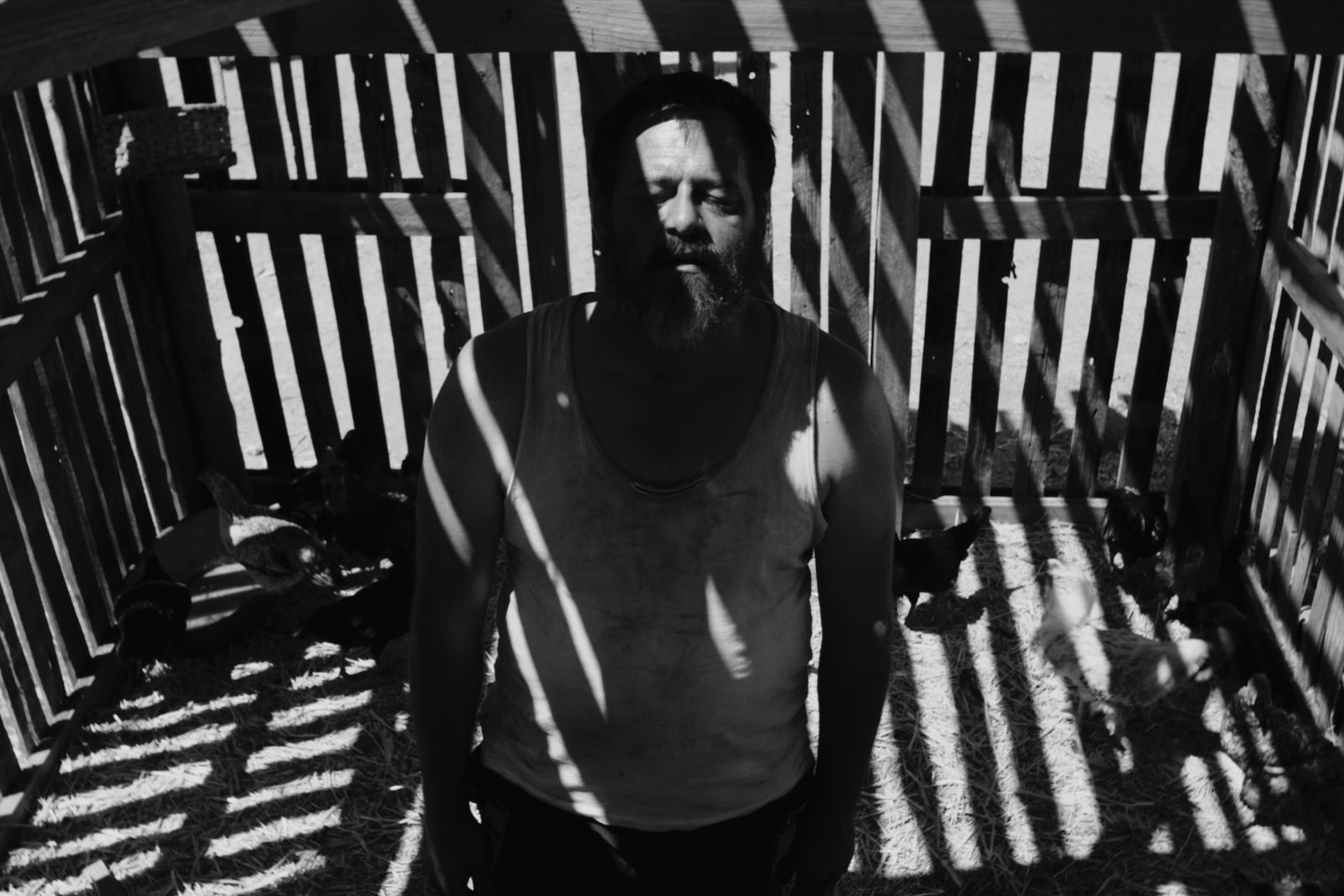
Coming across like an unholy union of Robert Eggers and Béla Tarr, Hen is a meticulous, eerie chiller that signals a confident, assured new voice in horror. Nico Scheepers‘ debut is the very definition of a slow burn, but more than rewards patience with anticipation and dread applied like ever-tightening thumbscrews. It’s a film whose effect lingers long past its doom-laden conclusion.
While out hunting, farmer Dawid (Stian Bam) comes across the scene of a bizarre massacre in a small copse of trees. What appears to be an entire family lie mutilated in a circle around a large box bound in heavy chains and adorned with a crucifix. Inside, he discovers a terrified young boy (Dawian van der Westhuizen) and takes him home to his wife Hanna (Amalia Uys). The couple are austere and pious, but kindly enough and welcome the boy as the son they never had. But there’s something not right with the boy, and the couple begin to lose their grip on reality.
From the start, Hen has the air of a timeless fable thanks to the remoteness of the film’s setting and Chris Lotz‘s beautiful, but stark and unsparing black and white cinematography. Dawid and Hannah live on a farm without any amenities, clearly scrabbling an existence. It could be the 19th, early-20th century, or even some post-apocalyptic near-future. What’s certain is that they’re used to their isolation, and their lives have become almost ritualised. The boy’s arrival forces them out of this. Although the boy is defined by his skittish strangeness – to say nothing of his lack of appetite for anything except raw eggs – and things start to skew off-kilter straight away, it’s hard to pinpoint what is exactly wrong. Perhaps he’s actually a relatively normal child who has been through something awful and it’s Dawid and Hanna who’ve been curdling in their own hermetic religious mania.
Instead of narrative drive, Scheepers relies on his technical craft and his knack of freighting the must mundane of activities with suffocating, monolithic portent. Even at its most glacial and oblique, the sheer atmosphere of the piece is gripping. Its vagueness is part of the reason it works. It never feels the need to explain where the boy has come from, the nature of the force that seems to have accompanied him, or whether he’s somehow bringing pre-existing madness to the surface. And the horror, when it comes, has real impact as Dawid and Hannah have done nothing wrong; quite the opposite in fact. In their own joyless, Calvinist way, they’ve showered the boy with kindness.
A film so attuned to its own unique rhythms will undoubtedly be an acquired taste, and you get the sense that Scheepers has uncompromisingly made the film he wanted to make. Like Robert Eggers, there’s a precise sense of purpose and an insistence that genre filmmaking does not preclude a film from being real art. Like Béla Tarr, there’s an air of fatalism, as if Hen is an ornate and surreal, but bleakly gorgeous memento mori. Arthouse it may be, but Hen isn’t an intellectual exercise; it works on a gut level. It’s a perfect example of cinema as a sensory medium, which is often the best approach to take for folk horror.
Screening as part of Glasgow Film Festival Thu 5 Mar & Sat 7 Mar 2026

Comments