
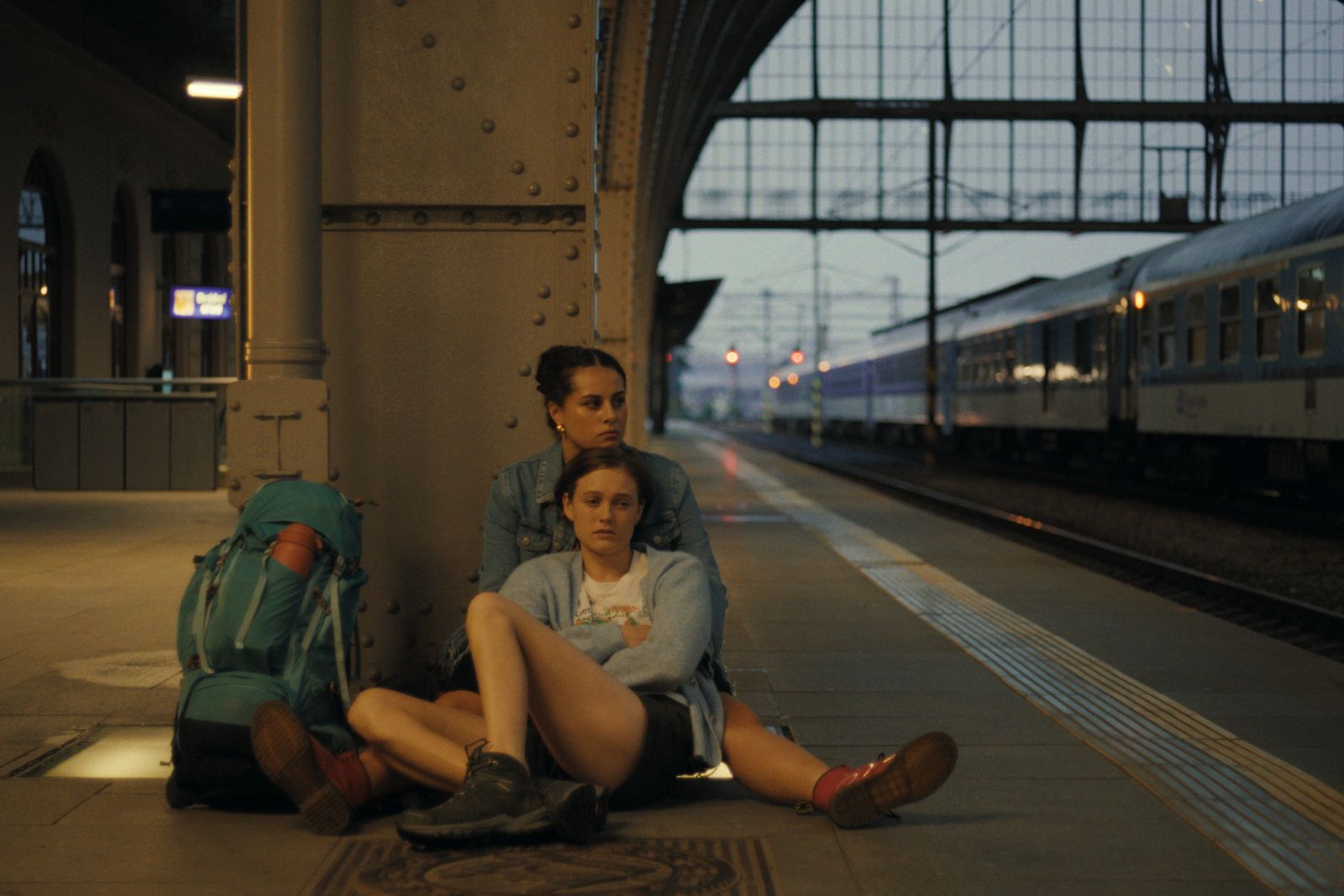
Fanny Ovesen’s debut Live a Little meshes road movie with coming-of-age drama to largely successful effect. The friendship of two young Swedish women is tested when the first night of an interrailing trip ends with a blackout and a potential sexual assault. It’s commendably light on easy answers and free of cautionary tale finger-wagging, but is hampered by a second half that doesn’t quite achieve the promise of the first,
Laura (Embla Ingelman-Sundberg) and Alex (Aviva Wrede) are best friends who’ve been planning a couch-hopping trip across Europe for two years. Things go awry almost immediately on their first stop in Warsaw. Laura, normally the more sensible of the two, and who has a boyfriend, gets very drunk and wakes in a strange bed. This sends her into a spiral of guilt, particularly as her boyfriend Elias (Odin Romanus) makes an impromptu visit at the next stop in Prague. As she tries to piece together the night, she begins to suspect that she may have been the victim of sexual assault, which triggers even more complex feelings in the already confused young woman.
Live a Little‘s first act is exceptional as it establishes the relationship between the two friends. Alex is open, free-spirited, and sexually voracious. Her aim is to sample two aspects of each country; the booze and the men. Laura is more reserved. Tall and slim; there’s a an awkward physicality to her that Ingelman-Sundberg only accentuates the more the film go on. Despite their differences, the pair are as close as can be, and the two actors make the friendship feel lived-in and loving. It’s therefore intended to be a little surprising that it’s Laura who finds herself teetering around a club in Warsaw, before a brutal cut to black.
From then on, the film follows Laura in the haze of that first night. Ovesen frequently cuts to what we initially think are fragments of memory returning, but which change each time; clearly alluding to Laura playing out certain possible situations in her head. Ovesen asserts the ambiguity of the situation. Was Laura simply drunk enough to be tempted? Was she taken advantage of? Was she spiked? Ingelman-Sundberg is excellent at conveying the internalisation of these possibilities, while expressing them physically in alternatively defensive and self-destructive ways.
Where Live a Little is less successful is that it’s a film with travel as a central aspect that leaves out most of the travel; rather it jumps from Warsaw to Prague to Berlin etc. It’s clear that Ovesen is more interested in the drama that plays out in the destinations themselves, which is the focus of the narrative. However, as most of the film takes place in anonymous rooms and clubs, there is little flavour of the girls’ actual trip. Additionally, once there has been a reckoning in Prague between Laura and her boyfriend, the film begins to spin its wheels slightly, with the film wrapping itself within her inner turmoil, and therefore shifting its momentum. Its unwillingness to give Laura the answers she seeks is ultimately laudable, but the pace ultimately drifts.
In many ways, Live a Little feels like an interesting sister piece to Molly Manning Walker‘s How to Have Sex. Both deal with very similar subjects, but approach it from different directions. Walker’s film builds up to its defining incident, dealing in anticipation and anxiety. Ovesen’s debut resides in the limbo afterwards and is definitely more opaque in its conclusions. Live a Little is slightly less satisfying dramatically, but Fanny Ovesen certainly offers a version of a familiar tale that is refreshingly nuanced, with a central performance that is finely attuned to the complexities of the situation and doesn’t lapse directly into trauma.
Screening on Sat 28 Feb & Mon 2 Mar 2026 as part of Glasgow Film Festival

Comments