
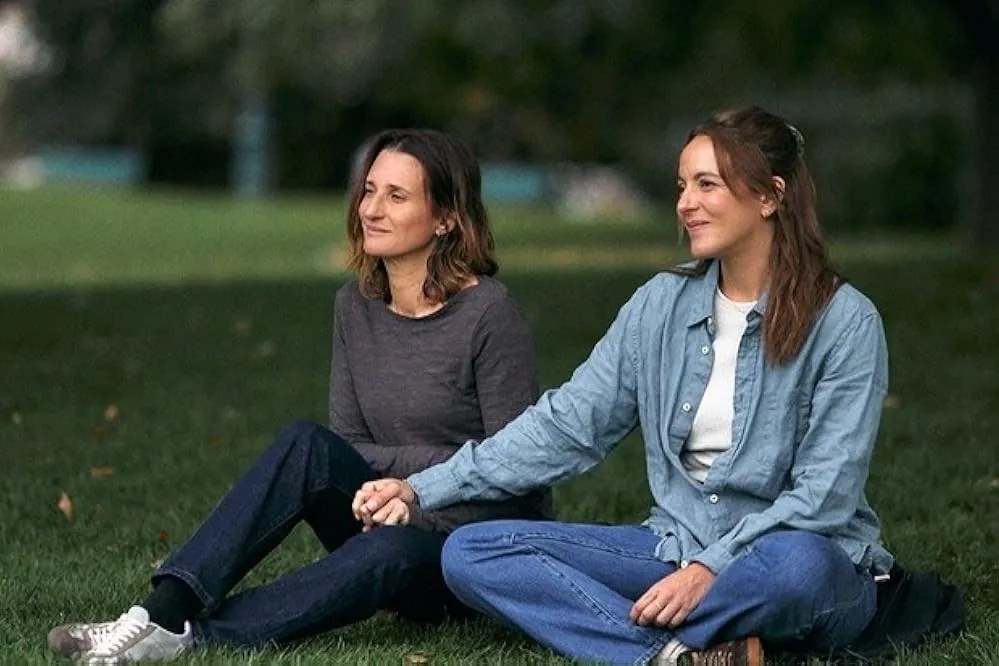
Winning the Best Director Award at the Karlovy Vary International Film Festival earlier this year, Nathan Ambrosioni’s Out of Love arrives at this year’s French Film Festival as a touching, quietly piercing gem.
The premise seems simple at first glance. After a long drive on the motorway, Suzanne (Juliette Armanet), a single mother of two, leaves her children Gaspard (Manoã Varvat) and Margaux (Nina Birman) in the care of her estranged sister Jeanne (Camille Cottin). Jeanne works as an insurance assessor and has separated from her partner Nicole (Monia Chokri) after disagreement about whether to have children. Suzanne does not return. There is no call, no message, no explanation, only a letter whose contents are never revealed. Jeanne and the children must learn how to live inside this sudden absence.
Read on paper, Out of Love may not sound like the most daring offering in a festival line up. Many films have built stories around abandoned children or unwilling guardians. What sets Ambrosioni’s film apart is his choice to refuse every easy path the genre offers. He allows the characters to lead, and the story unfolds with an unusual patience and honesty. Cottin’s Jeanne begins the film as someone entirely unprepared to care for children. There are reasons for this. She is guarded, often silent, unwilling to express affection or need. She does not smile easily. She does not cry in front of the people who matter. She resists the idea of taking responsibility for the two children now in her living room. Yet, as the story moves forward, tiny pieces of her interior life come to light: fragments of her family history, the ache of her past relationship and the quiet ways the children unsettle and soften her. Another director might have been tempted to give Jeanne a neat “happy ending” that resolves all her problems in one go. Ambrosioni is wiser. He treats Jeanne as a character of flesh and blood, not a device for the plot. Cottin carries that integrity beautifully, never pushing for tears or melodrama, yet grounding the entire film with her presence.
Still, the film’s true revelation comes through Gaspard and Margaux. Gaspard turns ten during the film; Margaux is a few years younger. Ambrosioni gives them both space to breathe as full, complicated people. Gaspard’s emotional turmoil is especially striking. He is gentle with Margaux, trying to shield her from fear. He sometimes wets the bed after his mother leaves, and he doesn’t want to wake her up while changing the sheet. He is considerate to Jeanne, even when he catches her crying. Yet he is also a child in pain, and pain makes him unpredictable. He lashes out at Jeanne, snaps at his aunt, pushes against his classmates and even turns his confusion toward the mother who left him. Ambrosioni allows him to be tender and difficult, loving and angry. Grief moves in circles, not in a straight line, and Manoã Varvat captures this truth with a rare, luminous sensitivity.
One of the film’s most delicate achievements is Ambrosioni’s refusal to give a single, definitive answer to the question haunting everyone: why did Suzanne leave? Pourquoi? Jeanne wants to know. The children need to know. The audience also feels the impulse to ask pourquoi. The film offers hints, never certainties. Suzanne rarely left home. She spoke of a journey without a destination. Gaspard and Margaux sensed danger when she once left them alone in the car. Their family history is marked by early loss and emotional distance. Jeanne left home young. Suzanne has been raising the children alone. None of these clues form a clean explanation, but together they form a portrait of a woman overwhelmed by circumstances she cannot articulate.
Ambrosioni understands how damaging it would be to reduce Suzanne’s absence to a simple cause. A neat explanation would be manipulative, flattening the story’s emotional truth. So instead of answering pourquoi, the film turns toward the quieter, more difficult question: what does living with the absence do to those who remain? How do Jeanne, Gaspard and Margaux change as they search for answers that may never come? The film traces these shifts in gestures so small they are almost invisible, yet by the end of its one hundred and eleven minutes, the audience can feel the shape of the hole Suzanne has left. It is vast, painful and impossible to ignore. You can feel the weight of the time it takes to accept that someone may not return, at least not soon.
The film ends the way life often does, with the question still unanswered and the wound still open. Jeanne and the children continue forward, not completely healed but changed, trying and learning to live with a shadow that no longer terrifies but quietly shapes their days. In the spaces Suzanne left behind, something almost like light begins to gather. It is faint, hesitant, but real. Out of Love closes like sunlight long overdue, offering not answers but the fragile beauty of carrying on. It is in this final, gentle light that Ambrosioni’s sensitivity becomes unmistakable, marking the film as one of the festival’s quiet treasures.
Screened as part of French Film Festival

Comments