
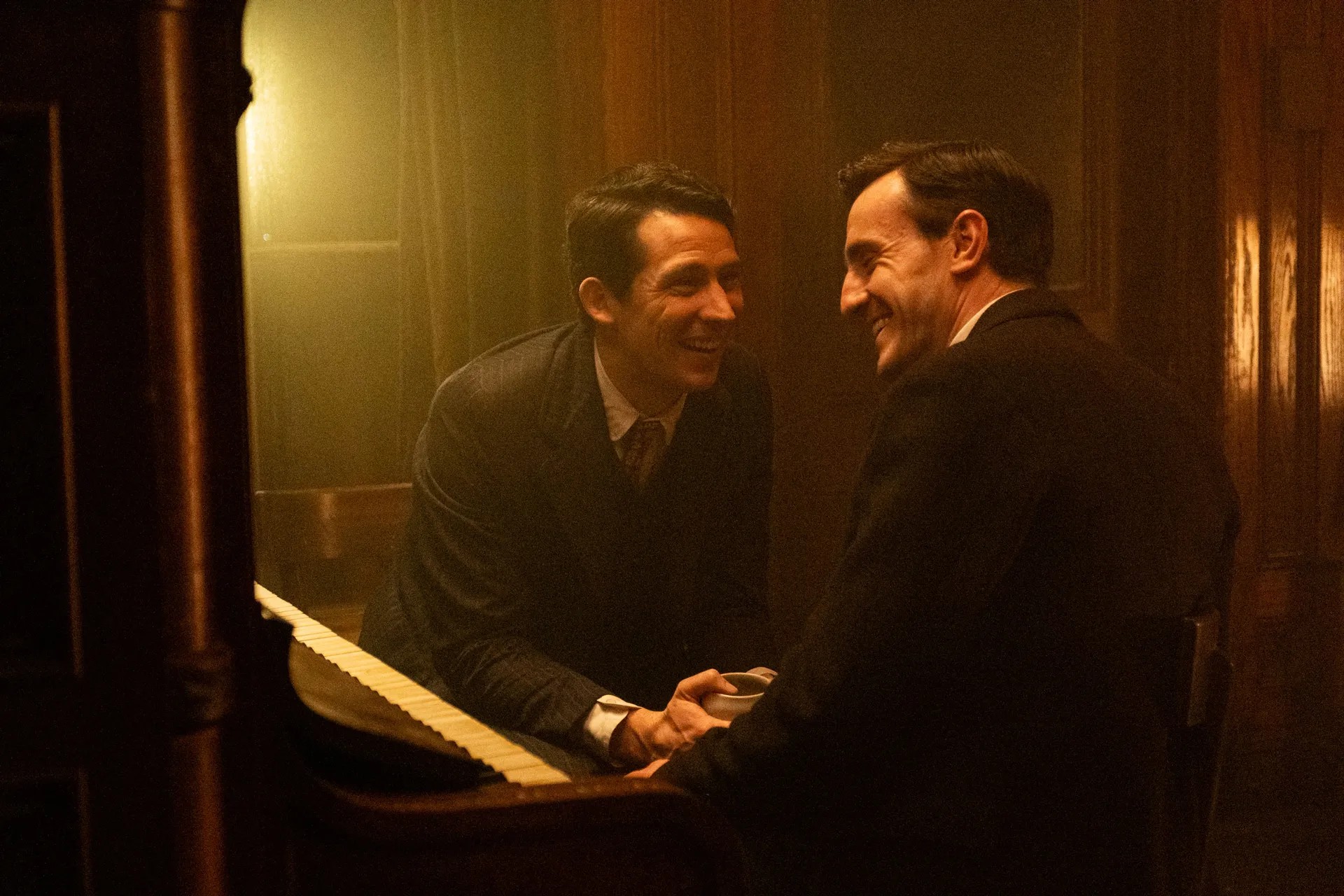
This story of fobidden love in the early part of the 20th century stars two of the most charismatic actors of recent years in Paul Mescal and Josh O’Connor, but is content to keep its light under a bushel for the most part. Director Oliver Hermanus eschews explosive passion in favour of fastidious, wistful melancholy. It may be tasteful to a fault, but does arrive belatedly at a powerful conclusion.
In Boston, 1917, music student Lionel (Mescal) connects with pianist David (O’Connor). Their instantly intense relationship is interrupted by David’s conscription into the US Army, with Lionel missing the draft due to his poor eyesight. When David returns, he invites Lionel on a research trip across New England, collecting recordings of folk songs on wax cylinders from people in the various communities they come across. It’s a trip that deepens their intimacy, but also drives a wedge between them.
Hermanus, who made restraint a virtue in his previous film, Living, the very respectable reworking of Akira Kurosawa‘s masterpiece Ikiru, has made a rather old-fashioned, strangely chaste love story. In a moment in which the exuberant, irreverent Heated Rivalry is redefining what gay love onscreen can look like, Hermanus and writer Ben Shattuck find their resonance in what isn’t shown, and what has been lost. For the most part, their relationship is like the echo of a soundly struck bell, or the final refrain of one the songs about a pining, obliterated heart they record on their journey.
It feels like some characterisation has been trimmed in favour of this lilting narrative. The opening narration makes much of Lionel’s synesthesia, yet it has little bearing on the story. One would think that his perfect pitch and David’s photographic memory for playing music would play a powerful yin and yang role in their connection. Instead, Hermanus relies on the chemistry between the two leads, and the subsequent pain of Lionel’s yearning after their separation. Neither can be faulted. O’Connor has far less screen time, but his David is magnetic, with something of Ivor Novello in his mannerisms, and with an almost beatific smile when his attention is locked on Lionel. Mescal has the trickier role as the more reserved Lionel, whose arc becomes defined by David’s absence, which is felt palpably, sometimes to the film’s detriment. As in Hamnet, Mescal proves himself a generous actor, ceding the spotlight to a more demonstrative co-star.
Many comparisons have been made with Brokeback Mountain, for tediously obvious reasons, but The History of Sound is much more buttoned-up, restrained, and less memorable than Ang Lee‘s modern classic. Both O’Connor and Mescal have also been in better films with a gay narrative. HoS lacks both the ‘sheep-dip for lube’ mud and slurry tactility of God’s Own Country and the sheer emotional devastation of All of Us Strangers.
There is something to be said for Hermanus’ approach here, however. The pair suffer no instances of homophobic hate, because this is so firmly the ‘love that dare not speak its name’ that they only show each other affection when in entirely hermetic circumstances. It’s unusual for a gay historical narrative to be without any explicit acts of bigotry, but this of course speaks to its own kind of tragedy. Perhaps a more apt comparison than Brokeback Mountain is with Terence Davies‘ achingly sad final film Benediction. There’s also something of Atonement in its coda.
The patient viewer will be rewarded in this coda with the poignant catharsis the film cries out for, and it’s well worth the slight lapse into melodrama that accompanies it. In fact, the wobble in the film’s stiff upper lip is very welcome. It’s a little sad that it isn’t Mescal who gets it, but the estimable Chris Cooper, playing the elderly Lionel some six decades later. Many will conclude that the road to this moment is too long, maudlin, and meandering – with O’Connor’s absence felt far too strongly come the film’s second half – but there’s a real pleasure in how that handsomely-mounted emotional dam finally breaks.
In cinemas nationwide now

Comments