
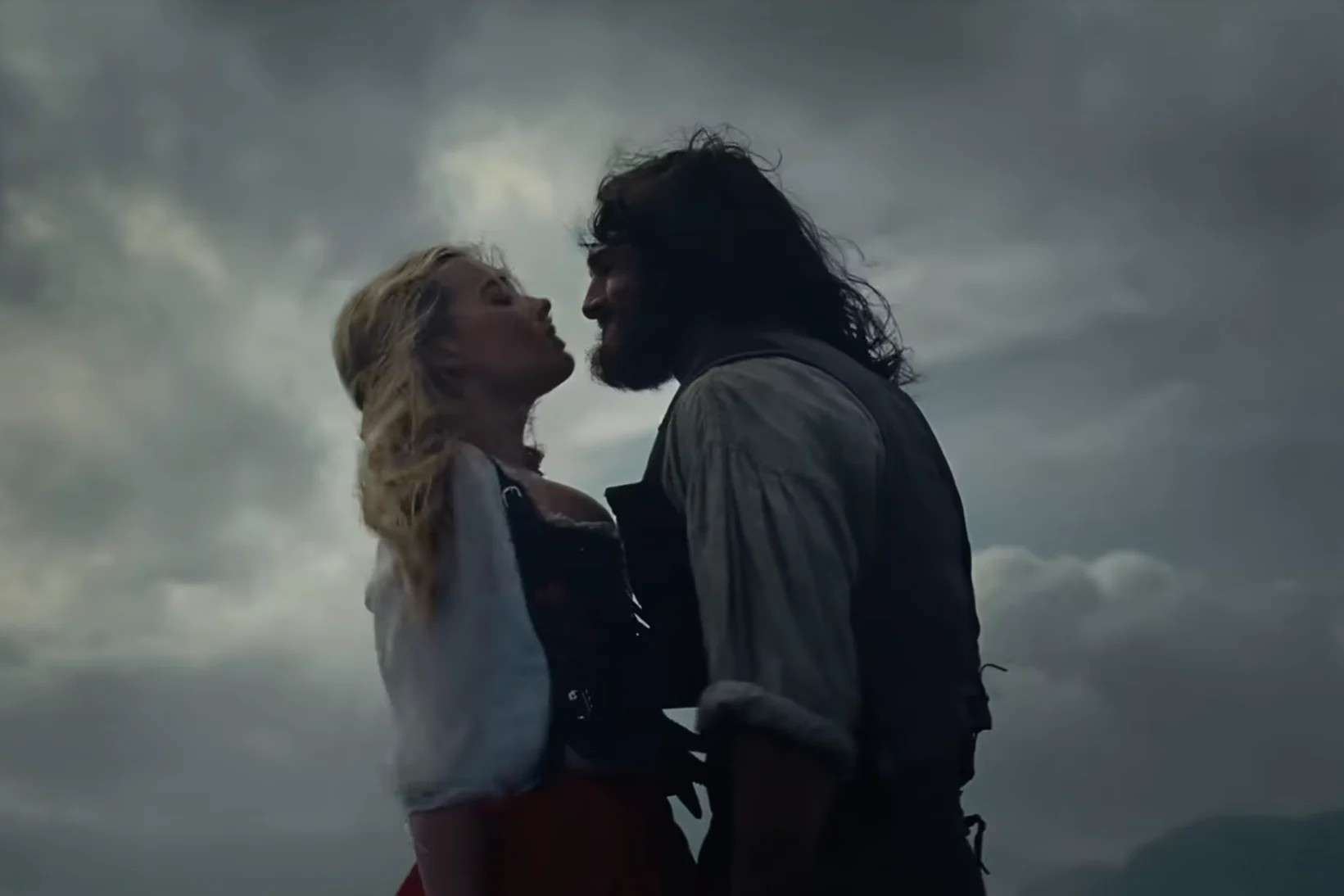
By putting the title in quotation marks, Emerald Fennell seems to be knowingly distancing her adaptation of Wuthering Heights from fidelity to Emily Brontë’s original text. Not that many previous adaptations have been true to the literary source, and, like most, Fennell has excised the second part of the novel to foreground the tempestuous relationship between Cathy and Heathcliff. However, by reducing one of the most minutely analysed pieces of classic literature into a style-over-substance provocation, and by fatally miscasting its central pairing, the film sputters when it should catch fire.
After an instructive day at a public hanging, young Cathy (Charlotte Mellington) discovers that her father (Martin Clunes) has taken on a young urchin (Owen Cooper) as his ward. The pair begin a complex relationship, that continues until they grow into young adulthood and the familiar faces of Margot Robbie and Jacob Elordi. When Cathy marries the wealthy Edgar Linton (Shazad Latif), Heathcliff abruptly leaves, leaving Cathy bereft, albeit materially comfortable. Five years later Heathcliff returns having made his own fortune, and the pair’s destructive relationship resumes, riven with their own individual resentments.
If it needs repeating, any devotees of the novel will have to continue to wait for a version that’s faithful to Brontë’s vision. Adaptation and interpretation necessarily involve excision, editing, and condensing. There is little point in criticising “Wuthering Heights” on that basis. In fact, for all the changes Fennell has made, she seems to understand better than most that there is precious little romance in Cathy and Heathcliff’s relationship, and that the reputation the novel has as a transcendent love story for the ages is really fucking weird. Individually the pair are vile, together they’re corrosive to the touch.
Fennell has decided that lurid, sticky melodrama is the tone that best suits the material. Everything is heightened; the costumes, the billowing mist of the moor that resembles an early Cradle of Filth video, the artisanal artifice of the interiors, the histrionic emotions. It’s florid, breathless, sweaty stuff, but fails to nail the very specific atmosphere of the novel – the earth and mud, the class dynamics, the mutual link between sex and death – in the way that Andrea Arnold’s claustrophobic, grubby-fingernailed 2011 adaptation dialled directly into.
Most fundamentally the central pairing is borderline disastrous. The much-discussed racial aspect aside, Elordi lacks the necessary roughness of Heathcliff, although he exudes a certain imposing disdain that Fennell accentuates with low-slung camera angles. Robbie is simply too old for Cathy, and as an actress she’s always exhibited a certain poise that doesn’t work with this pouting, bratty character. Together, the pair seem almost brutally mismatched and unbelievable. There is little spark between them, let alone an inferno of passion that engulfs all in its path. As their characters are written, there is a general one-note immaturity in their mutual cruelty that kind of strikes true in one way, but which elides all the novel’s complexity.
Elordi, in fact, has far more chemistry with Alison Oliver’s Isabella, Edgar Linton’s ward, and it’s in their troubling pairing of domination and subjugation that Fennell’s penchant for the perverse bears the most fruit, and which provides the chewiest scenes of the film’s third act. Oliver pretty much steals the film as the flighty dullard turned ravenous power-sub. As with her role in Saltburn she has an instinctive ability to shine amidst absurd situations, and with one well-placed wink skips away with the film’s sexiest moment (which admittedly may be more revealing of this reviewer than the general cinema-going public).
Elsewhere, Martin Clunes unexpectedly excels as the alternately sinister and pathetic Mr. Earnshaw, whose corpse is on the receiving end of one of the more successfully shocking moments. Hong Chau and Shazad Latif fare less well, Chau’s Nelly reduced to a simple figure of pure resentment, and Latif’s Edgar so milquetoast as to be barely present. Both are nevertheless a better fit for Fennell’s approach than the beleaugered Robbie.
Glaring issues aside, “Wuthering Heights” has its moments, mainly via the lens of DP Linus Sandgren. There are some striking compositions, with Cathy’s white wedding train billowing across the crepuscular moor a highlight. And then there are the leeches… Overall, “Wuthering Heights” is a trainwreck, albeit a weirdly watchable one. It careers giddily through its run time (although one feels such a thematically weighty story should have more of a sense of gravity or heft), and you get the sense at least some of its curious absurdities are by design; that Emerald Fennell is thumbing her nose at anyone who ever took Emily Brontë’s baroque gothic fantasia seriously as a love story in the first place.
In cinemas nationwide now

Comments