
Kathy Rose O’Regan works in film restoration and preservation at the San Francisco Film Preserve. One of her recently-completed projects is the restoration of Maurice Tourneur’s The White Heather, which will be screened this week at the HippFest Silent Film Festival in Bo’ness, and for which Kathy has also provided the programme notes. Set on an island off the coast of Scotland, The White Heather is a 1919 melodrama that is notable for a climactic sequence featuring exquisite and ground-breaking underwater cinematography. We spoke to Kathy about her work on restoring the film, how the underwater sequence was achieved, and her wider experience in film restoration and preservation.
Can you tell us about The White Heather? I believe it was thought to be a lost film for decades.
It was very much thought to be lost for 105, 106 years, something along those lines. And then my colleague Rob Byrne, who’s the founder of our organization, San Francisco Film Preserve – he spends some of his year in the Netherlands and Amsterdam – and he we have many colleagues at the Eye Filmmuseum. And they reached out to Rob and said that they had found a film that that is The White Heather by Maurice Tourneur, and would SFFP be interested in doing the restoration, because it’s an American title. It was made by an American production company, but held in a European archive. Obviously, a European archive is a state entity, so there’s no reason for them to restore an American title.
So they reached out to us as their partners to do the restoration. And then I happened to be in Amsterdam for a different project, so myself and Rob inspected the materials at Eye Filmmmuseum. And, I mean, after watching the first reel, we kind of both looked at each other and we’re like, ‘Yeah, we need to restore this movie!’
Actually, our organisation is quite new. We’re about a year and a half-old, the San Francisco Film Preserve, but we began life as the Preservation Department of San Francisco Silent Film Festival. So when the restoration process began, it was under the umbrella of the silent film festival, but by the time the restoration ended, we were a separate entity. So actually the restoration is between ourselves, who are San Francisco Film preserve, San Francisco Silent Film Festival, and EyeFilmmuseum. So, as every restoration is, there’s always multiple partners in these projects.
And can you tell us a bit about the restoration process and the condition the print was in when you received it from Amsterdam?
Sometimes with a restoration project we’re lucky enough to have multiple sources, or something quite pristine to work from. This was not one of those cases. In this case, there’s only this one print. It’s a nitrate print from the silent era, and it was in… luckily, there wasn’t much nitrate decomposition, which is when basically the plastic starts to decompose. But it had seen a lot of wear. It had obviously been screened a lot, so there’s lots of scratches, lots of tears, lots of dirt. So that can be time-consuming to mitigate when you’re doing the digital restoration.
For the restoration it’s kind of a multi-step process. So once we decide what element we’re going to use, we have that scanned at a film lab. We don’t have a scanning capacity in our own office. So we had that done in Europe at Haghefilm, which is a few hours outside of Amsterdam in the Netherlands. So they did all of the necessary repairs; repairing tears, repairing broken sprockets, things like that. And then they scanned it at 4K resolution. And then at that point they send us the files in a DPX sequence. And so there is one file per frame, so we’ll be gathering as much information as possible.
So when we receive that digital file sequence here to the office in San Francisco, we then use D1 restoration software to do a full-scale digital restoration on the work. So we stabilize the image, we de-flicker it if necessary. We dust it, remove scratches, and then we do what we call hand work, which is when we watch the film through slowly, and remove anything that is obviously not native to the original production; how the film would originally have been seen on screens in its first run. What the print would have looked like on the screen in 1919.
We did that with the whole end-to-end digital restoration process, and then at that point when we export from our computer here, that new restored DPX sequence goes back to the lab, in this case to an American lab, Colorlab in Maryland, and there they do the grading. So you’re balancing your illuminance and your contrast to make sure that you’re getting the depth of image quality that you want. And The White Heather has colour throughout the majority of the film, as you would have seen. There’s loads of really beautiful tinting and toning. So that is recreated digitally for when we are screening film digitally, which is the majority of the screenings in this day and age. But then we also create a new black-and-white negative and a black-and-white print. Then that print was sent to one of our partners in the Czech Republic, who does hand tinting and toning. So he hand-tinted and tones the film print. So if you’re watching on 35[mm] you’re looking at a real tinted and toned print.
And believe there were enough surviving Maurice Tourneur films to be able to match the intertitles?
Yeah, the titling can take, obviously, as long as the restoration process itself. So because this was found in the Netherlands, obviously the intertitles were in Dutch. That was the beautiful thing about the silent era. You know, you could send your film from the US to any country in the world, and they just chopped out the titles and put in whatever the local language is. But one of the things about that is that they would often change things to kind of localise the story. So you might change a name from an English-sounding name to a Dutch-sounding name. Sometimes they would change parts of the story. That was not the case in this film, but it isn’t just a case of back translation, you know. That’s obviously the first step. We just do a direct translation from Dutch to English, but then you have to make sure that the language matches the way that English was used in that era. If it’s a period piece, you have to do research on how period English would have been used.
There’s all these different steps towards making sure that the titling is done correctly. And if you’re lucky enough to have an original script to work from that has the titling language present… but we did not have that. But what we did have was that The White Heather was an adaptation of a pretty popular stage play by Cecil Raleigh. We were able to access the manuscript of the stage play, so that was very helpful for recreating any of the speaking intertitles. So we actually had a script to pull from to be pretty confident that, for the sections where people were conversing, we were using the right style of language.
Then for the actual visual style of the intertitles, we were able to look at contemporaneous films from the same production studio and from the same calendar year to, again, be as confident as possible that we were matching the font style and the design style of the titles. So then what we do to recreate that digitally today is we pulled screen grabs of some of those titles and worked with the graphic designer to use those as a template. Then we could generate all of our new titles. We always have our [logo] in the bottom right hand corner.We put, ‘SFFP’, just to make it clear that these are recreations. These are not original titles, but they are recreated to the best of our ability.
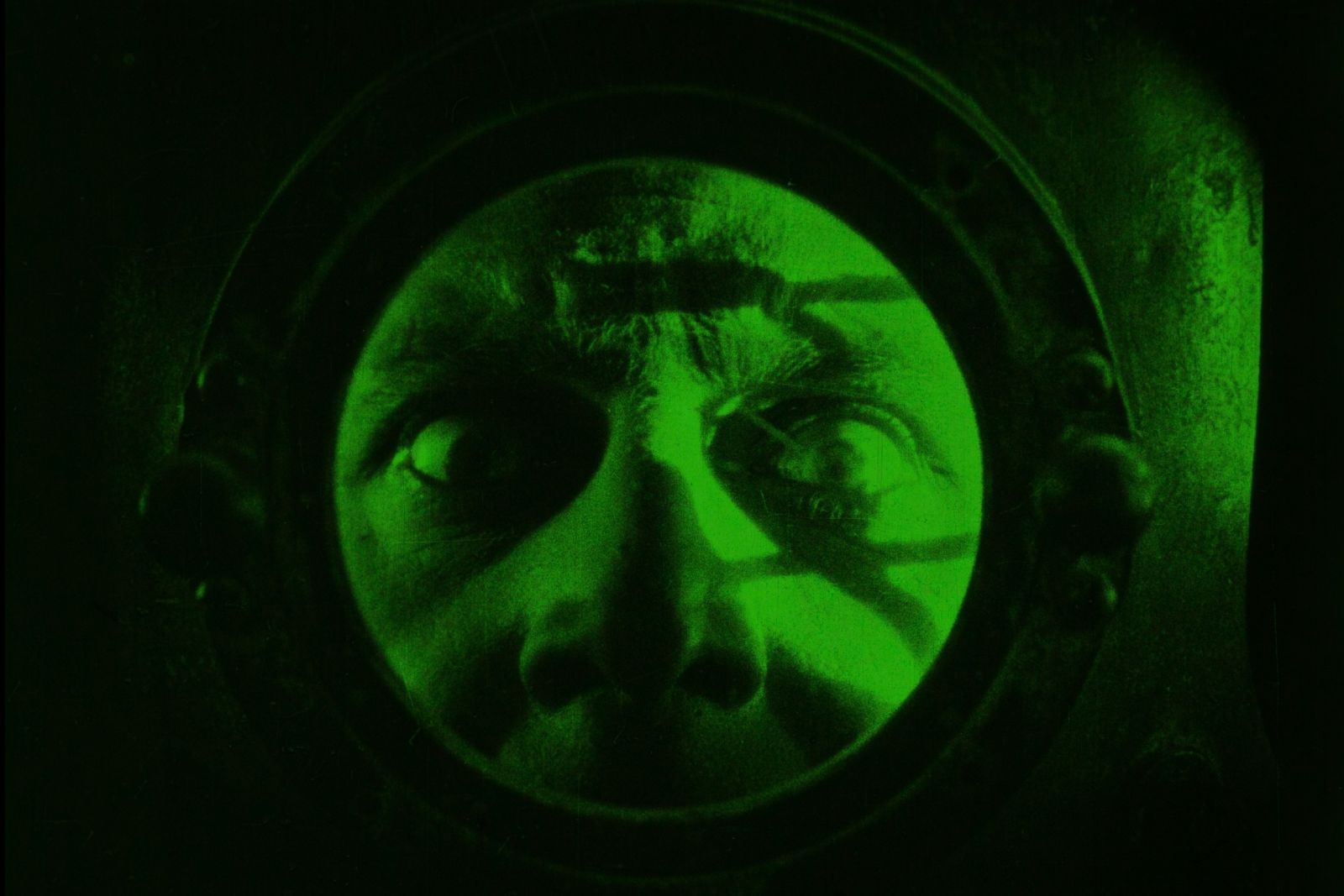
The film would be most notable for its underwater sequence at the climax of the film. Could you tell us a bit about how those shots were achieved in 1919, especially because most of us would sort of see Jacques Cousteau probably as being the one of the pioneers of underwater cinematography, but this was decades and decades before.
100% Yeah. I became so interested in this while working on this project, yeah. So for this feature, they use the Williamson submarine tube that was developed by Ernest Williamson and his brother George. Their father Charles had invented lots of different machines and equipment for doing kind of submarine salvage, like underwater work, but not for filming, specifically. For working underwater on ships, stuff like that. But Ernest, his son, was a journalist in his younger life, in his early 20s, and he really saw the possibilities available for developing some of his father’s inventions for being able to use either still or moving image photography underwater.
So, building on his father’s designs. His father had designed a type of tube that would facilitate going underwater into a viewing area. So he developed the Williamson submarine tube to then connect to what he called the photosphere. It was this large metal sphere that had thick, very clear glass set into port holes in the tube. Then a cameraman could climb down the tube from a ship above, climb into the photosphere, and then be able to shoot out of the portholes. The photosphere didn’t sit on the seabed. It basically swayed in the water below the ship.
They had made a few films kind of under their own steam. And then they worked with Maurice Tourneur on The White Heather. And Tourneur was the first director to actually direct action underwater himself. So, he wore the diving suit. He learned how to dive… Scuba diving was not a common practice then. Scuba diving wasn’t developed until later. He went down with the actors. And he’s just off screen, so you can’t see him, obviously, but he used hand signals to direct the action while the actor divers were filming the fight scenes, etc. underwater, which is amazing to me that they were doing this over 100 years ago.
It’s fascinating to me that the only time the camera moves is in those sequences. So they were able to achieve that before the tracking shot was even thought of.
Such a good point. And then the beautiful thing about those scenes is… obviously the footage itself is incredible, but then also they use this really powerful green tint, so you feel like you’ve been submerged in this marine world with just one color. They didn’t need the full colour spectrum to achieve an otherworldly effect.
How did a film restored in San Francisco come to be get a screening in a little town in Scotland?
Well, like always, Ali[son] Strauss, [Director of HippFest] is a powerhouse, and we are lucky to have a great relationship with her. Coming from the silent festival in San Francisco and from the Film Preserve in San Francisco, we attend the Pordenone Silent Film Festival every year, which is the largest celebration of silent film in the world. It’s in a small town in northern Italy, and that’s where I first met Ali. I can’t speak for my colleagues, but the first time I met Ali was there, and going to these sorts of festivals is where you get chatting to people, and you talk about different projects you’re working on and different films you’re shooting.
As soon as we started a restoration of a film set in Scotland, I think Ali was always in the back of our minds. But then The White Heather was actually programmed at Pordenone this year. It was the European Premiere, and Ali saw it there, and then reached out to us afterwards and said she was interested in screening it at HippFest, which I was absolutely delighted to hear. So that was the connection.
And more generally, what first interested you in silent film, and film preservation more specifically?
Boy, that’s kind of hard. I mean, I’ve been in this field now for 15 years, I guess. I got a degree in art, and then all through my 20s I was bartending, but wanted to do something different. I didn’t feel very, you know, stimulated. Cinema was always my big passion, but I knew I didn’t want to work in production. I was already based in San Francisco, and I reached out to a few film-focussed organisations; festivals and archives and things, and asked if there were any interning or volunteering opportunities. And I ended up interning at a small, very eccentric archive here in the city called Oddball Films, which was basically Stephen Parker, who, unfortunately, has passed since. He was a local artist. Classic San Franciscan, you know, wild man. And he had this incredible collection. Got a warehouse just absolutely full to the brim of really interesting films.
That was the first time I ever got to handle film as an object versus, you know, as a visual experience. And I was just kind of sold from day one. I was like, ‘This is what I want to do.’ Then [I] ended up going back to school, to the Selznick School in Rochester, New York, which does training in film restoration and film preservation. So I did that for a year, and then came back to the city and ended up working with the Silent Film Festival, who I had always been associated with for years; at first interning, then working seasonally, you know, helping with operations, all of that. And then they approached me. I was working with video at the time, and they approached me in 2018 about a position working in operations and preservation.
In the off-season I’d work in preservation, during the event season I worked on operations, which was great and a great learning experience, to be able to kind of learn the ropes of restoration processes while also kind of having a larger day job, essentially. But then that preservation aspect grew into a full-time position just doing restoration with the festival. And then two years ago, the Preservation Department had grown to such an extent that it made sense for us to be a separate entity, so the festival could kind of go back to fully focussing on live events, which is, you know, that’s the whole point of the festival.
So we’ve been a separate entity since and while at San Francisco Film preserve, I would say that Rob and I do specialise in silent cinema. That’s kind of the area we worked in a lot, and we are now working outside of the silent sphere. So we currently have three sound projects on deck for the year, and are planning on continuing on silent titles, of course, but also on really any projects that come across our desk that we think are interesting, even if they have sound on them. Yeah, I just kind of stumbled into silent cinema, but of course, you know, it’s now a big love affair at this point.
And finally, do you have any absolute favorite silent films?
I mean, there are a lot of wonderful films, of course, but there’s a film called Visages d’enfants by Jacques Feyder, which is a French film. Obviously, you can tell from my beautiful French! It’s just the most humanistic, powerfully unsentimental. But because of its unsentimentality, I think it’s [an] even more affecting investigation of how people cope when there is death and loss, and how children adjust to changes in family if they lose a parent. It’s about a stepmother coming into a family after the mother has died, and how specifically one of the children really struggles with this process of the loss of his own mother and his relationship with the stepmother. But it’s… I don’t think I’ve ever seen a better representation of that sort of transitional period where you have this big loss [that] completely changes your life and your childhood, but also just how human decency can save you from those horrors. You know, the stepmother is not an evil stepmother. She’s a good person trying her best.
The White Heather screens at The Hippodrome, Bo’ness on Thu 19 Mar 2026 as part of HippFest Silent Film Festival 2026

Comments