
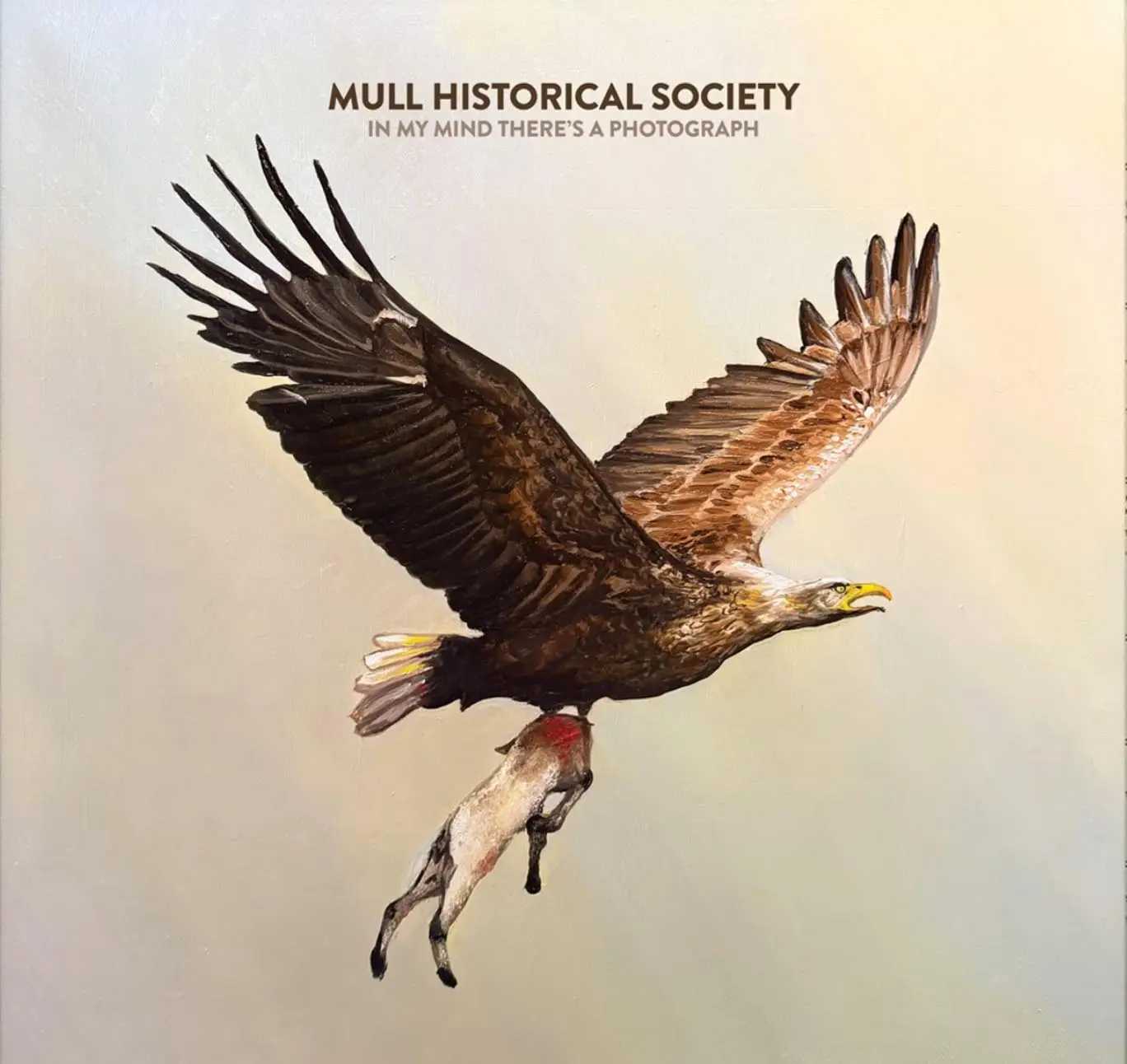
The latest album from Colin MacIntyre, aka the Mull Historical Society, is a follow-up to In My Mind There’s a Room, focusing this time on specific moments captured in photos, but with a similarly literary bent. Each of the 12 songs features a recollection and lyrics from a different author, with a serious bonafide pedigree behind them such as Booker and Pulitzer Prizes.
The concept is fairly simple: take a photograph, provide some thoughts about what it means to you and MacIntyre will fashion a song out of it. Unsurprisingly, almost every contribution is heartfelt, sincere and ripe for poetic reimagining. However, considering the breadth of authorial voices and personal backgrounds, the final result struggles to cohere in the traditional sense and ends up as a bit of a hodgepodge of thoughts and feelings that MacIntyre needs to sort into some workable order. We’re talking memories of 9/11, traumatic upbringings, Middle Eastern conflict, loveless marriages and childhood holidays. And if the content itself weren’t diverse enough, MacIntyre is scooting from the Highlands to Gaza, from Botswana to China, riding the railroads and contemplating the pandemic. It’s a bit much to really take in in under an hour.
Given the deeply personal contributions, it’s understandable that many of the songs skew toward maudlin piano ballads. ‘Cattle Bells’ is probably the worst offender in needlessly tugging the heart strings in an otherwise mundane tale (the strings do some heavy lifting towards the end). Undoubtedly this recollection means a lot to the author, but without the wider context that a long-form piece of writing can provide, it’s simply a snapshot without much to latch onto.
When the personal touches feel lived in, rather than MacIntyre simply regurgitating someone else’s words, the songs come to life and show what this ambitious project is capable of. ‘A Wish We’d Taen Mair’ is the best example, with Len Pennie’s perfectly framed (and relatable) distaste for photos being replaced by the realisation that her mother was right to document those precious moments. Something that can only come with age and experience, and delivered in her inimitable Scots to provide a genuine window into the world she’s describing.
‘Dopamine Eyes’, the contribution from Irvine Welsh, is similarly successful because it avoids making any grand statements in favour of drilling down into the minutiae of a moment in time: finding love during lockdown. It’s easy to reach for the grandiloquent when considering a traumatic event or sweeping, generational change, but the best songs here create miniature worlds where the author’s voice can be clearly felt.
‘We Called It A Lake’ (Yiyun Li) and ‘Hillman Imp’ (Ali Smith) also manage this by keeping things focused, which allows MacIntyre to limit the musical pallette to what’s strictly necessary. Often songs race into a rockier mode (‘Where are the Heroes?’, ‘Midnight Sun’) or slump into treacly nostalgia (‘The Soldier and the Waitress’, ‘Charing Cross Canyon’). The words are uniformly poignant, touching, and clearly deeply considered, but when passed over to MacIntyre he’s faced with the unenviable task of trying to turn those musings into a catchy four minute tune, when perhaps they’d best be kept to the page.
MacIntyre is a prolific artist, with his latest crime novel, An Island Burning, arriving last month and a musical he wrote, Culloden, going into production later this year. A seamless collaborator, this sort of far-reaching concept would be tricky to balance for anyone but MacIntyre pulls it off well, despite the odd stumble.

Comments