
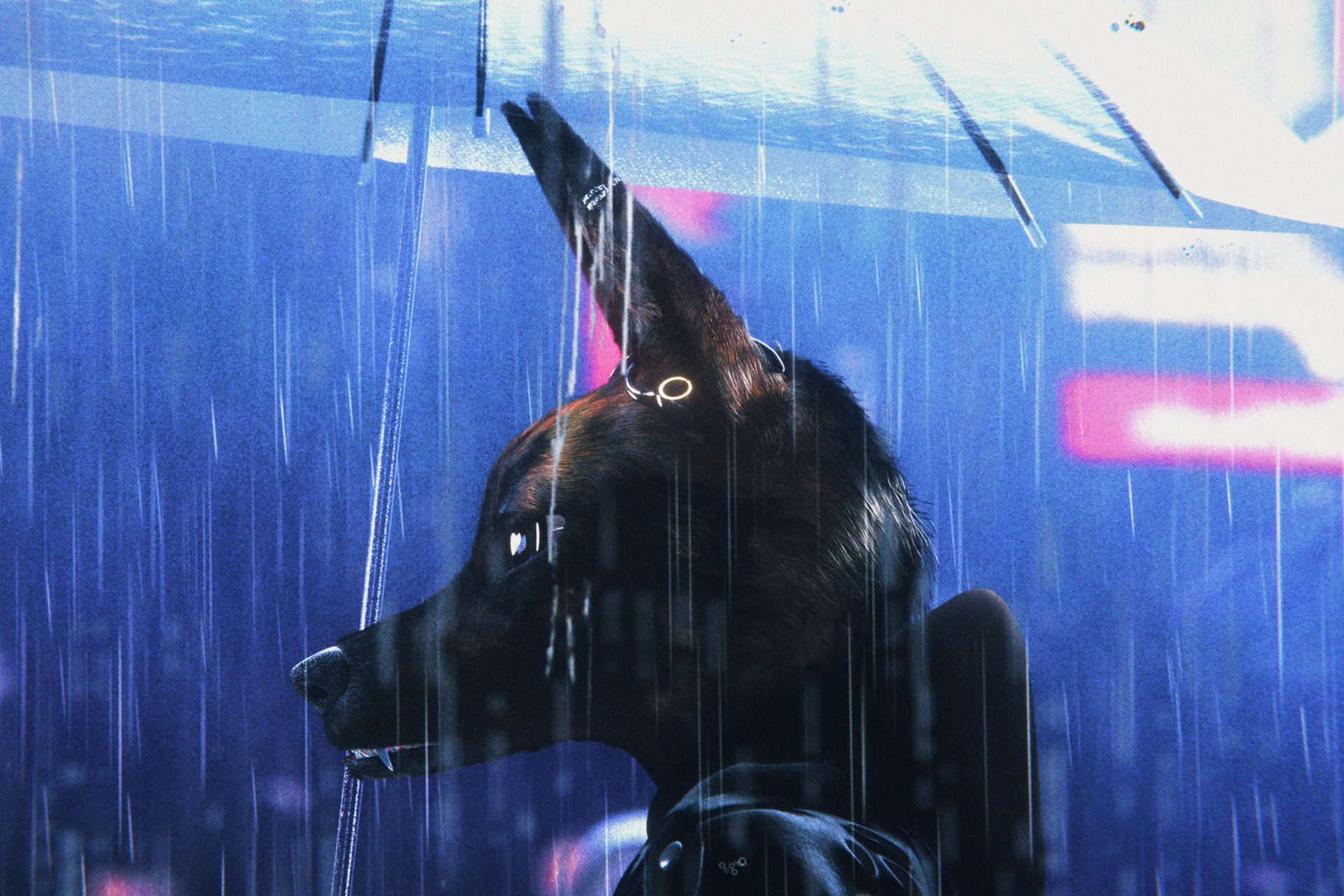
Bouchra is a singular piece of autofiction from New York-based Moroccan Meriem Bennani and Israeli Orian Yani Barki that navigates the semi-estranging impact a young, queer filmmaker’s sexuality has had on her relationship with her mother. It’s an ultra-personal, frank and often witty work that easily avoids solipsism. Oh, and it’s an animated film where all the protagonists are animals, which definitely adds an odd, furry-adjacent spice to the more intimate scenes.
Bouchra (voiced by Bennani), a coyote, is struggling to find inspiration for her next project until she speaks to her mother in Casablanca, bringing up her sexuality as a topic between them for the first time in nine years. This difficult but tender exchange opens the floodgates on a Proustian rush of memories which prove a catalyst for both a new project, and the first tentative steps towards a true reconciliation between mother and daughter. At the same time, she meets a potential new lover in Moroccan lawyer Lamia (Salima Dhaibi).
Bouchra is perhaps as self-reflexive as filmmaking gets. It’s an autobiographical film about a filmmaker making an autobiographical film. It could be infuriatingly naval-gazing, but Bennani’s self-aware script easily extrapolates to the wider experience of queer people from religious or conservative cultural backgrounds, and how they square that with their faith or the attitudes of that community. The issue for Bouchra isn’t her sexuality – she’s entirely comfortable with that – but her mother’s discomfort in talking about it. It’s not even that her mother struggles with it per se, but wouldn’t dream of allowing her wider family in Casablanca to find out. The tension is in Bouchra having to hide a crucial aspect of herself from the people she loves. The film becomes a complicated dance of conversations and film-within-the-film reenactments that can become a little confusing, particularly given the limitations of its aesthetics, but always remain interesting.
It admittedly takes a while to get past the slightly stiff animation, and the occasional dip into the uncanny valley of the generally very humanoid rendering of the animals. There are a few reasons why the filmmakers may have made this unusual choice, aside from it being a thoroughly distinctive decision. Firstly, it allows the blending of the two threads – Bouchra’s ‘real’ life and her cinematic reenactments without the obvious distinctions that different actors would bring.
The animation also erases obvious racial and gendered signifiers. Although both Moroccan, Bouchra is a coyote and Lamia is a bear. There are also lizards, cows, and rodents which don’t correspond to any particular ethnicity. It also offers little clue as to the characters’ gender expression. There are a few hints that Bouchra may present in a tomboyish, slightly masculine way, but there’s little in the conversations she shares with her mother and friends that would make this obvious. There’s a sense that there is both obfuscation and liberation in the choice.
Animation is not an unusual choice for telling deeply personal stories; see Persepolis or Waltz With Bashir, for instance. It’s just rarely been used quite like this. On a thematic and stylistic level, Bouchra is doing lots of interesting things, with its deliberate visual artifice adding another clever layer to its self-reflexive onion of a narrative. Some won’t be able to see past the sex scenes (and some will probably seek it out just for them), but there is a wise and uplifting narrative for those who can attune to its singular wavelength. It does slightly tie itself in knots with its intertwining meta-narrative, but it’s the kind of bold, unique filmmaking that indie cinema can exemplify.
Screening as part of Glasgow Film Festival on Thu 26 Feb & Fri 27 Feb 2026

Comments