
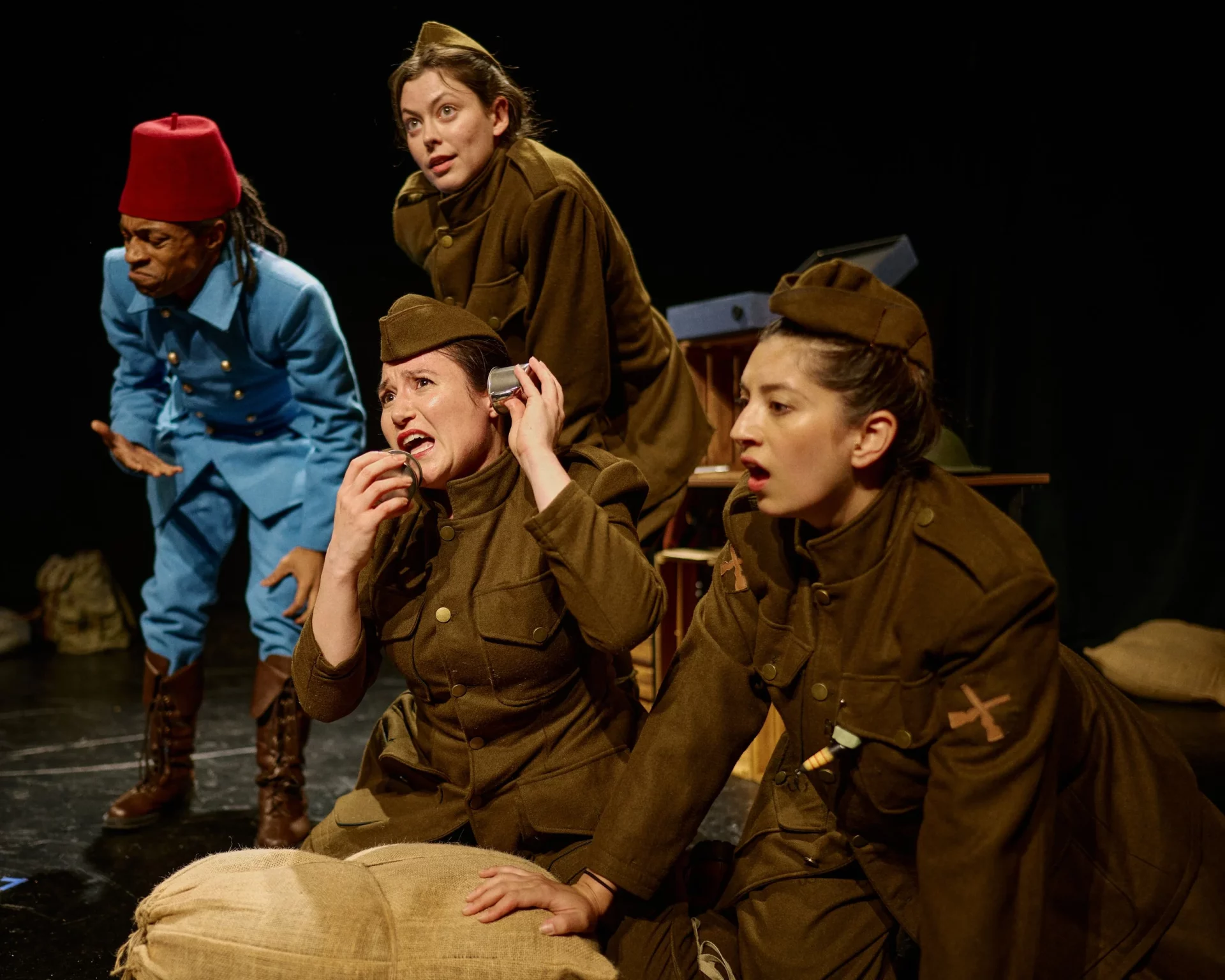
A dugout in Belgium, 1917. A square-shouldered figure is planted front and centre, radiating the limitless confidence of a self-defined leader of men. This is Sergeant Haddock, and he’s an immaculate comic creation, from the top of his brilliantined head to the tip of his much-flourished swagger stick. He’s camp, he’s hearty, he simply loves war; most of all he loves the masculine bearing of the manly men who fight it. And tonight’s a special night in the trenches… because tonight the first Americans will arrive.
Yes, the setting has echoes of Blackadder, but there’s enough that’s fresh and different to set this show apart. In place of the incompetent general in headquarters far away, we have the comparatively lowly Haddock – already famed for heroism and actively looking forward to going over the top. His corporal’s from Senegal, so in this colonial age is forced to fight for France. And the three American arrivals are… well, they’re women, hiding that fact behind hopeless comedy facial hair.
The humour works best when it’s fast-paced and heightened, meeting the absurd premise head-on. And the funniest moments do hit that note: the theatrical swooning, the strapping Sergeant’s mincing run, a convoluted ruse involving a ventriloquised telephone. Some early scenes feel off the pace, and the vocal delivery’s not always as clear as it could be, but once they’ve set the story up it breezes along. The dialogue follows suit: the more blatant the innuendo, the better it lands.
If Darcy Thompson as Haddock is the master of ceremonies, Devon Alexander Young as Corporal Duchamp provides the star turn. He’s sprightly, cavorting, all springy jumps and clicking heels; there’s a plot-based justification for that, which builds to a bravura showpiece that brings the whole cast in. They could sell it more – on the night I attended, it wouldn’t have taken much of a prompt to get the audience clapping along. But Duchamp also embodies the script’s great irony, that his involuntary role as a colonised subject compels him to be there while the women’s assigned place in society would lock them out.
For a while it seems that might be all this is: a serviceable comedy, though not a groundbreaking one. But every now and then the action pauses for a quieter moment – like the boldly extended scene where the American Sam stares into her compact mirror, brushing down her practical mens’ uniform and clearly liking what she sees. As 6am nears and no-man’s-land beckons, these personal stories click cleverly together, sometimes in a moment of bittersweet vindication and sometimes with a punch to the gut.
And despite the ludicrous setup, despite the high farce, each has been seeded craftily enough that the revelation rings true. This isn’t, of course, what the trenches were like – even the sombre endgame is a distinctly modern fantasy. But there’s still deep truth to Doughboys’ questions, about the places life assigns us and the heavy consequence of knowing who we want to be.

Comments