
It used to be universally accepted that there was no such thing as a decent movie adapted from a video game, and with good reason. Throughout the ’90s and 2000s threadbare offerings of cinematic nonsense like Super Mario Bros. and Streetfighter were usually the better of the barrel-scrapings being offered up. The studios clambered after name recognition, taking a concept, a character name, and usually little else, and then trying to crowbar it into a cheap B-movie mold, only to have it ignored or scorned by general audiences. However, among the few films that managed to succeed in taking the form from one medium to another with panache was Christophe Gans’ 2006 take on the Japanese psychological survival horror game, Silent Hill.
Whilst the film of Silent Hill was a moderate success, with Gans and screenwriter Roger Avary having managed to simplify the labyrinthine and convoluted story of the game into a workable treatise on motherhood and sacrifice. The real challenge was always going to be whether anyone could turn it into a successful franchise, particularly considering the sequel game, Silent Hill 2 is still today considered one of the best horror games of all time. It’s only taken 20 years, and a hideously terrible 3D entry, Silent Hill: Revelation in the interim, for Gans to return (sans Avary) and try to tame this behemoth of gaming horror with the wonders of celluloid.
Return to Silent Hill follows the story of James Sunderland (Jeremy Irvine), a depressive, alcoholic artist, broken up and constantly failing to make his appointments with his therapist. He’s in a right wee dwam about his ex, Mary (Hannah Emily Anderson) but while drunkenly crying about it one night, he notices she’s left him a letter, asking him to come back to their ‘special place’ which he knows to be the town of Silent Hill. Upon arriving there, he finds the place a fog-covered derelict mess, with ash raining from the sky. And before long he’s running from acid-spewing contorted monstrosities and swarms of flesh-eating insects as the town cinders supernaturally into a familiar rust and fire skeleton of what it was before. Will he survive to find Mary? Who are the strange other women he meets there, who bear an uncanny resemblance to her? And will any of this make sense by the end as he follows the trail of clues around the accursed streets?
It’s rather a shame that for the most part there are solid intentions and good ideas at play in Return to Silent Hill. The original game’s story, by Hiroyuki Owaku, is generally regarded as a brilliantly layered piece of psychological mystery, as the player uncovers James’ story and puts the pieces together to build to the game’s ever-more inevitable and bleak finale. The trouble being that it’s hard to put what normally amounts to 20 hours of game story, told in ways often oblique and deliberately uncanny, into 100 minutes or so of film. It’s not impossible, as Gans showed in the first film, but here perhaps as a result of being without the guiding hand of Avary at the script, the film flounders from well known location to location without ever feeling like there’s a good reason. It’s all well and good to have rendered the apartment block, or the hospital, or Lakeview Hotel in perfect detail as a set, but if there’s no pressing emotional reason to be there, it just feels flat.
As a result, the film starts to get kind of dithery after the first 20 mins, feeling aimless and not helped by constant flashbacks to James and Mary’s life together before this dark episode. While some of them are helpful, the newly imagined subplot about Mary being part of a cult of weirdos might well fit the Silent Hill brand, but it detracts from this story in ways that only hurt the narrative momentum. Worst of all, it feels like Gans has simply lost his bottle with this film. Whether by his own insecurities about whether the film would make sense, or through insistence from above, the film feels the need to explain almost everything in painful detail towards the end, removing the subtlety that made the original story so thoughtful and interesting.
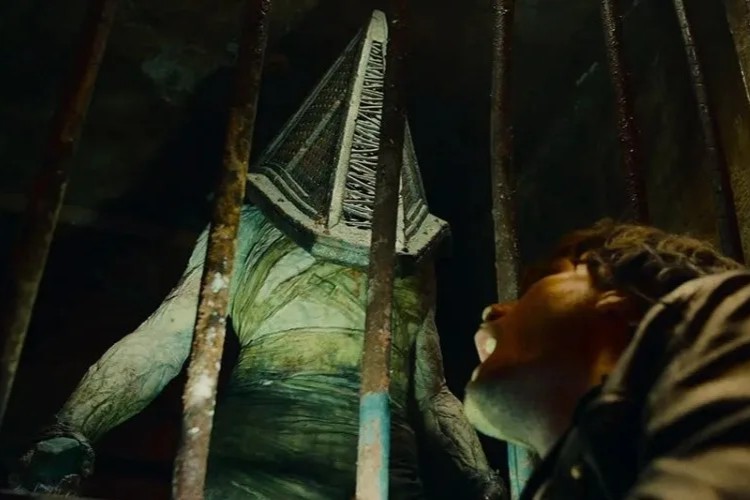
That’s not to say it’s all bad. The creature designs and costumes look mostly good, there’s a nice bit of gore dotted around, and there’s some nicely tense scenes. Irvine and Anderson really do commit to their roles, and most of their interactions, despite the odd bit of cliched dialogue, actually feel perfectly acceptable if not at all special. There’s also some great work from Evie Templeton as Laura, a small child hanging around the town, annoying James in a nicely creepy and uncanny fashion. Yet it all feels rather like it’s there simply because it ‘was in the game’, not because it fits this story perfectly.
In the end, what’s left isn’t a disaster. It’s an occasionally pretty, occasionally atmospheric retelling of a great story by lesser hands. Horror movie fans unfamiliar with the game will probably have a decent time with it, and it’s still far from as bad as most video-game adaptations. But most people will just walk away scratching their heads, wondering why people talk so lovingly of this story, when the film barely even raises itself above the parapet of mediocrity. Those hoping to enjoy a true Silent Hill experience would be far better off seeking out the recently remade and updated version of the game upon which this movie is based.
In cinemas nationwide now

Comments