
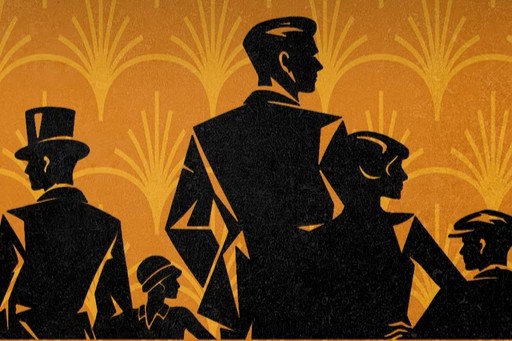
The Great Gatsby is an interpretation of the timeless story about crushed hopes and dreams. Set in 1920s Long Island and New York City, it follows Jay Gatsby, a hopelessly romantic nouveau riche who built a fortune through shady business practices to impress his first love, Daisy Buchanan, and regain her affection. He hosts lavish parties that rarely hurt anybody: the alcohol doesn’t end, the fun is a given and the rules are bendable, all in the hope of seeing Daisy — who lives with her husband across the bay.
The story of Jay Gatsby has been told in many different ways: classic, experimental, forwards and backwards. This particular production by Key Players emphasises the monologues, giving the characters room to transmit their point of view. You feel like the actors are letting you in on some sort of secret that you are not supposed to discuss with anyone.
The adaptation by Sophie Key is centred on the conflict between old and new money ways in a rapidly changing America. The difference of opinions is there to stay and the disdain is palpable. The play also pleasantly points out the limitations of women’s power of choice in the fundamental things despite their overall liberation in the less important details. They can choose to wear shorter dresses, but not demand respect from ‘the other sex’. They are welcome to the late-night parties, but they are excluded from the serious men’s talk. They choose how to love, but they pay too high a price – as high as their life – for their choice. Set more than a century later, the play makes you question how much has really changed.
For book lovers, the performance stays relatively close to the original, bringing back the feeling of revisiting a favourite book and stopping at its most memorable scenes.
The cast competently delivers the text and has fun with it along the way. They act from ‘a maximum return, minimum effort’ standpoint, checking off all the boxes of the 1920s Roaring Twenties — they dance the Charleston, sip champagne from the so-popular-back-then coupe glasses, show off colour-blocked shoes, and bob to the jazz tunes of those times.
Ollie Gardner gives Gatsby a naive yet resolute portrayal of a man who can’t forget a woman, while Chloe Porter-Twigg stands out as Myrtle Wilson, an adorably annoying seeker of more the beautiful things in life. Georgia Tout as Jordan Baker is noticeable for her accurate depiction of an ambitious young woman whose values are yet to be lost.
In terms of staging, the venue has this old-school feel of a classic raised stage that adds to the atmosphere — high ceiling, walls decorated with small wooden ornaments, the narrow stairs leading up to it.
Decorations-wise, the actors do so much with so little: a few chairs and glasses are efficiently moved on and off stage, while a screen behind them shifts to reflect each new setting. The play is a clear example of making the most out of the space and decor within it.
Key Players’ The Great Gatsby is not a groundbreaking piece of theatre, but it delivers an engaging depiction of high society that is conflicted, at odds with itself and with everyone else, and never quite satisfied.
The Great Gatsby has finished its run

Comments