
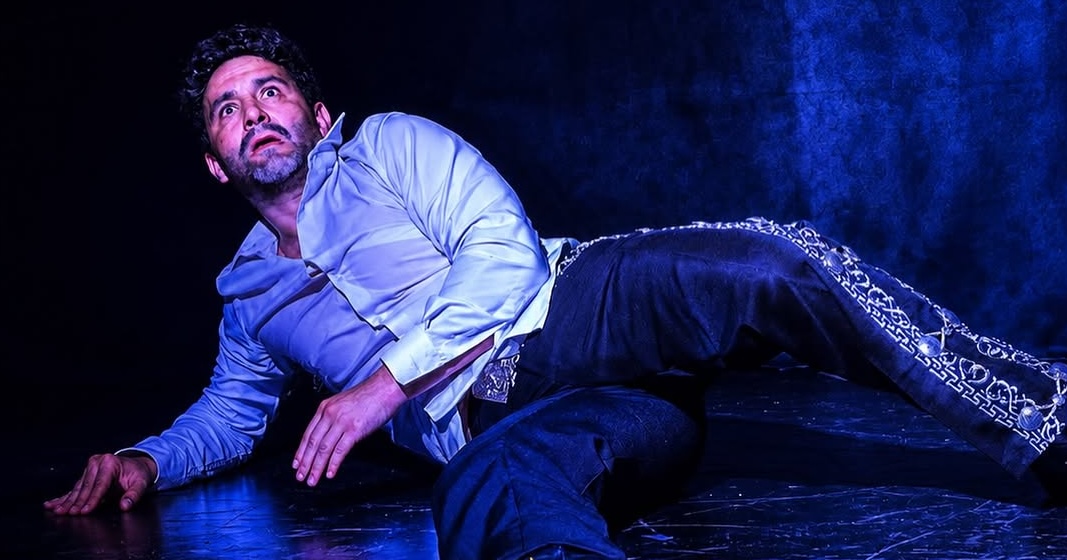
There’s nothing the Fringe loves more than an exploration of performance itself, and the opening of this solo show – where the proud but vulnerable Rafael reminisces about the tiny audiences he’s sometimes played to – feels almost custom-written for Edinburgh in August. But we soon learn we’re in the presence of a star, a mariachi singer who once wowed multitudes with his commanding, dramatic, distinctively Mexican style. The fame’s come at a cost, and as his last song approaches, he has some thoughts to share.
I know little about Mexican culture, so I can’t judge how authentic Eduardo Enrikez’s portrayal truly is, but the picture he paints is a vivid one. On stage, Rafael is proud to the point of arrogance, strutting and posing with formidable confidence and intent. When he sings, Enrikez pairs emotion with macho restraint, hinting at powerful forces held thrillingly in check. And Rafael has a lot to feel emotional about: we hear how his music both found and won the woman of his dreams, only for the relentless call of fame to tempt him slowly away from happiness.
But that’s the show’s only fully developed theme, and I’d thoroughly absorbed it about halfway through. Regret is poignant; repeated regret can feel self-pitying, and in time I grew impatient for the story to move on. I’d have loved to hear more about the flip side of the coin, of everything he said “yes” to when he said “no” to family life. He touches on interesting ideas – the electric danger of a live performance where every flaw is on display – but doesn’t explore them thoroughly enough to explain the choices he’s made.
Perhaps the use of language adds to that effect. The narrative’s structured around a particular song, El Rey (The King), which Rafael often references and sometimes sings extracts from. The script does translate selected lines, and a lot of the meaning’s conveyed by the vocal performance alone. But it still feels like there are resonances and layers within the lyrics that an English-speaking audience is destined to miss – in a way I found more distancing than culturally intriguing.
The tone shifts markedly towards the end, and we finish with some neat circularity: lines we skipped quickly past at the beginning gain added meaning when we hear them again. The visual motifs work too, as Enrikez gradually removes his stunning costume to signal he’s reverting to the man underneath. And when that final song does come, it bears all the gentle power and profound emotion the story’s set us up to receive. So, the show as a whole could use a little rebalancing, but I’m sure this won’t be the last we hear.

Comments