
Never let it be said that modern horror lacks the ability to surprise the viewer. Even in an effectively creatively moribund subgenre like the zombie flick, the latest in the 28 Days Later universe features several scenes that come so far out of leftfield that even the most jaded connoisseur will be kicked awake. Whether all this imagery hangs together is another matter, but writer Alex Garland and director Nia DaCosta certainly remember that the infected are the least interesting part of the franchise.
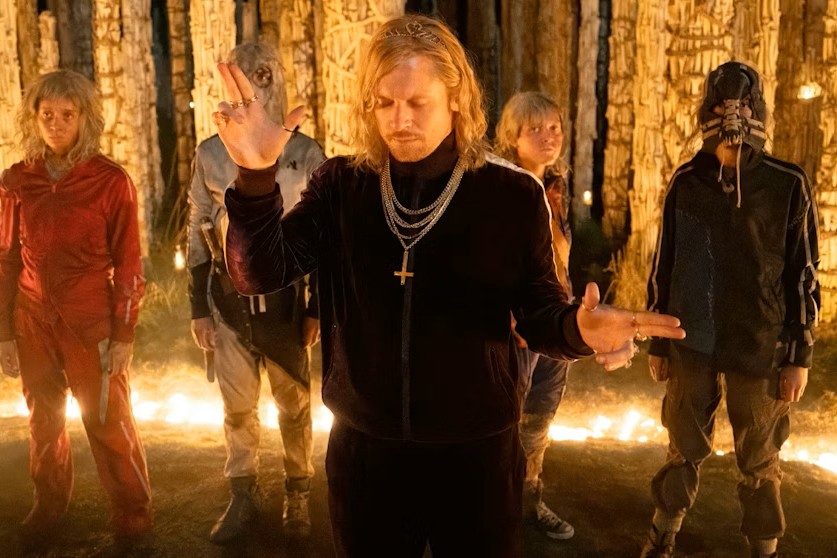
The Bone Temple picks up where Danny Boyle’s 28 Years Later left off. Young Spike (Alfie Williams) has been saved from the infected frying pan and tossed into the psycho cult fire, as he’s forced to fight for his life to join the ‘Jimmies’, the be-tracksuited, Savile-inspired Satanists who roam the land bestowing their warped ‘charity’ on all they encounter. Meanwhile, the solitary Dr. Ian Kelson (a phenomenal Ralph Fiennes) maintains his bone temple, Britain’s largest memento mori, while rocking out to classic ’80s vinyl and maybe, just maybe, uncovering the lost humanity in terrifying Alpha infected Samson (Chi Lewis-Parry) through industrial quantities of pharmaceuticals.
DaCosta’s (Candyman, Hedda) has no problem picking up Boyle’s baton and visually, The Bone Temple is perhaps more striking than its predecessor. Like Boyle’s film, it’s essentially two separate narratives. But whereas 28 Years Later played these out chronologically, each involving Spike’s relationship with one of his parents, The Bone Temple plays both strands simultaneously until they meet in a firey climax. Here, both of Spike’s surrogate fathers take certain stage; Dr. Kelson, representing science and reason, and Jack O’Connell‘s ludicrous but lethal Lord Sir Jimmy Crystal, representing warped faith and blind belief.
Both strands are tremendous, if not entirely tonally cohesive; although both hammer home the point that looks can be deceiving. Kelson’s narrative is weirdly peaceful, even wistful at times. He drugs Samson with morphine, which the massive infected turns out to love. Before long, Kelson is regaling his blissed-out new chum with philosophical monologues, or leading his pal in a happy dance to Duran Duran’s ‘Rio’. Despite his orange skin, stained with iodine to ward off the Rage virus, and the fact he has his own personal ossuary, he’s kindly and wise and may well be on to something regarding a treatment for the disease.
Sir Jimmy on the other, may look ridiculous, but he and his acolytes are far more dangerous than the infected. A scene of ‘charity’ carried out by the Jimmies on a luckless family in a barn is perhaps the most brutal scene of the four movies so far. O’Connell’s performance is much broader than Fiennes, but he’s unfailingly watchable as one of the most despicable characters in recent memory. He even finds a measure of empathy for a lost boy whose entire world view was twisted by the original outbreak occuring when he was eight. Not just in the collapse of society itself, but in the mythology he’s built for himself from the debris of memories, symbols, and cultural references left behind.
Thematic cohesion aside, until the two men meet in an utterly bonkers and wonderful finale that may just about be the most singular of Fiennes’ long career, the film is admittedly a little disjointed in pace and tone. Also, as much as this second trilogy is clearly the overarching story of Spike, The Bone Temple largely happens to the young man, rather than him being a proactive participant. Not that Alfie Williams gets completely subsumed, but Fiennes and O’Connell own the film so completely that everyone else rather trails in their wake.
But it’s just such a brilliant time. Alternately hilarious, nauseating, hopeful, and touching, it continues the recent run of unexpectedly great sequels, like Smile 2 and Final Destination: Bloodlines. It’s also as blood-soaked and intense as you could wish for from a mainstream horror. Really though, it’s for its frequent inventive, gonzo, remarkable individual moments that The Bone Temple will be remembered, and a good part of that is down to Nia DaCosta’s incredibly assured hand that knows when to show restraint and when, to quote Dr. Kelson quoting Nigel Tuffnell, to ‘turn it up to 11’.
In cinemas nationwide now

Comments