
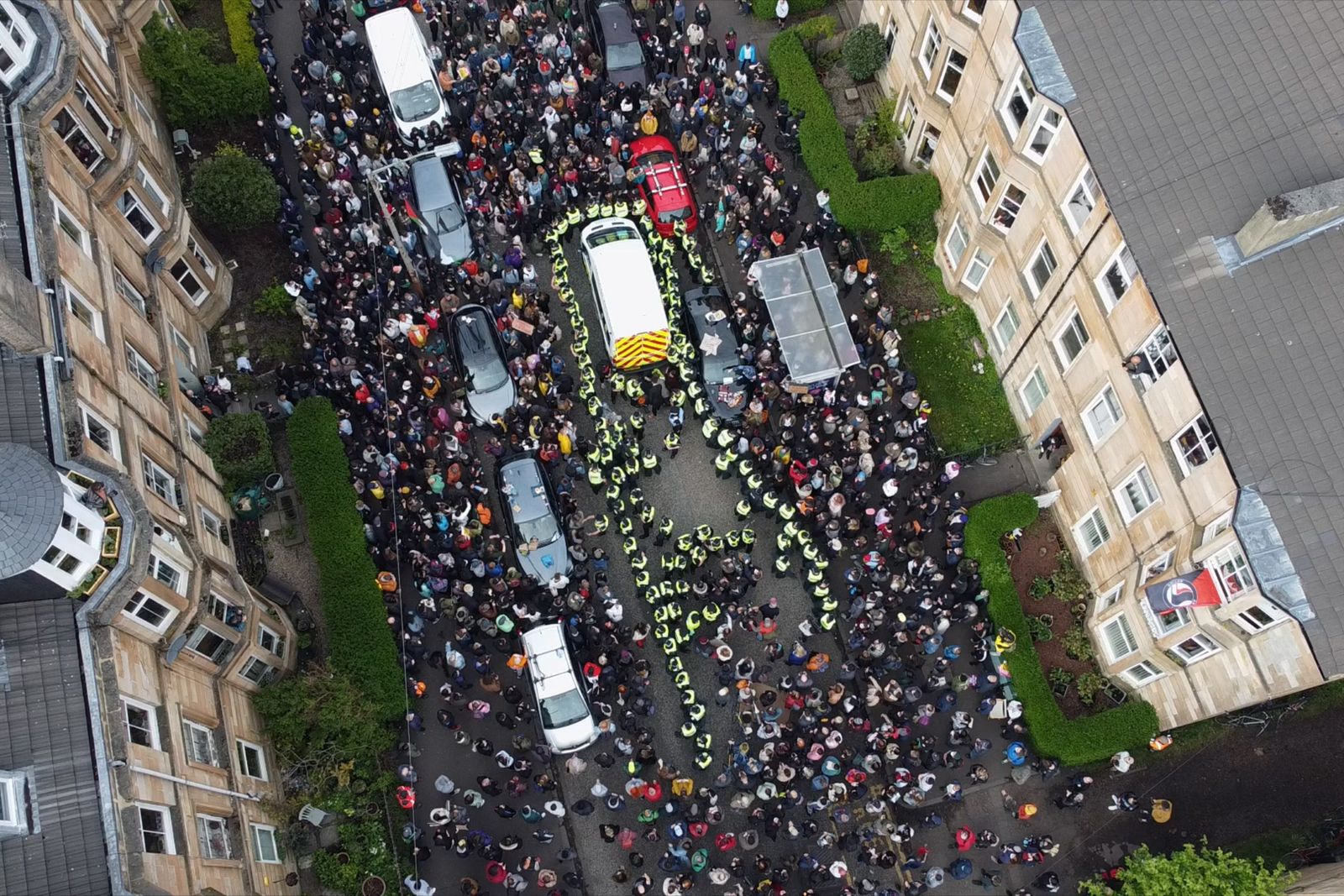
It hasn’t been long since the Berlinale, where Wim Wenders suggested that art and artists are, ‘the counterweight to politics’. That films, in a sense, stand as the opposite of politics. The statement, echoed across the festival, quickly became a kind of framing device for its programme. Yet it is difficult not to see a confusion at its core. What Wenders seems to reject is not politics as such, but a very specific version of it: the institutional, strategic, and often cynical realm of politicians and power. What it overlooks is the more pervasive form of politics that structures everyday life, the very space from which cinema so often draws its material. Luckily, on this side of the canal, the Glasgow Film Festival appears far less hesitant about this entanglement. Opening with Everybody To Kenmure Street (2025), the festival foregrounds not only the proximity between cinema and politics, but also cinema’s role in witnessing, documenting, and shaping it, across past, present, and future.
Directed by Felipe Bustos Sierra, Everybody To Kenmure Street revisits the 2021 immigration raid in Glasgow’s Pollokshields neighbourhood, where local residents gathered to prevent the detention of two men by the Home Office. In 2026, as increasingly hostile policies towards asylum seekers are once again being proposed, the film resonates with renewed situation. Through a careful combination of reenactment and crowd sourced footage, Bustos Sierra does more than document a moment of resistance. He situates it within a longer historical continuum, drawing connections to the shipyard occupations and to Scotland’s entanglement in the slave trade. What emerges is not simply an isolated act of solidarity, but a political tradition embedded in place, memory, and collective identity. In doing so, the film also performs its own political act: it transforms an ephemeral moment into a shared memory of the community, one that can be recalled, mobilised, and reimagined.
If Everybody To Kenmure Street demonstrates how collective action emerges from the everyday, Dead Man’s Wire (2026) turns to the inverse movement. Inspired by the 1977 Indianapolis hostage crisis, Gus Van Sant’s film traces how a private act escalates into a national spectacle. Its multi-narrative structure attempts to situate the kidnapping within a broader social and political context, moving beyond the perspective of the perpetrator. Yet, unlike the spatial and temporal layering of Elephant (2003), where its multi narratives generate a sense of systemic violence, the multiplicity here feels more schematic than lived. The secondary perspectives, rather than deepening the social texture, often function as explanatory devices, overshaped by the central relationship between the kidnapper, played by Bill Skarsgård, and the hostage, played by Dacre Montgomery. The intense and increasingly ambiguous dynamic becomes the film’s emotional core.
A more expansive exploration of this interplay between the structural and the intimate can be found in Sound of Falling (2025). Directed by Mascha Schilinski, the film traces four generations of women across the twentieth and twenty-first centuries, all connected to a single farmstead in the Altmark region. Moving nonlinearly between the 1910s, 1940s, 1980s, and 2020s, it constructs a dense temporal fabric in which trauma is neither contained nor resolved, but instead lingers within spaces and bodies. Politics here is rarely named, yet constantly present. It resides in the conditions that shape each life, in the constraints placed upon identity, and in the transmission of experience across generations. As different temporal layers begin to echo and overlap, the film suggests that politics is not something external to lived experience, but something that permeates it. If this is the case, then the idea of cinema as “counter politics” becomes difficult to sustain. To stand outside politics would require either a withdrawal from social existence altogether, or the privilege to deny its effects. Neither position is available to the subjects of Schilinski’s film, or let’s be honest, most of use in the modern capitalist world. In this way, the film extends the notion of “small politics”, showing that politics is not only enacted in public spaces, but also negotiated within the most private ones.
This tension carries into Satisfaction (2025), directed by the brilliant Alex Burunova. Following the relationship between composers Lola, played by Emma Laird, and Philip, played by Fionn Whitehead, the film unfolds during a trip to a remote Greek island, where they encounter Elena, played by Zar Amir Ebrahimi. What initially appears as a story of artistic and emotional entanglement gradually reveals a more complex structure of control, dependency, and self perception. Here again, politics does not manifest through institutions or collective action, but through intimacy itself. The shifting dynamics between the three characters expose how power operates within personal relationships.
Taken together, these films suggest that the distinction between ‘big’ and ‘small’ politics is less a division than a continuum. Institutional power, historical structures, and personal experience are not separate domains, but interconnected processes that constantly shape one another. Rather than standing in opposition to politics, cinema reveals its textures, contradictions, and consequences. If anything, festivals like the Glasgow Film Festival demonstrate that films do not offer an escape from politics, but a way of seeing it more clearly, and perhaps of imagining how it might be otherwise.
All screened as part of Glasgow Film Festival 2026

Comments