
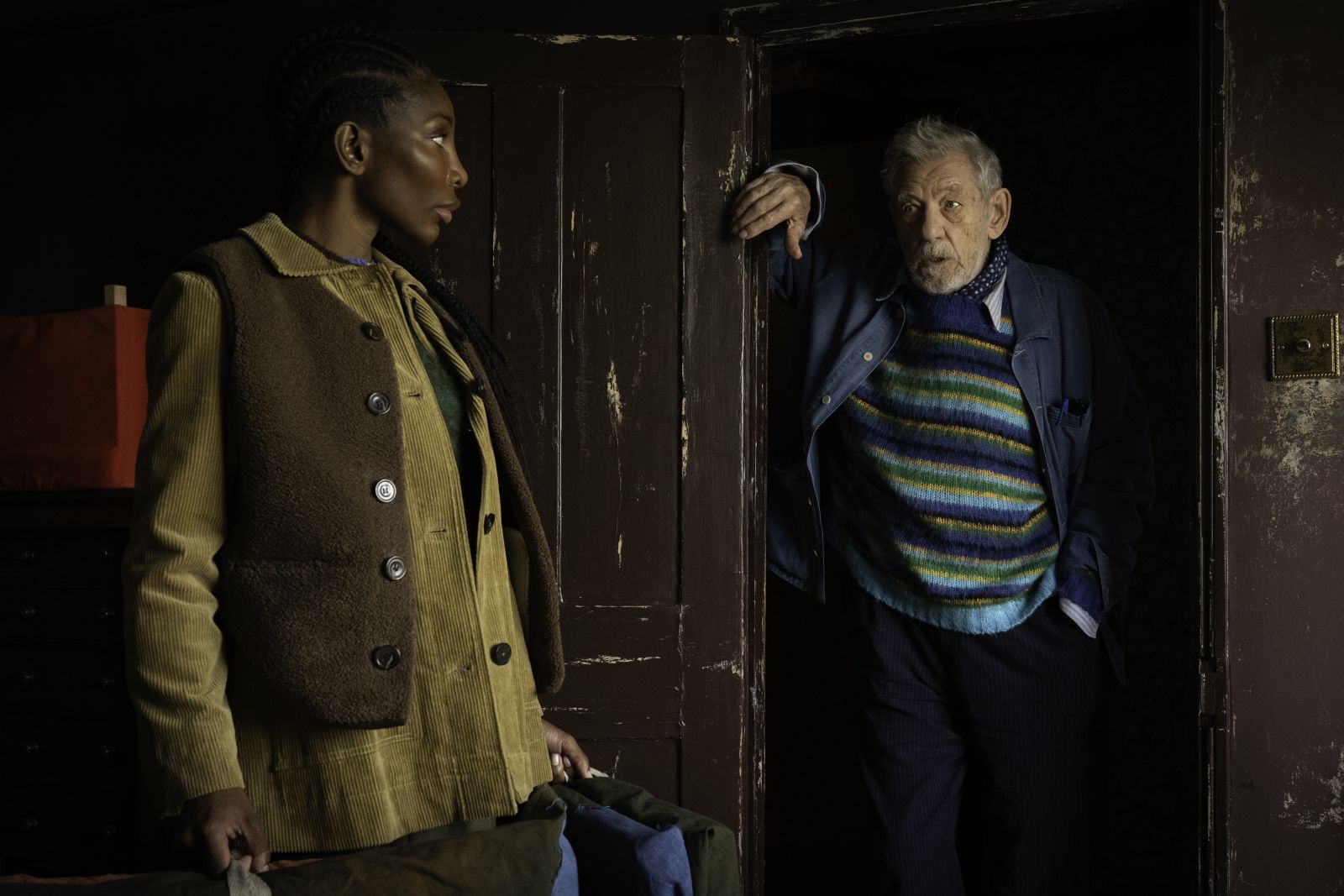
British actors have long been celebrated, at least within the English speaking world of cinema, for their theatre backgrounds, for better or worse. Among them stand the Dames and Dirs, with Ian McKellen foremost among them. Yet the face of British performance is always shifting, as new talents arrive to bring fresh flavours to the craft, among them the star of I May Destroy You, Michaela Coel. It is the tension, chemistry, and eventual showdown between these two powerhouse performers, each shaped by a very different tradition, that gives Steven Soderbergh‘s new film, The Christophers, its singular charge.
The film follows Lori Butler, played by Coel, a young and gifted painter and restorer, who is approached by her former classmate Sallie Sklar (Jessica Gunning) and Sallie’s brother, Barnaby (James Corden). They are the children of Julian Sklar (McKellen), a once celebrated painter who has retreated into self-imposed seclusion and, perhaps inevitably, been cancelled. Sallie and Barnaby want Lori to forge a new, third series of ‘The Christophers’, using a collection of unfinished canvases Julian has buried somewhere deep within his home. The first two series made Julian a star of his generation, and the siblings dream of the fortune a third could bring them.
McKellen needs little introduction. From ‘You shall not pass!’ in The Lord of the Rings to Magneto in the original X-Men films, his is a voice that can move freely between a low, dangerous murmur and a thunderous, soul-shaking eruption. He handles dialogue with a poet’s precision, finding meaning in rhythm and breath, and his body language carries the full weight of whomever he inhabits. In The Christophers, he plays a character who feels close to one version of his own public persona: a sharp tongued, old bisexual man. Julian was once an icon of a certain idea of equality and progressiveness; he has since become controversial, partly for no longer fitting neatly within the demands of contemporary online political correctness, though the film wisely never specifies exactly what condemned him. There is a showiness to McKellen’s performance that recalls the fabulousness of the 1960s, and yet that same showiness is also a form of armour, the defence of a deeply insecure artist, haunted by regret and quietly aware of how his sharp tongue could wound, even without meaning to.
Coel, who began her career with plays such as Chewing Gum Dreams in 2014, takes the opposite path. Her face is often difficult to read, and that opacity feels entirely deliberate. The lessons life has handed Lori surface in her eyes rather than her expressions, painting the inner world of a disheartened artist in strokes that are ambiguous and open, inviting interpretation rather than declaring it. This ambiguity gives Lori’s repeated changes of heart over the forgery a sense of genuine, lived complexity. She is no longer the traditional woman in this kind of dynamic between admirer and artist, passive, dazzled, moved by forces beyond her. Instead, Lori is always watching, always judging, quietly taking measure of every character around her, and more often than not, quietly taking control. It is this quality that makes her the true driving force of the film.
When that cool, unreadable stillness meets the dramatic colour and precision of McKellen’s performance, the shifting power between them is already present and already playful. Coel’s quietness keeps the film’s emotional life soft and sincere, holding it back from the edge of sentimentality.
Alongside this powerful two hander, Gunning and Corden form a comedic duo treated with little mercy by Ed Solomon‘s witty screenplay, a pair of grasping siblings whose existence nonetheless provide Julian with much of his sharpest, most enjoyable cruelty. With David Holmes‘ perfectly-timed score and Soderbergh’s characteristic precision in steering the central relationship, The Christophers becomes a deeply satisfying journey into the truth of art, where authorship, authenticity, and performance are never as easily separated as they first appear.

Comments