
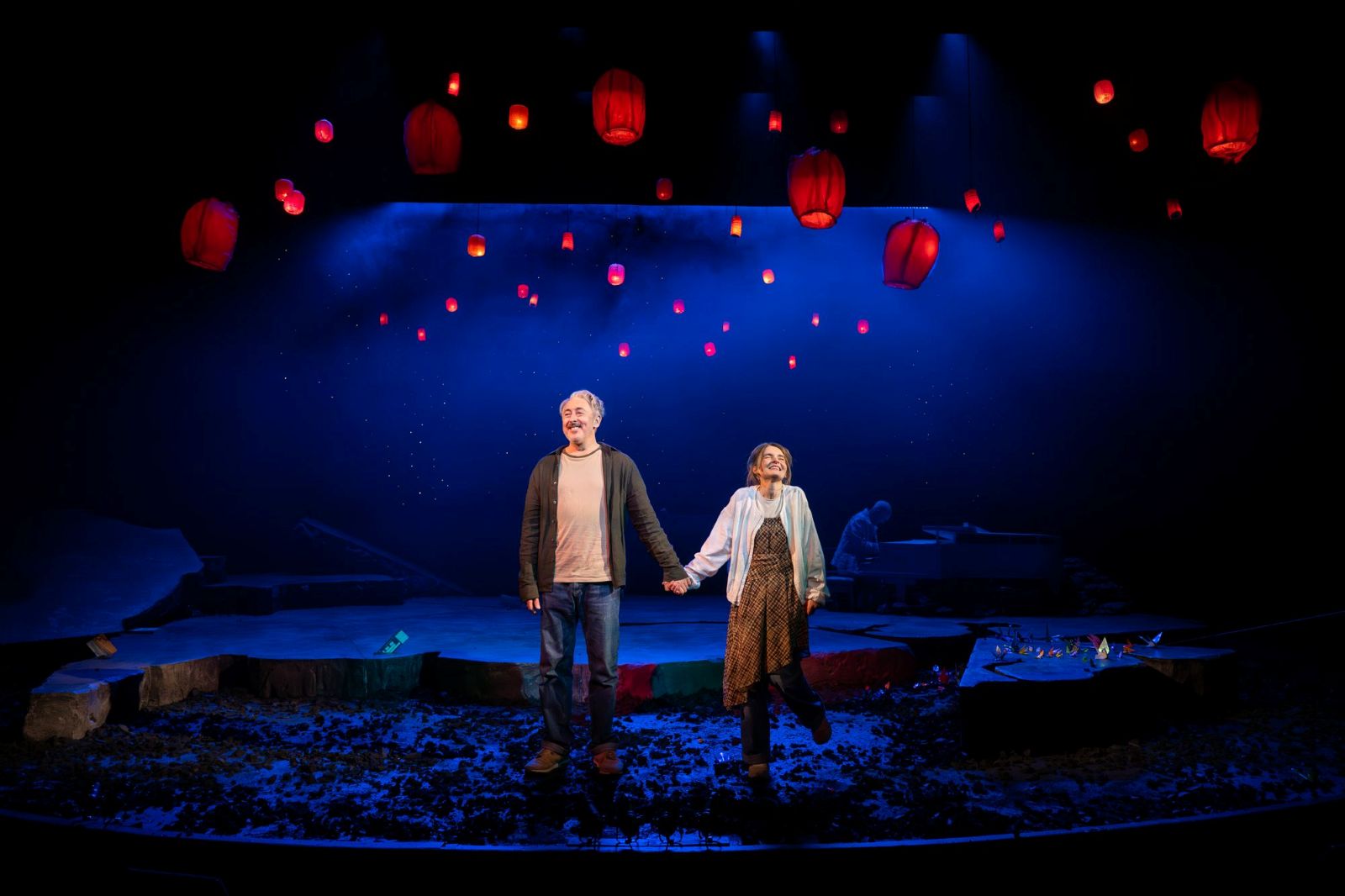
It was always going to be a gamble casting Pitlochry’s man himself, Alan Cumming, alongside Shirley Henderson, as neither are associated with musical theatre.
Those that saw the 2024 Traverse production hold it close to their souls and the casting of the leads that are 30 years older (sorry Alan) than the originals was potentially troubling. But in this reboot of the spectacularly moving, and Fringe First winning, show they’ve pulled it off. Big style.
More than that, it moves the show on. Not just in the casting but with a bigger budget, and a bigger stage than the tiny Trav 2, extra specialness is possible.
The other significant advantage is that Pitlochry, along with Dundee Rep, have invested in a much greater spectacle than could ever have been possible on the Fringe. The investment pays off in shedloads with all of the big moments challenging the lacrimal glands.
Andrew Panton’s brilliant direction has given the show more magic. And the development of the show, from is original manifestation, is evidently to its benefit, with these older actors improving the storytelling. The fact that they are both tremendous helps too.
Shirley and Alan have known one another for forty years and that’s immediately clear in the chemistry they establish from scene one of this beautiful grief-laden production. But let’s dwell on the musical and comedic elements of the show, rather than the tragic bit, because that’s spoiler-ridden.
The show opens when “He” (Cumming) is rummaging through a box full of memories. It starts the ball rolling on the story of his love affair that started between neighbours. “He” was overcoming a break up by playing Radiohead records at full volume “She” (Henderson) doesn’t like it and places a postcard under his door telling him to, ‘Shut the fuck up’. This is the first piece of paper that has significance in their relationship. It’s followed by origami figures, books, Pizza Express menus, Chinese lanterns, letters and George Wylie’s boat. Each is important in telling the story and it’s further relevant when we learn that “She” is a journalist and “He” a bookshop employee with a lust to write a novel (yup, paper). Half of it is in the box.
Their romance is funny; she’s kooky, he’s clearly love struck and Andrew Panton’s direction really brings their relationship to life.
The star of the show, though, might actually be the sadly deceased writer Olly Emmanuel because the script is electrifying. It bristles with humour, pathos and downright tearjerking brilliance.
It’s a play with music really, rather than a musical and the ten or so songs (some just little shards of light) are gorgeously composed (by Gareth Williams), written and performed by MD Gavin Whitworth who has a moment of greatness in his solo number. Pin drop silence.
The design is beautiful by Ana Inés Jabares-Pita with sympathetic lighting and sound design. Really there is nothing to fault in this glorious production.
It’s an paradoxically laugh-out-loud study in grief and when the mood changes three quarters through, boy does it change.
Rarely, if ever, can this celebrated stage have staged such a joyous masterclass in theatre. The resulting standing ovation, by every single member of the audience, is not only deserved, but expected.
Paper will go on to even greater things in future years so this is your chance to say, ‘I was there’ in the Theatre in the Hills.
As my companion said as we exited the auditorium, with tears running from her eyes ,’This is why you go to the theatre.’
A production of utter class that truly deserves all the plaudits that will follow.
A History of Paper is at Pitclochry Festival Theatre until Sat 12 Sep 2026

Comments