
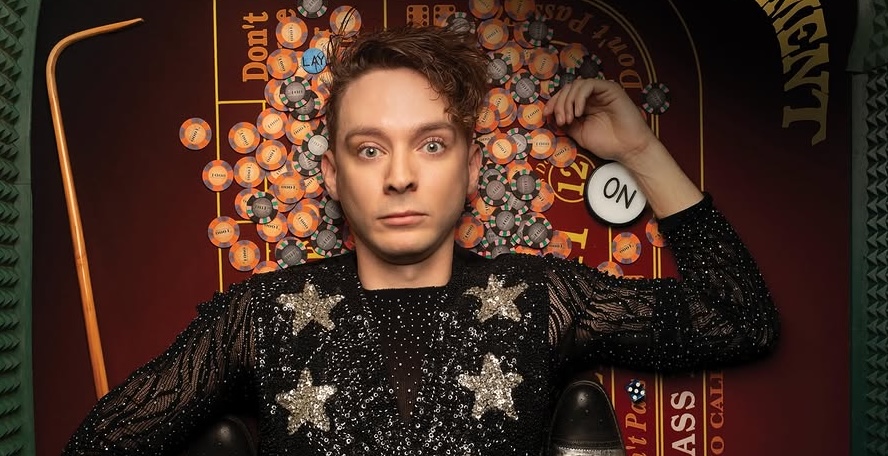
The lights click off, and we’re dropped right into an internet livestream with infomercial DNA. An excitable man cranks his voice up an octave as he exhorts us to call in, to send a message, above all to leave a positive review. This is Tom, high-octane gambler and self-identified twink, and he’s here to sell us – for a low, low price – the secrets of being lucky. But there are noises off, then voices too, and we slowly come to realise that Tom’s world of bright lights isn’t all that it seems.
Playing the percentages is crucial to any gambler, and it’s the theme that weaves together the converging threads of this show. In blackjack, if you play with skill, you’ll win 49% of the time – but the casino wins 51%, and that tiny edge makes all the difference. The gap between 51 and 49 is crucial in another context too, and so Tom’s excitable patter contains a truth more valuable than anything he knowingly sells.
Playing Tom, Tom Stilwell is wide-eyed, expressive, mobile-faced; he has the TV presenter’s trick of staying frothily on-message however much he’s cringing inside. Happily for our sanity though, both the salesman persona and the bubbly background music are soon turned down. While the likeable brightness remains, we see well-judged vulnerability too, as Tom explains how adults’ love of gambling shaped some oddly happy childhood memories but also laid foundations for long-term pain.
The scene Stilwell sets is vivid, and though he’s sitting alone at a card table he’s not the only presence on the stage. As other people pass through the story, he builds impromptu puppets to represent them, which end up arrayed on the table like a kind of bohemian honour guard. I won’t spoil the details – this is one of the wittiest and most creative aspects of the show – but it’s amazing how much character he can build from an ordinary object and a pair of googly eyes.
The one significant flaw is that the narrative stops more than it ends – the conclusion’s dramatic, but lacks a sense of completion. The show’s based on a true story and the next chapter’s still being written, but we expect more closure from theatre than we do from real life. Still, there are important messages about the danger of letting others have an edge over you, and it’s a sign of how much we connect with Tom that we care whether his luck might hold. This rush of a show may not make you rich… but you’ll definitely walk out a winner.

Comments