
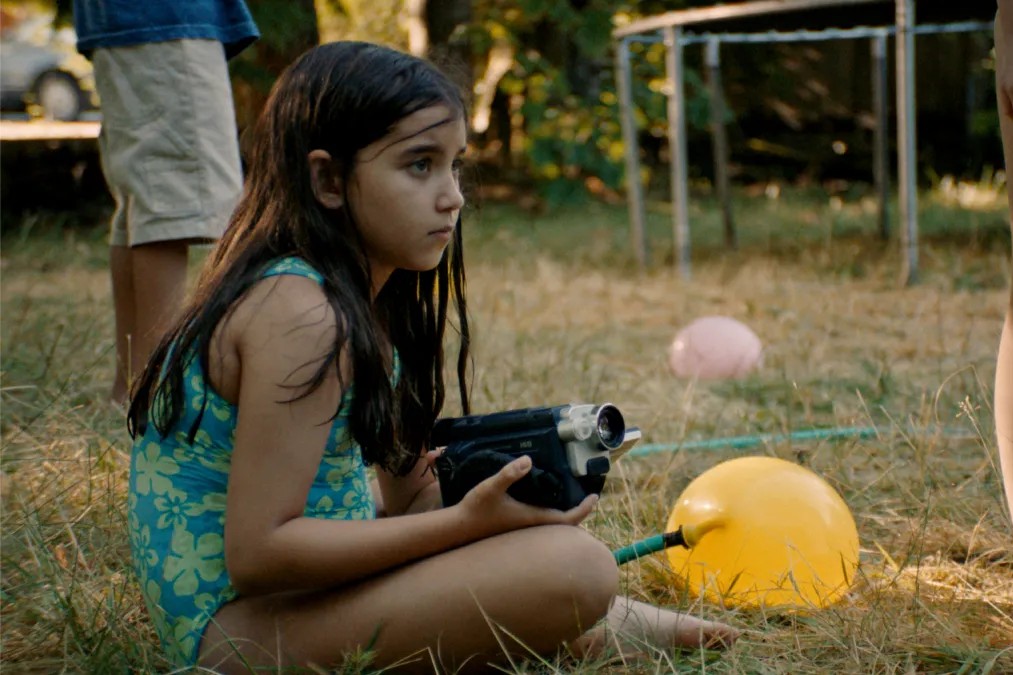
When eight-year-old Sasha (Eylul Guven) wanders through a seemingly deserted bird museum with her family, accompanied by the distant voice of a documentary describing the blue heron, Sophy Romvari‘s Blue Heron immediately establishes an uncanny atmosphere. The sequence recalls the estranged, almost extraterrestrial quality of Apichatpong Weerasethakul‘s Memoria. Although Sasha is surrounded by her siblings, it is the emotional absence of her troubled older brother Jeremy (Edik Beddoes) that quietly haunts the room.
That sense of estrangement continues throughout Romvari’s semi-autobiographical debut. Set during a late 1990s summer on Vancouver Island, the film captures childhood through humid skin, lush green landscapes, and long days that seem suspended outside ordinary life. Yet this is not the nostalgic summer often found in coming-of-age cinema. Beneath its warmth lies a persistent sense of instability. The film’s later shift to an adult Sasha, now a filmmaker attempting to understand the events of those summers, transforms what initially appears to be a recollection of childhood trauma into an investigation of memory itself.
In attempting to recollect fallible memories and represent them in a form that mirrors the fragmented nature of memory, Romvari depicts Sasha’s childhood episodically, resisting a simple reading of the family dynamic or a detective-like search for the root of childhood trauma. Instead, we experience the troubled parents from Sasha’s point of view, alongside the bullying and exclusion she faces as an immigrant.
This perspective is reinforced through Romvari’s visual approach. Deploying obscured compositions, distant framing and partial views , Romvari suggests that both young Sasha and adult Sasha can only access fragments of what happened. Young Sasha does not fully understand the crisis her family is facing, while adult Sasha can only return to those memories through reconstruction. What memory offers them is often limited and unable to recover the whole picture. By introducing adult Sasha’s perspective later in the film, Romvari allows the earlier images to be read in two ways: as the blurred internal experience of a child, and as an external act of remembering by an adult trying to piece together the past.
Yet the film takes a surprising turn when the adult Sasha enters the narrative more directly. Through a subtle magical realist device (by which I am not referring to a specific genre or filmmaking tradition, but a way of making the impossible possible within an otherwise realistic film) Romvari allows her protagonist to revisit the spaces and people that shaped her childhood. This does break the mesmerising atmosphere of the film’s earlier parts. It gives structure to a film whose beauty is born from its lack of structure. But that rupture also signals something honest: the filmmaker’s willingness to accept the imperfection of memory, to depart from it, and to find a way to live with her parents’ decision about her brother, in a situation where there could never be a perfect way out.
In cinemas from Fri 26 Jun 2026
Comments