
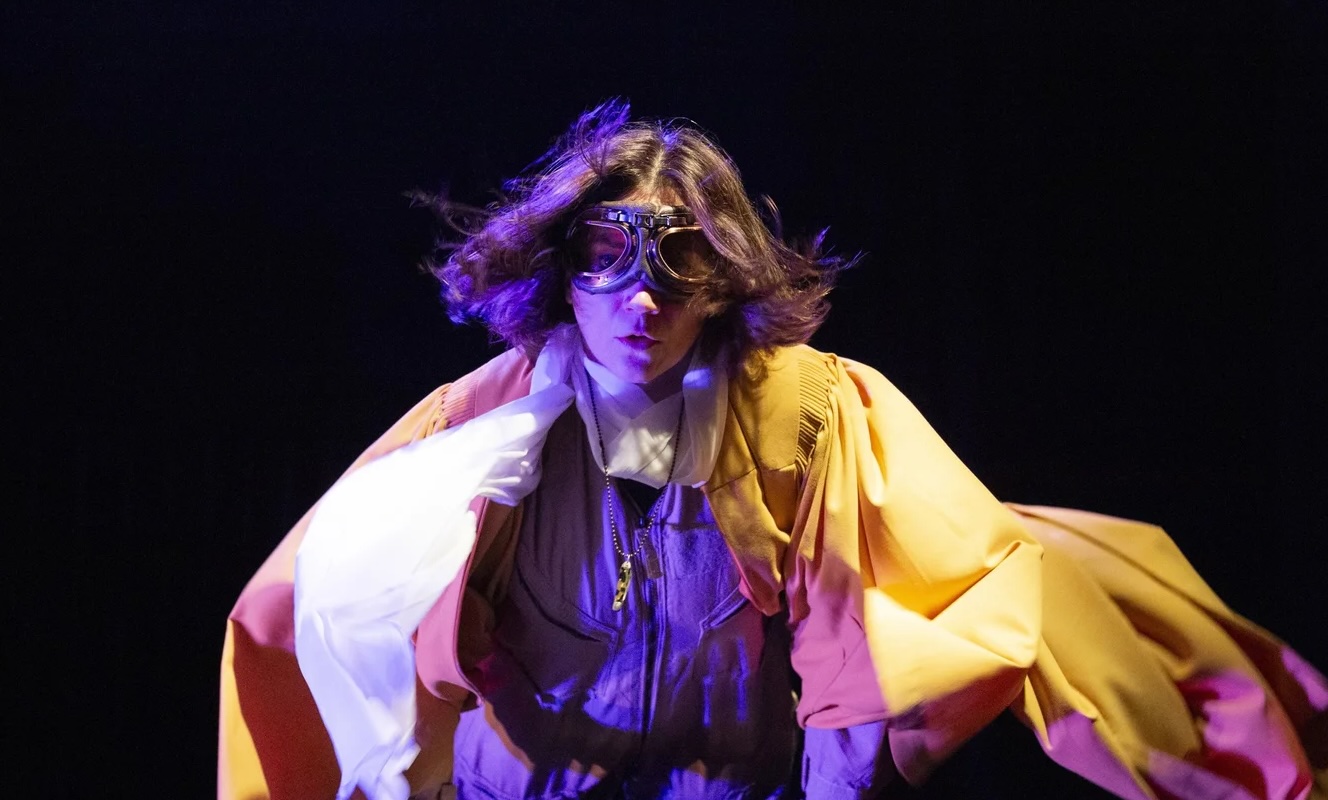
We’re greeted by a woman with a lampshade over her head, instantly setting an offbeat arty tone but signalling a knowing humour too. This lampshade comes with happy associations: of warmth, of softness, of kindness itself. Lindsey Barlag Thornton’s homage to a formidable great-aunt blends into a celebration of pioneering female aviators, from Amelia Earhart to the space shuttle era and beyond. But taking to the skies means taking a risk – so death and loss are prominent too, poignantly framed as the ultimate flight of a soul.
Thornton explores her theme through a smooth-flowing series of physical vignettes: they’re creative, unexpected and sometimes humorous, but always bear an emotional load. A beautiful, soulful danse macabre uses an empty yellow coat to represent the departed, made human and real in the performer’s hands. An audacious sortie atop a whirring giant fan captures both the thrill and the peril of flight. The mood can change quickly, from celebration to wistfulness, with narration of sorts provided by an old-fashioned tape recorder playing into a microphone at the side of the stage.
There are stories to piece together from these fragments, though they’re more pocket biographies than dramatic through-lines. Thornton’s real family history emerges from keepsakes and photographs, while the pioneering women are slowly introduced and, through the tape recorder, allowed to speak for themselves. The motifs can seem disconnected, even random, but there’s a frisson of satisfaction as they finally link together: a tennis ball appears for no apparent reason, later serves as a memorable but abstract puppet, then acquires a much deeper meaning as we near the end.
It does require a willingness to surrender to its pace. This is not the show to squeeze into the middle of a stressful day: most scenes are lengthy, build their own subtle rhythm, and stay with a concept until by sheer repetition it comes to feel like the most natural and comforting thing in the world. The visual imagery also builds slowly as props emerge from a suitcase, with the beautiful active set-pieces complemented by quirky, creative tableaux.
The trouble is that, with so many narratives intertwined, it takes a long time to bring them all to a satisfying resolution. Several times Thornton delivered what I was sure was the final scene, only for the action to continue just as I prepared to applaud. A long slideshow section suffers particularly from coming after the showiest of these non-endings, and feels a little too much like an author’s-note explanation of what we’ve just seen. It’s not that the show is objectively too long – it’s just that our instinctive sense of theatrical structure makes it seem that way.
But it’s a joy to find such patient work amidst the hullabaloo of the Fringe, and for a show in an intimate space to hit such visual heights. The most striking and surprising of the set-pieces elicited a genuine gasp of delight – and if you can extract that from even a jaded reviewer, your show has surely taken off.

Comments