
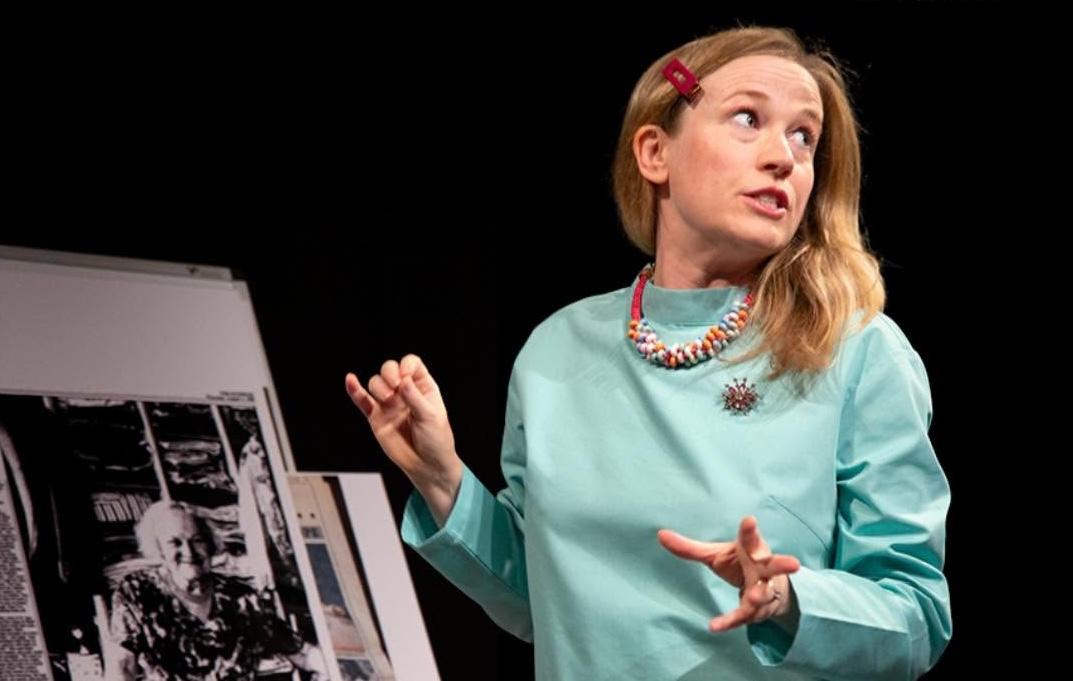
The stage is busy – crowded, even – with rows of clothing rails. Each one’s packed with mismatched garments, out of fashion yet stylish in their own way. But this is not, repeat not, a charity shop. This is the second-hand clothes shop which Julie Flowers’ grandma ran: a place of unexpected allies, upended preconceptions, and fondly remembered quirks.
It’s a true story, she tells us, explored here through re-enacted childhood memories and modern-day research. Seen through the young Julie’s eyes, the shop was a “four-storey dressing-up box” – and the role of dress in self-discovery lies at the heart of the show. Grandma Hilda had the knack of choosing clothes for her customers that didn’t just flatter their shape or their colouring, but reflected who they wanted to be. From the young punk rocker kicking back against life on the dole, to the defeated man who grows a little taller in a well-fitting suit, a few pounds’ worth of second-hand clothing is the starting point for change.
And the shop changed Hilda into a minor celebrity too. Julie’s brought newspaper clippings, from the then-broadsheet Guardian to the distinctly-tabloid Today, which over the years featured Hilda as a quintessential eccentric. There’s a hint of condescension in their references to bad-taste chic, and her affinity for stray cats would feel stereotyped if we didn’t know it was true. But in an age when Hilda’s undoubted hoarding would most likely be pathologised, it’s a timely reminder – backed by statistics – that a conscious choice to live life differently can bring contentment and spread joy.
It’s the 1980s, and we’re in Sheffield, so there’s a Thatcher-shaped elephant in the room. The political content stays refreshingly light, but there are some interesting contrasts all the same: Hilda’s a committed socialist, yet she’s not above changing her prices to match supply and demand. When a stand-offish middle-class woman steps into the shop we might feel inclined to judge her, but Flowers’ touching portrayal of barely hidden sorrow reveals that her story’s more complicated than it seems.
Throughout the show, we see Julie sharing her research with a local family history group – and while the imagined characters she meets there are entertaining, I’m not sure the framing’s truly necessary. I found that the interruptions took me out of the moment, and the real Julie Flowers needs no excuse to tell a story this resonant and meaningful. Indeed, her direct engagement with the audience is well-judged and lively, bringing us closer to a story rooted in ordinary lives and recognisable emotions. Grandma’s Shop is a warmly observed social history, but its truths about identity, dignity and belonging look just a good in modern clothes.

Comments