
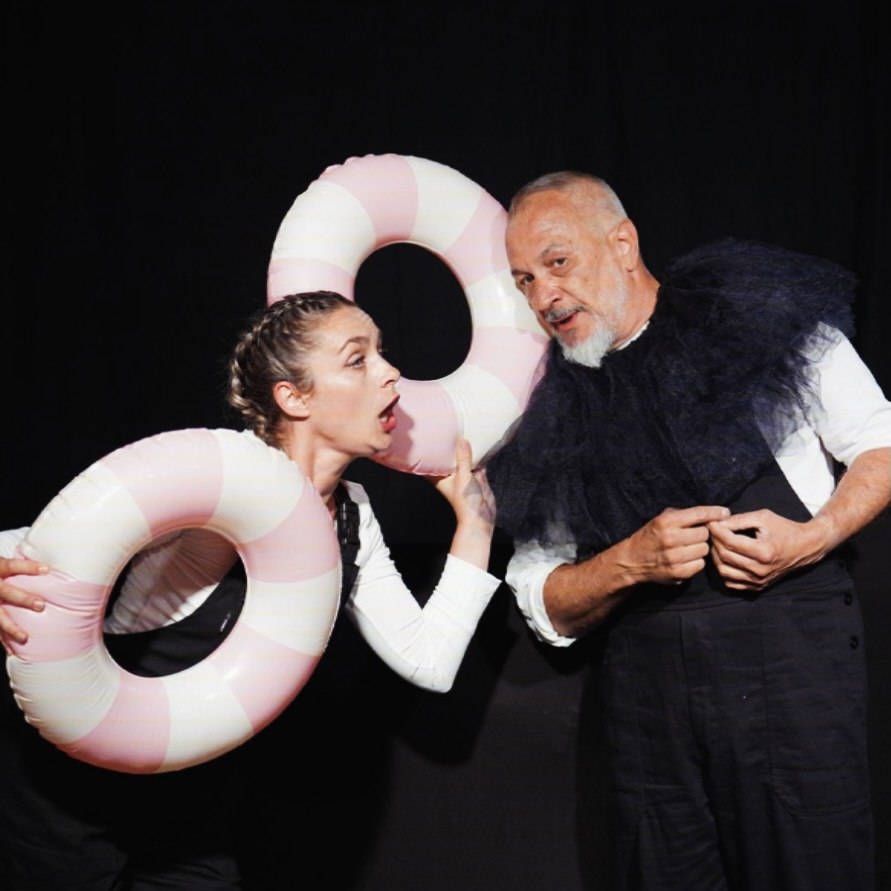
I’m sure you know the plot of Romeo and Juliet. But do you understand it? Like, really understand it? Bulgarian clown duo Ivomir Ignatov-Kenny and Zdravka Hristozova have put in the work to crack it, and they’re ready to distil the Bardic essence into something better suited to our cultural palate. They’ll use slapstick physicality, outsized characters, and a lot of inflatable props… and if we still don’t appreciate the great man’s genius, well, then they’ll just have to do it all over again.
As the title implies, we’ll take five trips to Renaissance Verona before the hour is up, and it’s the first which comes closest to a briefing on the story (though I reckon you’ll still need to know the basics to properly follow along). The greatest hits – the balcony, the ball, the street fight – are present and correct, but they pick out some unexpected quieter moments for comic attention too. The best of the visual gags are very sharp indeed, and the characters’ defining traits are nicely chosen too; I particularly liked Hristozova’s portrayal of Juliet as a tantrumming toddler.
In a sense, though, that’s all the set-up for the hilarious second run, which rates among the most delightful few minutes I’ve spent at this Fringe. Performing this time at breakneck speed, Hristozova and Ignatov-Kenny bring back visual motifs and character sketches from the first iteration, which become all the funnier as they hurtle relentlessly by. They’ve got a startling number of oversized props behind their unassuming screen, and the precision needed to make this seem effortless is a triumph in itself.
I won’t spoil the big surprises of runs three to five – but you can expect heightened chaos, even more balloons and audience members up on stage. The irreverence finds a different target as the clowns turn on art itself, or at least on the kind of art that funding committees like to see. It’s sharply observed, and the clowns speak truth to power, but when they introduced a black-coloured puppet I felt the atmosphere chill for a moment. The intent’s to lampoon tick-box claims of diversity rather than inclusion itself, but that nuanced point isn’t best served by this rapid-fire visual format.
But there’s a powerful twist still to come: a tonal shift that highlights what’s been sacrificed in the name of popularity, and a cathartic scream of creative frustration that many Fringe artists would share. It’s knowingly ludicrous but it’s heartfelt too, and they’ve earned the right to lead us through a philosophical coda. In the end, we discover, clowning turns on human connection – the very thing those star-crossed lovers were most cruelly denied.

Comments