
Arriving in cinemas astride a blaze of hype, Chloé Zhao‘s adaptation of Maggie O’Farrell‘s beloved novel is rich in its sensory pleasures and its broad-strokes emotional maximalism, but ultimately lacks the quieter, intimate interiority of its source material. It’s a showcase for an elemental performance from the great Jessie Buckley, but it is not the masterpiece that many critics have hailed.
Hamnet follows the relationship between William Shakespeare (Paul Mescal) and Agnes Hathaway (Buckley) up to the aftermath of the death of their 11-year-old son from plague. The film posits that this loss acts as a direct catalyst for perhaps the Bard’s most famous play, Hamlet, and the power of art to help process an otherwise unbearable grief.
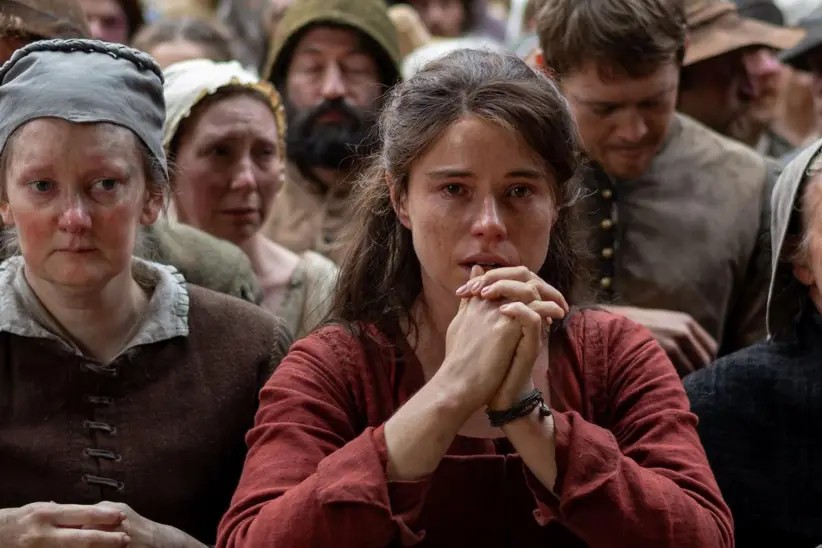
Zhao depicts a love story stained with mud and ink as the aspiring playwright and a healer with an almost supernatural connection to the land swiftly bond and wed. A courting couple with grimier fingernails have rarely been seen. Cinematographer Łukasz Żal, known for his crisply gorgeous black and white compositions for Pawel Pawlikowski, provides a fecund pallette of greens and browns and extreme close ups of faces flushed and freckled. The approach is not unlike Andrea Arnold‘s almost primordial take on Wuthering Heights, a complete tethering of a relationship to its environment. And as Will takes extended leave from Stratford to make his way in London, the tether begins to fray and then potentially snap as the family is overtaken by tragedy.
The source of that treagedy is one of the film’s greatest strengths; young Jacobi Jupe as Hamnet. In a film characterised by its blunt emotionality, Jupe’s almost underplays his doomed youth with an incredible maturity. The pivotal scene in which he endeavours to fool death by trading places with his dying sister Judith (Olivia Lynes) is a moment of tender subtlety and tightly controlled performance that the film otherwise lacks.
It’s not that the other performances aren’t great. Buckley, as we all know, is an absolute force of nature and dominates the film. The scene in which Hamnet passes is genuinely shattering. As Will, Mescal gracefully cedes to his co-star, acknowledging that this is Agnes’ story first and foremost, but shining as needed. However, when Hamnet is lost, the film threatens to collapse into the vaccum he leaves behind and the only escape it has is to climb out via the heartstrings.
Emblematic of this is the use of Max Richter‘s almost ubiquitous ‘On the Nature of Daylight‘ for one of the film’s most emotional scenes. Given Richter provides the entire score – and it’s a fine one – it comes across as an overly obvious move. It makes one wonder whether the scene is genuinely moving or whether the music is eliciting a Pavlovian response from the tear ducts from earlier uses. It’s a wonderful piece of music, but it’s become a cliche. It’s frustrating that a filmmaker who was known in her early work for her restraint resorts to such naked sentimentality. There is power there, and a culmination of the film’s thematic focus, but it feels a little too blunt.
For all its faults, Hamnet is easily Chloé Zhao’s finest film since The Rider, and it’s great that she’s not just survived the Marvel machine, but come roaring back into awards contention. Jessie Buckley is almost a shoe-in for the big prizes and noone would begrudge her. One just wishes there was a little more of the restraint of Zhao’s earlier work on show and that the execution of its story was a match for the lushness of its visuals.
In cinemas nationwide now

Comments