
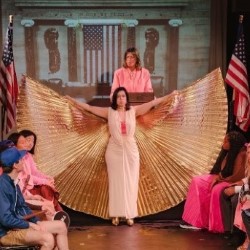
Lysistrata is a comedy from 411 BCE, where a group of women from warring city-states torture their husbands with sexual abstinence and thereby broker peace. In this ambitious but sadly incoherent adaptation, Ancient Greece exists alongside the Women’s March of 2017, which protested against Trump’s first inauguration and the culture of misogyny surrounding it.
These aren’t parallel storylines – it’s a single set of characters and a single plot, which somehow spans both the Peloponnesian War and the twenty-first-century USA. A podium tells us we’re at the White House, but the man behind it in a MAGA hat seems to be leading Athens. There are sacred Greek rituals, but also a televised debate covered on Fox and CNN. It would make sense to set Lysistrata in modern-day America, and it would make sense to embed a Trumpian character in Ancient Greece, but this mix-and-match approach to the timelines is both confusing and confused.
Some of the humour does translate well. There’s an entertaining motif where innocuous items of clothing are used to signal something far racier, and the knowingly camp portrayal of a baby also raises a smile. The classically inspired costumes are excellent, and the white cloth forms a striking screen for projections, which are often bold and energising. But there are visual weaknesses too, with mimed props such as cups and bedclothes jarring against the otherwise tangible stage picture.
Delivery is inconsistent, with some lines simply impossible to make out, and subtlety is often lacking – there’s only so much shouting we can take before our brains start to tune it out. Much of the dialogue is splendidly lewd, proclaiming the women’s right to enjoy and exploit their sexuality, but the register shifts haphazardly and some lines land with a clang: “there’s something rotten in the state of Athens” feels more derivative than knowing. And some sections need to signal their intent more clearly. A slow-motion fight scene might be an action-movie parody, but might equally just be a cliché.
There’s the germ of a good idea in this production, and for all the innuendo, there’s no doubting the sincerity of its political intent. But there are too many ideas, too many analogies that are superficially clever yet simply don’t cohere. In one of the script’s more high-minded moments, a protester addresses us directly: “Now listen to me, audience, and fathom what we say.” If only we could.

Comments