
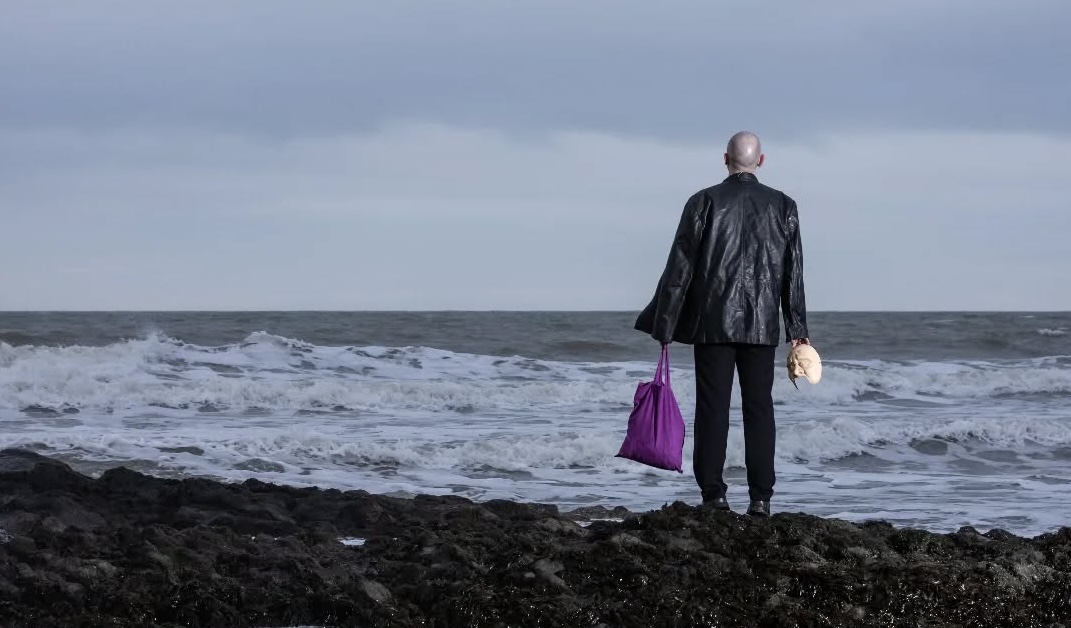
Most of this story is fictional, but this much of it is true: in 2009 a mysterious man travelled to a small town in Ireland, and somehow went into the sea. He gave the false name of Peter Bergmann and a fake address in Vienna, and even today his true identity remains unknown. But that’s just the catalyst for this strange, elusive, and ultimately rewarding solo play, centred around the embalmer who’s readying the washed-up body for its council-funded grave.
People call him Balmy, in honour of his profession, but the name carries a double meaning: his time alone with corpses seems to have made him gently barmy too. Actor and playwright Ronan Dempsey imbues his character with uncanny intensity, his permanent stoop tethering him to the earth, his shaven head more institutional than intimidating. He spends much of the play in one-sided conversation with the body on his slab, and there’s dark humour in his would-you-believe-it anecdotes and roster of increasingly ludicrous nicknames. But over time, as he talks, this apparently impenetrable man reveals profound emotional depth.
In a way, this is a theatrical bait and switch. The mystery we’re sold – the story of the body on the beach – gives way to a subtler and more complex puzzle about the inner life of the man who’s tending to it. Dempsey’s script yields its secrets softly, almost conversationally, as Balmy returns time and again to a handful of themes. The power of words and the tempestuous force of gossip are playing on his mind, and while the current storm of speculation surrounds the body on the slab, it’s clear there’s something in his own past still to be revealed.
We do see a little of the dead man himself, as Dempsey dons a mask for slow, dreamlike scenes from Bergmann’s final days. We witness him journeying across Europe, tannoys in many languages ringing in his ears, and methodically erasing his identity before travelling to Sligo and his end. These physical passages are spare and haunting, a welcome contrast to the verbal density of the embalmer’s scenes, and the expressionless mask paradoxically adds to the sense of hidden tragedy. There’s deep pain in Balmy’s life too – best captured in a mundane but meaningful childhood tale, that uncovers the scars left by poverty and by clawing, inescapable shame.
This is a play that rewards close attention, and a story you need to sit with for a while. Several hours after I’d left the theatre, I realised there was an alternative reading of Balmy’s monologue – one that addressed a few wrinkles I’d spotted in the plot, and threw a very different light on his narrative. I’m genuinely not sure whether my new interpretation is the right one, or whether the ambiguity is planned. But it’s a fittingly enigmatic end for a story that’s rooted in mystery, and which pushes us to question the things we thought we knew.

Comments