
John Carney returns with a new riff on his regular crowd-pleasing theme of the power of music in this predictably earnest and heartfelt film that deals deftly with knotty themes of authenticity and ownership. As you’d expect from the man behind Once and Sing Street, the joy of creativity and the rush of performance proves irresistible, although there are slightly deminishing returns from the incredibly high watermarks of his earlier work, both in terms of the music and the story. This despite largely winning roles for its high-profile leads, Paul Rudd and Nick Jonas.
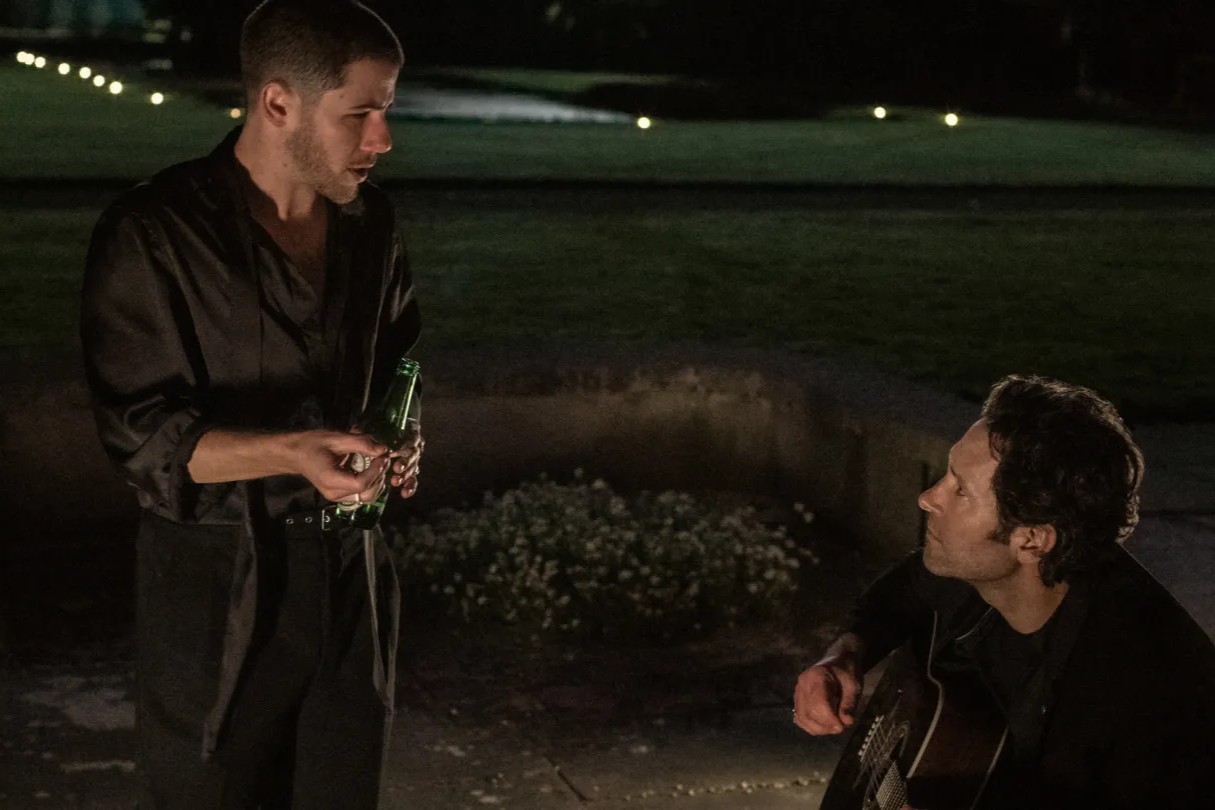
Rudd plays Rick Power, a singer with a wedding band who cheerfully left his dreams of rock stardom behind when he fell in love while touring and moved to Dublin to raise a family with Rachel (Marcella Plunkett). During one performance, wedding guest Danny Wilson (Jonas) – a former boy band star who’s solo career has stagnated – is coaxed onto the stage for a spirited rendition of Stevie Wonder’s ‘I Wish’. The two musicians bond and jam together in Danny’s hotel room, during which Rick plays a song he wrote years before. Danny takes the song and it becomes a huge hit, prompting Rick to take increasingly extreme measures to have his ownership of the track acknowledged.
Carney is clearly fascinated by creativity as a process, and Power Ballad sparkles in the extended montage of Rick and Danny throwing ideas back and forward; the gulf in relative status between them forgotten. It’s a glitzier analogue to the magical scene in Once where Glen Hansard and Markéta Irglová discover their musical spark, and showcases Carney at his most wistful and idealistic; in the depiction of music in a pure, platonic form as it’s teased into bring.
The tune here is unfortunately the syrupy ballad ‘How To Write A Song (Without You)’ rather than the soaring ‘Falling Slowly’. It works in the context of the film, and it’s almost a pitch-perfect pastiche of the kind of robust, gallumphing anthem that used to get lighters in the air and the promise of knickers on the floor come last dance. But by Christ, you’ll be sick of it come the end.
The performances are as you would expect. Rudd is ideal casting. You can’t imagine many Hollywood stars with the everyman charm necessary to sell his suburban Irish nest with any realism. He has a nice, flirty rapport with Carney regular Plunkett, and a fun, if incredibly broadly-played comic sidekick in loyal, rough diamond sidekick Sandy (co-writer Peter McDonald). It’s very much in Rudd’s comfort zone, but it works. Jonas has the tricker task in finding empathy for Danny. Milage will vary given how much tolerance one has for the boyband member gone solo trying to prove themselves as an artist. He does a very decent job but he’s given a rather surface-level arc to work with, with Carney glossing past his behaviour in favour of a healing message that celebrates the power of performance, whether it’s at Madison Square Garden or the function room of a hotel (a message promptly undercut by its coda). If you want the version of this tale with real bite and self-loathing, Better Man is the film for you. Carney simply lacks the cynicism.
As an overall viewing experience it’s an undemanding, frequently funny and endearing work, played with the pace and bounce (and some of the narrative beats) of a rom com. It lacks the yearning, bleeding soul of Once, and the exceptionally depicted evolution of a songwriting talent of Sing Street, but it’s a deeper film thematically than it first appears. There’s an interesting undercurrent about how the performer, or even the listener, of a song can change its meaning and context. The wellspring of inspiration Rick drew from when he wrote the song becomes a different tonic through Danny’s interpretation. It’s like Johnny Cash’s stripped-back, elegiac recontextualisation of Nine Inch Nails’ ‘Hurt‘. ‘How To Write A Song (Without You)’ is a blob of calcified treacle by comparison, but in a film that’s aiming for as wide an audience as Power Ballad, the reminder of just how a song can work on an individual level is some welcome spice.
Ultimately, there’s nothing too much wrong with Power Ballad. With a larger budget, bigger names, and an Atlantic-spanning scale, it’s likely to gain a wider audience for John Carney. It just feels slightly lacking in the elemens that made Once and Sing Street so great. It’s missing some of the lo-fi charm, the music is not as good, the narrative is a bit less satisfying overall. Noone is going to grudge someone like John Carney – a filmmaker who clearly cares deeply about art above product – the success he deserves, and Power Ballad is a good film. But it feels less pure and slightly more compromised than his earlier work.
Screening at Filmhouse, Edinburgh until Thu 11 Jun 2026

Comments