
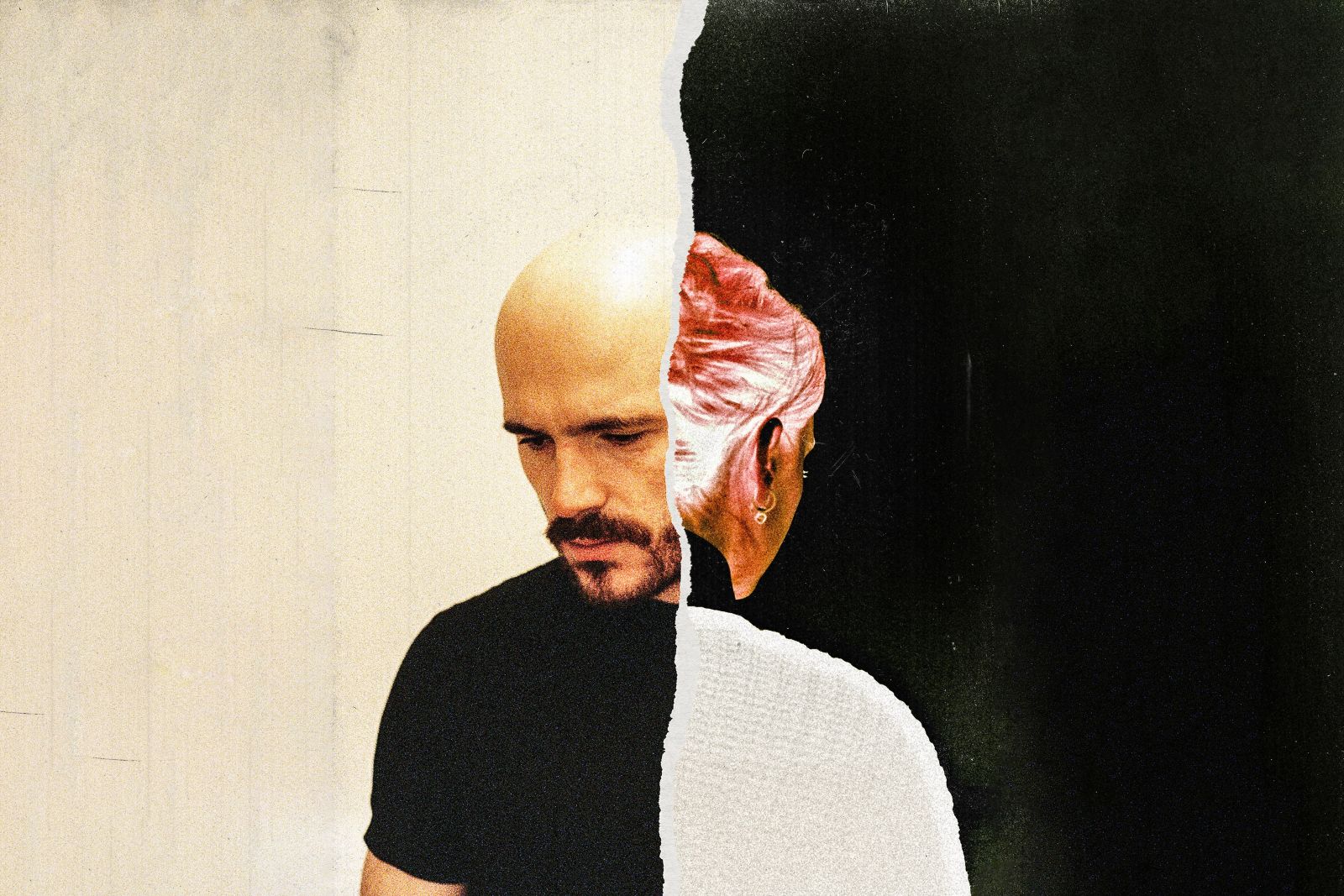
Jack MacGregor is a playwright from the north of Scotland. The current IASH/Traverse Fellowship Writer for 2026, they have received numerous awards, including receiving a Fringe First, Scottish Arts Club Prize, and a Summerhall Lustrum Award. Fraser Scott is a theatre director from Paisley. He is a recipient of the Andrew Lloyd Webber Foundation Scholarship, a Cross Trust Award and the John Byrne Award. They are bringing the new psychological drama Prophets to the Fringe in August. We spoke to Jack and Fraser about the play, the films and music they mined for inspiration, and the difficulties in finding an audience during the festival.
Can you tell us about Prophets?
JM: Prophets is a psychological drama. It’s a thriller, a two hander. It’s about a researcher from Scotland who travels to a British Overseas Territory in the South Pacific Ocean, a place called St John. And upon arrival Kerris, the researcher, finds the island to be under the control of a secretive religious cult that is rapidly growing and changing. It is approaching the ‘Day of Paradise’, which is the central event in the canon of this developing religious sect. And we’ve got a central plot that takes place on the island, and then lots of other threads that spiral outwards back in Scotland, and we know that something happens on this island, and the point of the drama is to find out what.
What inspired the play, and how did it take shape? What’s your creative process?
JM: Well, Fraser will have a different process from me, but my own as the writer is I’ve been working on this for a few years. It started life with Page2Stage back at the [Edinburgh] Storytelling Centre in 2023 and I was really interested in writing about Britain’s overseas territories as space for drama; these sort of legal gray zones that have been in the news recently with the Chagos Island deal, and have sort of occupied a bit of my own imagination since reading Zinnie Harris‘ play Further Than the Furthest Thing, which is set on Tristan da Cunha in the South Atlantic. And so I’ve wanted to explore this kind of strange, imperial relic of a space that still exists in the 21st Century.
And I was also very interested in thinking about cults, and about the pathology of cults. Why are we drawn to them as subjects for narratives? How can we sort of untangle our own interest as a culture with cult-like thinking politically, socially? Where do cults manifest in today’s world? How are they spread in an increasingly secular world, and sort of looking at it not as an irrational concept, but as a very rational vehicle for evil. So I was very interested in this idea of where faith in regular things, or faith in secular ideas, clashes with faith in extreme ways, as with radicalisation in cults.
How closely did you both work together between the writing and the staging of it? Did the play change at all from page to stage, with Fraser’s input?
FS: Yes, I can talk a little bit about that. As a director, what’s exciting about Jack is you receive a draft of the play, and it’s incredibly ambitious in terms of what it’s trying to put on a stage, and it’s asking really global, big questions. But it’s always rooted in really human characters and really truthful characters. So when I read that early draft of the play, what I’m always looking for are those hooks for an audience. What are the thematic or emotional cores that we can really polish or crystallise in further drafts. So, for me, big, big ideas about free will, about isolationism, about community in lots of ways, and our relationship with faith, whether that’s like ‘Capital G’ God or not.
I think those are really big themes in the writing of the play, and I think our conversations – myself and Jack and the wider team – have been around pulling some of that stuff out and making sure that we’re telling a really exciting drama that will surprise the audience, that’s going to tell them a really exciting story, but one that also is able to really deeply explore these very human, very relatable themes. You know, we don’t all have direct relationships with cults, but we certainly all can understand that question of free will or predestination, you know, of prophecy and how much are we a product of the place that we’re born? And how much are we able to change our future, which is something that I think we’re both really looking forward to exploring more as we get into rehearsals, which will be in the summertime, just before Fringe starts.
Does the fact that Karris is a woman, make any difference to the dynamic of the play? The story sounds like it harks back to work like The Wicker Man, which has a male protagonist coming upon a cult.
JM: You’ve absolutely picked up on it, because it’s one of the massive influences for writing this. It is, in some ways, a reply to the ideas explored in the original Wicker Man. whereas that was [a] Presbyterian Scottish constable goes to the Summer Isles and finds this pagan cult, in Prophets we have this… It’s funny because in the first draft of the play she was also a police officer, but I changed it because I thought first of all, it’s a bit too much like The Wicker Man. And then second, police officers have a lot of rules, and a police officer has a lot of power, and in the 21st Century, a police officer can end a narrative very quickly. So making them a researcher gives them that intellectual reason and also a task. And they’re on the island, and it’s taking a secular protagonist who we find has been raised with a type of faith, who encounters something new, but also something certainly familiar with her own childhood. And rather than an investigation of pagan ideas, it’s actually a distortion of evangelical ideas. Evangelical Christianity is very strong in the South Pacific, and it’s spread mostly by American megachurches, and so that’s what the cult is based on, as a distortion of American megachurch doctrine,
As theatre creatives, do you have any particular influences that have informed your various work?
FS: I think our influences are broad and vast.I think I try and find influences from not just theatre, but Jack and I talk a lot about films that influence us and we share a lot of music that influences us as well. I think those mediums are really successful at conveying tone and mood in a way that’s really helpful in terms of the conversations that we’re having about what we want the play to feel like. I think Prophets, from the first read it was really clear to me that Prophets needs to create a very specific mood and feeling in the space with the audience. It is tense. There’s lots of fear and the unknown in Prophets. There’s lots of absence and darkness, and leaning into that sort of folk horror element is really helpful. So we’ve been doing a bit of a dive into that sort of work, and trying to pick out the things that we feel are helpful to start thinking about how we create that feeling in the room, you know? I think that’s all quite specific to Prophets, certainly. But yeah, I really try and look wide in terms of finding influences for each specific piece.
JM: Just to echo, folk horror is a huge influence. British folk horror, and British film of the last 25 years has got some amazing examples to follow. Of course, you mentioned The Wicker Man, which I consider up there with some of the greatest examples of folk horror. But I think The Borderlands, known in the US as Final Prayer, is a very strong influence as well as films like Dead Man’s Shoes, which I absolutely love. And Blair Witch, and the work of Ari Aster I find to be quite influential.
In many ways, we’re taking these ideas of, ‘Where does pagan thought and early Christian thought combine?’ Where do those things align? And then, in the terms of of the South Pacific context, that was a proselytising, consuming type of Christianity and Christian thought. It’s like this whole thing about the reinvention of the world. Also a huge influence is the film The Stranger, the 2022 film with Sean Harris, which tonally has the sparseness and the topic being about an investigation into a suspected killer of children. There’s no supernatural element in it at all, really, but it feels like a very dangerous and active world with a lot of tension in it. I felt like that’s also because of the part of the world it’s set in, because Prophets is an Antipodean kind of story. It pulls very heavily from that culture. And hopefully our accent work will be good enough to reflect that as well.
And then, I guess, in terms of playwrights, Zinnie Harris is someone I’ve mentioned. David Greig, is basically my go-to first influence ever, growing up as a teenager reading plays I read David’s plays. And I think someone like Kieran Hurley, who is giving us this kind of very up-to-the-minute, very political, very active, investigating kind of story that isn’t afraid to push those buttons. And this hopefully will also be that, because it’s not just a story about a cult, it’s also a story about politics and the British Overseas Territory system, which is very, very under-discussed in the UK today. Anyway, so sorry, massive answer! It’s an absolute mad house in my head right now.
What are your hopes for the play? What would constitute a successful Fringe for you?
FS: I think the key thing for us is we just want to get people to come and see it. That’s, for us, the biggest goal really, is to is to put bums in seats and have audiences come to see the play. The play has received the ART Award from Assembly, so we’re sort of presenting the play in partnership with with the Assembly, which is really great, and means we’ve got a lot more support for the production and a lot more eyes on it, which is fab. And, you know, I think Jack I both went into this Fringe with Prophets specifically because we want the play to have a future life, and we don’t always get to have control over if that happens or not, but certainly for us, we would love the play to go further, to go on tour, to go down south to London or further afield.
You know, I think we’re really keen that this piece of work will have life beyond the Fringe. And whether that happens or not, we’ll have to hope for the best, but certainly to get people along to come and see it is our key priority really at the moment, and to create a hopefully quite exciting and quite unique Fringe experience for audiences. And then after that, we’ll see what happens.
What the best and the worst things about the Fringe as a festival overall?
JM: The best thing is that it’s like all of Scottish theatre… because Fraser and I, we make work in Scotland all year round, but in the Fringe, it feels like everyone is in not just the same city, but the same kind of area. And it’s really nice, because I come from the highlands, and for a long time I was making work up there and having to commute down to the Central Belt, and that was difficult. It was really hard, and it felt like you were kind of dispersed even, right? Even if you’re artists in Glasgow and artists in Edinburgh, there’s still a bit of dispersal there. But during August, everyone’s in Edinburgh, everyone’s together, and you get a real sense of community.
I do a lot of work with the Scottish Society of Playwrights, the playwright trade union, and all of us are in town during August. And so the real sense of the community amongst writers is really strong. And this year, I’m the Resident Writer at the Traverse. So I’ll be presenting a different play, a commission I’m working on called Foil. I’ll be doing a reading of that on the 24th of August, at the Traverse as part of TravFest. And I’m just very excited that so many of my colleagues and peers will be able to see two things that I’m doing in the Fringe this year. So that’s awesome.
The thing I don’t like is how much it all costs, and also the accommodation, which everyone complains about. The fact I live in Edinburgh now, is huge. But previous Fringes I have had to be on friends sofas, in flats with rats in them, and in derelict houses that have no running water. I mean, one time a few years ago, I got a Fridge First [Award], and I was staying in a derelict house so I left the little Fringe First on the side of the skirting board, and then went to sleep in my sleeping bag on the floor of this house. Yeah, it’s the glamour of the industry that we know and love. But you know that’s, that’s part of it, that’s part of the thrill,
FS: I mean, it’s the biggest arts festival in the world, which I think simultaneously is the best and the worst thing about it, right? I think, for me being able to access work from all across the world, that is in our own country, in Scotland, for a month is unbelievable. Some of the most inspiring and most exciting and craft-altering work that I’ve seen has been in August in Edinburgh, and that is so invaluable, and we’re so lucky to have it.
I also think that that makes doing a show here really, really difficult, because there is so much work and it’s so easy as an artist taking work [there] to compare yourself to other shows that might seem like they’re doing better, or might seem like they’re doing worse. I think that’s really tricky, or can be really tricky. And also, just to make sure that your show sells tickets and gets people to come along and see it like, you know, when there’s 3000 plus pieces of work in that brochure. You have to really work awfully hard to get people to come along. And so I think, you know, it’s a double-edged sword.
JM: One time I remember with that Fringe First I went flyering on the mile while holding it to get people to come along. It did work, which was nice. But, you know, you have to really be outside of the box, because the competition is so vast. It feels like less of a theatre festival and more like a massive trade show sometimes, which can be quite dispiriting, because we’re artists, and we want to think that the work of art that we’re making means something, and it’s not more than just a commodity or a product.
So you have to also try to like be amongst your peers and your artists and your colleagues, to remind yourself that what you are making is a piece of work, a piece of art and expression, and not a product. It has to be thought of as an artistic artifact first, and to treat it like the work of art that it is.
Are there any other shows or performers at the Fringe that you would recommend that we go and see?
JM: Our colleague, Ben Standish is doing a show at Summerhall called Nesting, which we’re looking forward to. That’s that’s got Michael Guest in it, and it sounds great and I’m excited to see it. And on the same topic of cults, there is another play called Headcase by Douglas Yannaghas, which is at Greenside. And I’m looking forward to seeing that one, because I was a script reader as part of a thing last year, and I read this play, and I thought it was… it’s very different from Prophets, but it also talks about ideas about cults, except it’s set in the far north of Scotland, and I found it to be a really interesting piece of work and quite spooky. So, yeah, Nesting and Headcase. Those are the two ones I’m looking forward to seeing most.
Prophets is at Roxyboxy at Assembly Roxy from Wed 5 to Mon 31 Aug 2026 at 17:45

Comments