
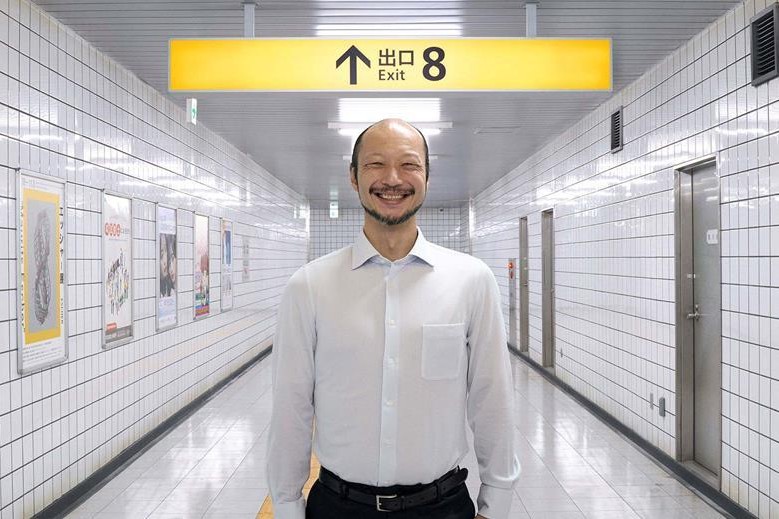
The circle of drudgery is a common aspect of modern life. People traipsing through liminal spaces, repeating the same journeys back and forth to the same soul-sapping jobs, only to repeat the actions the next day. In Exit 8, an everyman temp-worker gets a surprise and potentially life-changing call from his ex-partner on his way to work, he finds himself in a more literal sense of that experience, trapped in a seemingly endless looping corridor in the Japanese Subway system.
The ‘Lost Man’ (Kazunari Ninomiya) has only just discovered he may soon be a father and his attempts to reunite with his ex and discuss this momentous occasion, is thwarted again and again as he finds himself in a tiny repeating maze. As many times as he tries to pass through it, each time he turns the second corner he’s faced with an identical white-tiled hallway, and the same ponytailed, white-shirted, taciturn salaryman (Yamato Kochi) obliviously walking past him.
But it’s not always exactly the same, a sign on the wall warns him that there are anomalies present, and if he sees one to turn back immediately. Only by pressing forth through a ‘natural’ corridor, or identifying the anomalies and turning back, can he escape this supernatural purgatory. But he’s not alone, and some of the anomalies which appear may mean him more harm than good.
For those unfamiliar with Exit 8, it will likely come as no great surprise that it’s based upon a 2023 Japanese video game The Exit 8. The repetitive looping corridor concept was originally created as a short puzzle game with almost exactly the same aesthetic design, rules and many of the same anomalies that are seen in the film. In that respect, this is one of the most accurate movies ever adapted from a video game. Not only that, it manages to capture the experience of playing it perfectly, as eerie tension, and constant fear of something ominous about to happen that suffuses both the film and the game.
But the film is more than that. While the game was little more than a quirky memory puzzle with some scares, the film delves deeper, with The Lost Man’s inner turmoil writ large as an expression of his fear and uncertainty about his ex-girlfriend’s pregnancy and his anxieties coming to the fore. It’s certainly a slight story, and deliberately sketched out in thin lines, allowing the audience to infer far more than is explained. Even the opening phone call that establishes the stakes and the characters is broken up by dropped signal and noise.
Writer/director Genki Kawamura captures the action in sweeping steadicam shots that echo the feeling of being trapped in a loop. Adding to the immersivity of the experience, the first 10 mins are filmed from first person, in what is meant to appear as a single unbroken take.
Whether you’re a fan of the video game or not, the film is genuinely a great experience. It’s a competent, engaging horror movie, and easily one of the very best video game adaptations put to film. It also manages to be a properly mind-bending puzzle that rewards the viewer for paying attention to the background and has just enough creepiness and body-horror to make sure that horror fans will definitely not feel short changed. You might just find you want to see it again… and again… and again… and again…
In cinemas from Fri 24 Apr 2026

Comments