
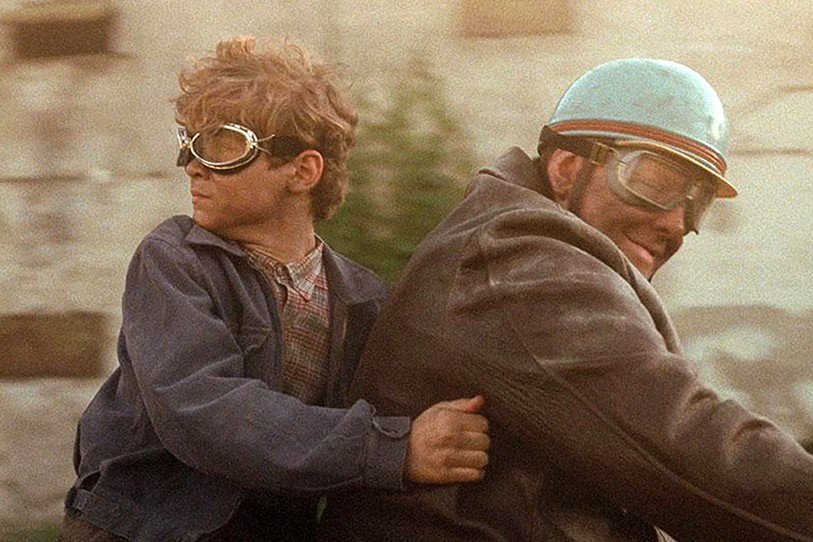
Budapest 1957. Jewish boy Andor (Bojtorjan Barabas) searches for his missing father whilst living an ordinary life with his mother Klara (Andrea Waskovics). However, his interactions with his friend Sali’s partisan brother Tamas (Soma Sandor) as well as aggressive rural butcher Mihaly (Gregory Gadebois) slowly strip away his innocence and make him increasingly desperate to preserve his identity.
Nemes, in his first film since 2018’s mixed bag Sunset, returns once again to historical Hungary, although this time he benefits from a stronger narrative and more consistent characterisation. Andor’s efforts to find his father are effectively mirrored by the struggle of Budapest’s Jewish community to maintain their traditions in a post-war Communist society that has little time for them.
This element, along with the aftermath of the failed 1956 Revolution, is skilfully handled through the individual struggles of Andor and Sali’s family and benefits from Nemes and regular co-writer Clara Royer‘s shared choice to favour subtlety over any overt messaging. Such an approach allows individual sequences, such as a fraught Passover Seder at Sali’s flat and Tamas showing his hiding place to Andor, to effectively convey the impact of these events on Hungarian society in a manner that doesn’t sideline its characters.
A similar approach is used in Andor’s conflict with Mihaly to great effect, with the boy’s desperate attempts to assert the existence of his biological father Hirsch in the face of the seemingly unstoppable rural Hungarian serving as an effective personification of the Jewish community’s struggles to survive in Communist Hungary.
These scenes also benefit from strong performances from Barabas and Gadebois, with the former in particular essaying both fear and anger effectively in the face of the very real threat Mihaly poses to Andor’s life with Klara. Waskovics also impresses as Klara, skilfully balancing the character’s love for her son and her need for support from Mihaly, regardless of his abusive behaviour.
Orphan is an impressive return to form for Nemes, as he uses a coming of age narrative to make wider points about the state of Judaism and freedom of speech in 1950s Hungary. Barabas in particular impresses in a complex role, which should be a springboard for future success as an actor.
Screening at Filmhouse, Edinburgh until Thu 21 May 2026

Comments