
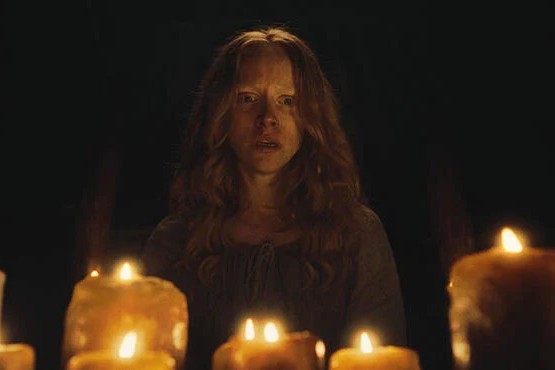
It’s a pity this little gem has been saddled with the generic English title of Heresy when the original, Witte Wieven (‘White Women’) is far more evocative and ambigous; a much better fit for Didier Konings‘ ethereal folk horror. Originally part of an anthology commissioned by Dutch filmmaker Martin Koolhoven (best known here for the unfeasibly bleak western Brimstone), it caught the attention of Shudder, who picked it up for a standalone release. And fans of hex positive fare like The Witch, Hagazussa, The Devil’s Bath, and You Won’t be Alone will be very glad they did.
In a grimly pious village in medieval Holland, a young woman called Frieda (Anneke Sluiters) frets about her failure to conceive with her husband, who countenances no suggestion that he may be the reason. When villager Gelo (Léon van Waas), both the local butcher and rapist, chases Frieda into the woods one day, he is killed by a strange, spindly female figure, who then casts a spell over the young woman. After returning to the village Freida discovers she is pregnant, which the fearful villagers reason to be due to a communion with the Devil, putting the lives of Frieda and her unborn child in danger.
Running a lean 61 minutes, Konings and writer Marc S. Nollkaemper operate with a super-economical script, telling the story through visual cues (massive wooden crosses, mud, forboding forests, weatherbeaten villagers) and the striking porcelein features of Anneke Sluiters (to whom the film’s Dutch title could also refer). The story is a familiar one, but sadly, eternally relevant as difference is interpreted as demonic, and women shoulder the blame for the ills of the community.
While the story is perhaps just efficient, Heresy really shines in its visual sense. Beyond the gorgous natural lighting and the assured composition, there are some moments that are shockingly vivid in a film largely characterised by restraint. The reveal of what happens to Gelo is horrendous, and the fate of one luckless villager resembles a crazed meeting of minds between David Cronenberg and Gunther von Hagens. The depiction of the ‘Witte Wieven’ is memorable too. Imposing, but not overly monstrous, they manage to visually represent their ambigious, unpredictable nature as depicted in the folklore of the Low Countries, as the region was known then.
While not the most original tale – it overtly resembles several other recent entries in the folk horror canon – the compressed timeline works in its favour, offering a more urgent viewing experience than the more languid likes of Hagazussa. It also wisely refrains from anything like a triumphant ‘good for her’ ending. Freida, played with fierce intensity by the impressive Sluiters, is allowed her catharis, yet the future is uncertain. Not least because Konings has presented such a compelling vision of Hobbesian village life – nasty, brutish, and short.
Streaming on Shudder from Fri 1 May 2026

Comments